![[object Object]](https://umsousercontent.com/lib_lphGCikIbVHjRWIV/w8mzrofmgaa9b3om.png?w=52)
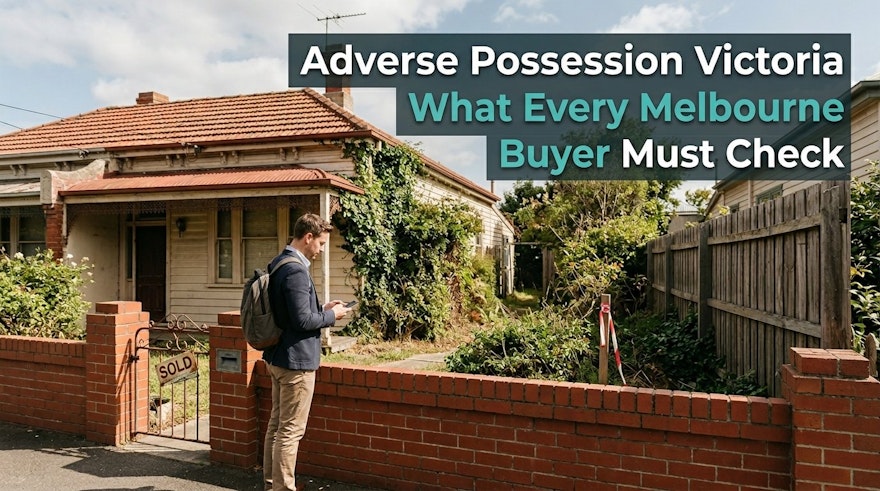
You walk through a renovated Brunswick cottage on a wet Saturday morning, glance at the neat side path, admire the back fence line, and start picturing where the bikes, bins and veggie beds will go. It feels like home already. Then months later, after settlement, someone says the fence is not on the title line and part of what you thought you bought may not be yours at all.
That is how adverse possession usually appears, quietly, late, and at the worst possible moment.
The short answer: In Victoria, a person who has had uninterrupted and exclusive possession of land for at least 15 years may be able to claim ownership by adverse possession. For Melbourne buyers, the real risk is not just the law itself, it is buying an older property where the fence, driveway, shed or laneway occupation does not match the title, then finding out after you are already locked into the contract.
What is adverse possession in Victoria?
Adverse possession is a rule that can let someone become the legal owner of land they have occupied as if it were their own. In Victoria, the headline period is 15 years under the Limitation of Actions Act 1958, and a claim is usually pursued through section 60 of the Transfer of Land Act 1958.
In plain English, the law asks a practical question: who has really been controlling this strip of land? If the answer is a neighbour who has fenced it, used it, maintained it, and kept others out for long enough, the registered owner can lose their right to recover it.
A claim is more likely to succeed where the occupation has been:
- exclusive, not shared casually with the true owner
- physical and obvious on the ground
- carried on like an owner would carry on
- without the true owner's consent
- continuous for at least 15 years
That usually means more than mowing now and then. Think locked gates, garden beds, paving, a shed over the line, an enclosed side strip, or a fence that has sat in the wrong place for years without challenge.
How does the 15 year rule work in Victoria?
The 15 years usually starts when the true owner is effectively dispossessed, or when they stop controlling that part of the land and someone else takes over. Once the limitation period runs out, the original owner's right to recover that strip can be extinguished.
Buyers are often surprised by one point: the 15 years do not have to belong to the current neighbour alone. Periods of possession can sometimes be added together, so a current owner may rely on occupation by a previous owner before them. That is one reason old boundary problems in Melbourne can sit quietly for decades and then surface all at once.
Permission changes everything. If the occupier had the owner's consent, even informally, that usually cuts across an adverse possession claim. The same is true if the true owner steps in and clearly retakes possession before time runs out.
Why is adverse possession a real risk on older Melbourne properties?
Older Melbourne suburbs are where this issue shows up most often. Brunswick, Fitzroy, Carlton, Northcote, Footscray, Yarraville and similar areas have tight blocks, old fences, narrow side access, old rear laneways and buildings added in stages over many decades.
There are a few reasons these properties need extra care:
- older subdivisions were not measured with modern tools
- fences were often rebuilt on old assumptions, not fresh survey work
- tiny encroachments matter far more when land is expensive
- side driveways, garages and laneway access make boundary drift harder to spot by eye
On a narrow inner suburban block, even a small fence movement can affect car access, extension plans, setback calculations, or whether a future townhouse design works at all. What looks like a minor strip of land on paper can be the difference between 'yes' and 'no' on a renovation you planned to do two years later.
The same warning applies on coastal and semi rural properties around the Mornington Peninsula, where access tracks, boatshed areas and informal occupation can create their own long-running title problems.
What should a conveyancer check before you sign?
Before you sign, your conveyancer should compare the paperwork to the land you actually inspected. That starts with the title search in Victoria, the registered plan, and the Section 32 vendor statement.
The paper review should cover:
- who is on title
- the lot dimensions and plan details
- any easements and other encumbrances
- caveats, notices or other dealings affecting title
- disclosures in the vendor statement that may point to trouble
The ground check matters just as much. Red flags include a fence that bends oddly, a side driveway that looks too narrow for the title dimensions, paving that crosses a likely boundary line, a rear laneway folded into the backyard, or an old shed that seems to straddle two lots.
This is also where buyers need a reality check about the Section 32. It is a useful disclosure document, but it does not guarantee the fence sits on the true title line. If something looks off, a title re-establishment survey may be the safest move before you sign, not after.
The same goes for auctions. If you are buying at auction, or within the no-cooling-off window around an auction, the title and boundary checks need to happen before you bid. Once the hammer falls, there is usually very little room to fix a problem by negotiation.
When we review a contract, we also look for the sort of notices, orders and disputes that often sit within the bucket of Section 32 red flags. A boundary issue rarely arrives with a flashing neon sign. It usually shows up as a pattern of small clues.
Does the standard Victorian contract protect you if the fence is wrong?
Usually, not nearly as much as buyers hope. The standard Victorian contract commonly includes an identity clause that can make it hard to complain later about differences in measurements, dimensions or boundaries if you signed without checking them first.
That does not mean every problem is beyond repair. It does mean the best time to deal with a boundary concern is before the contract is signed. At that stage, your conveyancer can try to:
- ask for more information from the vendor
- recommend a survey before you commit
- negotiate a special condition about boundary accuracy or known disputes
- make the contract subject to a satisfactory survey in the right private sale deal
Once you are already bound, your bargaining power drops sharply.
What if the property is bigger on the ground than it is on title?
That is not a bonus until it is legally sorted out. A buyer sometimes inspects a property that appears to include a little extra side land, a widened backyard, or a strip absorbed from next door. It may have been used that way for years. It may even look completely settled.
But if that extra land is not on the registered title, you are not automatically getting legal ownership of it at settlement.
In that situation, the sensible options often are:
- require the vendor to sort the issue before settlement
- negotiate a proper boundary realignment with the neighbour
- look at a not in common ownership subdivision if the owners agree
- renegotiate price or terms
- walk away
Where a boundary is being redrawn by agreement, there can be duty and other transfer costs on the part that changes hands. So even a friendly fix still needs careful legal and survey work.
When is it smarter to walk away?
Sometimes the answer is to stop. A charming period home is still the wrong buy if the boundary problem changes the value, use or future plans in a serious way.
Walking away may be the wiser call where:
- the vendor knows there is a dispute but will not deal with it
- the block is so small that a lost strip changes car access or building plans
- there is already active litigation or a live title application hanging over the land
- the seller wants a fast signature but resists survey conditions or extra disclosure
- the risk is hard to price and easy to underestimate
Melbourne always puts emotional pressure on buyers, especially in fast campaigns. Yet it is better to lose one Brunswick cottage before signing than spend the next year in a boundary fight after settlement.
Frequently asked questions
How long do you need to occupy land for adverse possession in Victoria?
The general rule in Victoria is at least 15 years of uninterrupted and exclusive possession without the true owner's consent. The person making the claim must show real control of the land, not just occasional use. In some cases, time spent by an earlier occupier can be added to the current occupier's time.
Can a neighbour really take part of my land through adverse possession in Victoria?
Yes, that can happen where a neighbour has openly and exclusively occupied part of the land for the full limitation period and the legal requirements are met. A classic example is a fence that has sat in the wrong place for many years. That is why a pre-contract title and boundary check matters so much for buyers.
What does an adverse possession claim in Victoria usually cost?
There is no single fixed figure. Even a straightforward claim can run into many thousands once you add survey work, land registry fees, legal costs and supporting evidence. If the matter is contested, the cost can rise quickly.
Can you claim adverse possession over council land or Crown land in Victoria?
Not usually. Victorian law blocks adverse possession claims against certain public land, including Crown land and land where a council is the registered proprietor, along with some other public authority land. The tricky part is that an old lane or strip used by the public may not always be registered the way people assume, so the title still needs to be checked carefully.
Does the standard Victorian contract protect me from adverse possession problems?
Not reliably. The standard contract often leaves buyers carrying much of the risk if they signed without properly checking title, dimensions and occupation on the ground. Protection usually comes from early review, survey advice, and well-drafted special conditions before signing.
What is the difference between adverse possession and a boundary realignment?
Adverse possession is a claim made without the neighbour's agreement, based on long occupation that meets the legal test. A boundary realignment is a cooperative fix where the affected owners agree to redraw or transfer the strip properly. The agreed option is often cleaner, but it still needs survey, conveyancing and revenue advice.
Should I get a survey before I sign if I am worried about adverse possession in Victoria?
Yes, if anything on site does not match the paperwork or your instincts. On an older Melbourne property, a survey before signing is often far cheaper than discovering after settlement that the fence, garage or driveway is not where the title says it should be. It is one of the clearest ways to turn suspicion into facts.
Talk to Pearson Chambers before you sign
Adverse possession is one of those property problems that sounds obscure until it lands on your doorstep. In Melbourne, where every square metre can matter, it is worth checking early and properly.
At Pearson Chambers Conveyancing, we review contracts, title documents, plans and Section 32 statements with a practical eye. If a fence line, driveway, rear lane or old structure does not sit comfortably with the title, we will tell you before you are locked in, not after.
If you are looking at a property in Brunswick, Northcote, Footscray, Carlton, the bayside suburbs or anywhere else across Melbourne, contact Pearson Chambers Conveyancing for a complimentary Section 32 contract review.