![[object Object]](https://umsousercontent.com/lib_lphGCikIbVHjRWIV/w8mzrofmgaa9b3om.png?w=52)
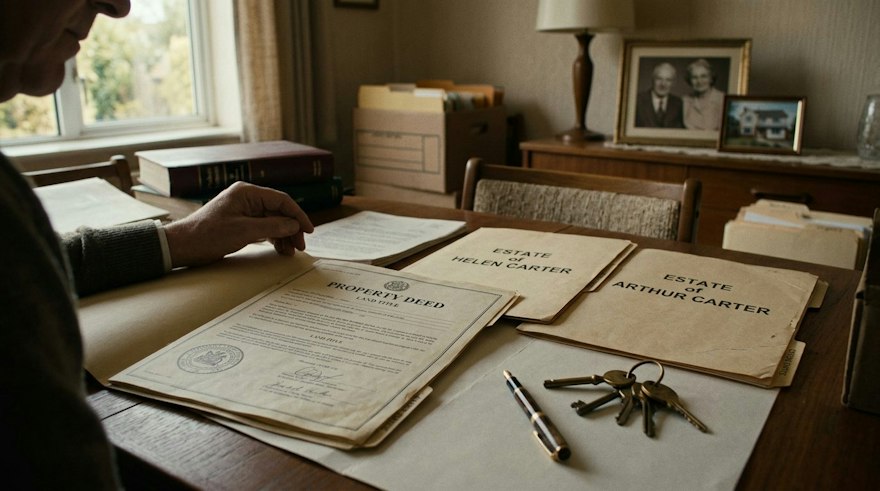
A current title search still names two joint owners, even though both have died. If the first death was never recorded, the estate needs to establish who survived whom before choosing the title application.
The short answer: Where one Victorian joint proprietor survived the other, then died without lodging the earlier survivorship update, Land Use Victoria accepts a section 49 application by the executor or administrator of that last survivor. The title, order of deaths and representative's authority need to be checked together. This is different from an ordinary survivorship application made by an owner who is still alive.
Start with the current holding and the order of deaths
First confirm that the home was held as joint tenants and that the current title still records both deceased proprietors. Joint tenancy includes a right of survivorship: when one joint owner dies, the land as a whole passes to the surviving joint owner or owners.
That legal event and the title update are separate matters. If the survivor never lodged the application to record the first death, the earlier owner's name can remain on the Register even after the survivor later dies.
Write down the sequence rather than relying on a general statement that 'both parents have died'. Which person died first? Who remained alive afterwards? Was any title application lodged in the interval? Your conveyancer should check any earlier dealing as well as a fresh current title search.
This article assumes there is an identifiable last survivor. If the dates or available records do not establish that sequence, or the ownership was changed before either death, the estate and title position require a different review.
The last survivor's representative is the relevant applicant
Land Use Victoria expressly identifies this situation as one in which a section 49 transmission application may be used. The applicant is the executor or administrator of the now-deceased survivor, even though that survivor did not lodge the earlier section 50 survivorship application.
A legal personal representative is the executor or administrator authorised to act for the estate. Under section 49 of the Transfer of Land Act 1958 (Vic), the representative applies in the approved form and provides their authority. The registration records the representative as proprietor in that representative capacity.
Suppose Alex and Rowan held their home jointly. Alex died first, Rowan lived for several more years and no survivorship update was lodged. Rowan then died while both names remained on title. The title review centres on Rowan's estate representative and the evidence of Alex's earlier death, rather than treating the two registered names as separate tenant-in-common shares.
This hypothetical example does not decide who inherits the property. Identifying the person who can carry out the land dealing is separate from deciding how the estate is distributed.
An ordinary survivorship application does not finish this case
Section 50 provides for an application by the survivor, supported by proof of death satisfactory to the Registrar. That is the usual title update where a joint proprietor dies and another joint proprietor remains alive.
Once that survivor has also died, the representative route needs to reflect the full sequence of deaths. The fact that survivorship operated on the first death does not mean the deceased survivor can now make the section 50 application intended for a living survivor.
A beneficiary should not simply be substituted for the deceased registered proprietors. Section 49 records the legal personal representative's capacity. Any later sale or transfer to a beneficiary requires the authority and documents appropriate to that separate transaction.
Put the title, grant and earlier records in one file
Give your conveyancer the available records so the title chain and authority can be reviewed together. A grant is the court document confirming who is authorised to represent the last survivor's estate.
a current title search and any earlier title dealing references
the names and dates of death of both joint proprietors
copies of available death records and any previous survivorship correspondence
the grant appointing the last survivor's executor or administrator, if available
any differences between names shown on the title, death records and grant
details of the intended sale or transfer and any proposed deadline.
This is a practical starting list, not a prescribed registry checklist. The conveyancer still needs to identify the evidence required for the actual application, including how the earlier death and sequence are established.
If the grant for the last survivor is not available, raise that at the start. Obtaining estate authority is separate from preparing the land application, and a grant relating to the first owner's estate does not by itself establish who represents the last survivor.
The current title should also be checked for mortgages, caveats and other registered interests. Registration of the legal personal representative does not make the property unencumbered or make the representative the beneficial owner. Once the authority and records have been reviewed, ask for a clear sequence of title steps for the intended transaction.
About the Pearson Chambers Conveyancing team
Pearson Chambers Conveyancing assists with residential purchases, sales and title transfers in Melbourne and across Victoria. Its residential conveyancing services include title and document work where estate authority needs to be connected with a later property transaction.
Sources we consulted
Have the joint title and death sequence reviewed
If both joint proprietors have died while both names remain on a Victorian residential title, contact Pearson Chambers Conveyancing about the conveyancing and title-transfer steps for your circumstances. Send the title details, death sequence and available grant, and mention any planned sale or transfer date.
Email contact@pearsonchambers.com.au.
General information only, current as at the date of publication. Victorian conveyancing rules and legislation change frequently. Please contact the Pearson Chambers Conveyancing team for advice on your specific contract.