![[object Object]](https://umsousercontent.com/lib_lphGCikIbVHjRWIV/w8mzrofmgaa9b3om.png?w=52)
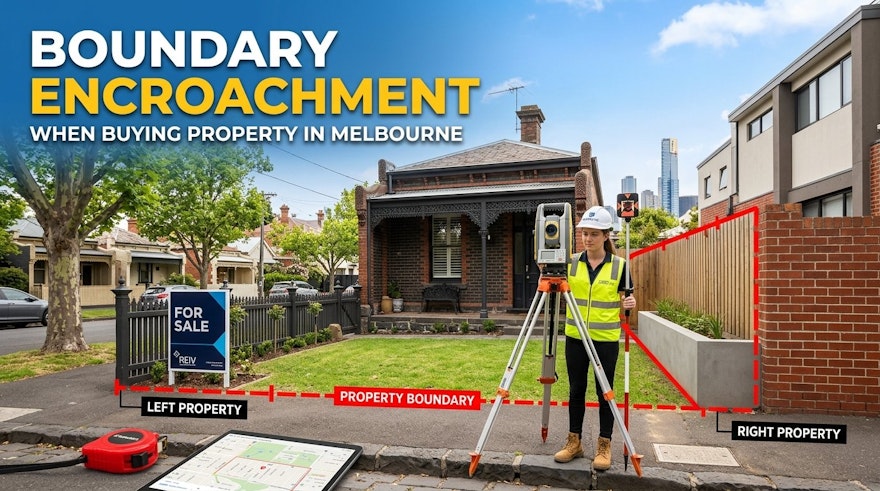
You inspect a terrace in Fitzroy, a brick home in Preston, or a townhouse in Carnegie, and everything feels right until you look along the side fence and realise something does not quite line up. The fence sits in one place, the plan in the Section 32 vendor statement suggests another, and the agent is already steering the chat back to the renovated kitchen.
The short answer: A boundary encroachment is where a fence, shed, wall, driveway, eave, or similar structure crosses the legal title line. In Victoria, buyers usually have the most leverage before settlement: a private sale contract will usually carry a three clear business day cooling-off right under section 31 of the Sale of Land Act 1962, and an incomplete or inaccurate Section 32 can give a buyer a rescission right before title is accepted under section 32K. After settlement, the issue usually shifts to surveys, negotiation with the neighbour, the Fences Act process, title insurance if it was taken out before settlement, or a formal title boundary amendment.
That is why boundary problems are worth taking seriously before you sign, not after. A small strip of land can affect access, future building plans, resale value, and your appetite for a neighbour dispute you never planned to inherit.
What is a boundary encroachment when buying property in Victoria?
A boundary encroachment is any physical improvement that sits over the registered title line. It can be the neighbour crossing onto your land, or the property you are buying crossing onto theirs.
Common examples include:
- a dividing fence built off the true line
- a shed, garage, carport, deck, pergola, or retaining wall crossing the boundary
- eaves or gutters overhanging the next lot
- a driveway, path, or paved area sitting partly on the wrong side
- old side access or a rear strip that has been absorbed into one yard for years
What catches buyers out is that occupation on the ground and title on paper are not always the same thing. In older Melbourne suburbs, fences have often been rebuilt several times without a fresh survey. A fence may look settled and neighbourly, but that does not make it the legal boundary.
Small tolerances in title measurements can exist on paper. That is not the same as saying a physical structure is allowed to sit over the line. If a fence, wall, or building improvement is in the wrong place, the safest move is to work from a survey, not from assumptions.
How do buyers usually discover a boundary encroachment?
Most buyers find it in one of four ways.
The paperwork raises a red flag
The first clue often comes from the title, plan of subdivision, or Section 32. Your conveyancer may notice that the dimensions do not sit comfortably with what you saw on site. That does not prove an encroachment on its own, but it is the moment you stop and look harder.
The site itself looks off
Sometimes your own eyes pick it up first. The side fence jogs inward. A carport seems hard up against the boundary at an odd angle. The backyard looks narrower than the plan suggests. A rear lane fence in Brunswick or Collingwood looks like it was moved decades ago and never questioned again.
A survey confirms it
A re-establishment survey is the clearest way to find the true boundary before you commit. In Victoria, only a licensed surveyor can properly re-establish the boundary on the ground. For a straightforward Melbourne residential block, buyers often budget around $800 to $1,500 or more, with higher costs for older, irregular, or more complicated sites.
The neighbour says something revealing
Buyers hear versions of this all the time: ‘That fence has been there forever’, or ‘We all just treat that strip as ours’. Comments like that do not settle the legal position, but they are a sign you should slow down and investigate before you sign.
What should you do before settlement if a boundary encroachment shows up?
Before settlement is where your bargaining power is strongest. Once you own the property, fixing the problem can become your problem.
Ask the direct question straight away
If the survey or paperwork suggests an encroachment, ask your conveyancer to raise it in writing. You want the vendor's position clearly stated. Has the issue been disclosed before? Has there been a past dispute? Is there an agreement with the neighbour? Is there title insurance in place? Has anyone ever obtained a survey?
Clear answers matter because section 32K is tied to false, incomplete, or missing disclosure, not just to the existence of an awkward fence.
Decide whether the problem is minor, manageable, or a deal-breaker
Not every encroachment justifies walking away. Some are irritating but manageable. Others change the value of the property or interfere with what you planned to do with it.
A narrow inner north block is a good example. On a terrace in Carlton or Fitzroy, a small strip can matter a lot if it affects side access, setback room, drainage, or a future extension. On a larger suburban block, the same measurement may still matter, but the commercial sting may be lower.
Negotiate before you are locked in
Once an encroachment is identified, buyers often look at one or more of these options:
- Ask for a price adjustment. If you are inheriting the risk, the price should reflect that.
- Require the vendor to deal with it before settlement. That might mean removing the offending structure, negotiating with the neighbour, or taking steps toward a formal boundary fix.
- Add a special condition. In a private sale, your conveyancer may be able to negotiate a condition dealing with the survey result, disclosure, rectification, or risk allocation.
- Walk away if the risk is too hard to price. That can be the smartest call where the problem touches access, future works, or a likely dispute.
Use the cooling-off right if you are still in time
If the property was bought by private sale and you are still within the cooling-off period, ending the contract may be the cleanest exit. In Victoria, section 31 generally gives a buyer three clear business days after signing, and the vendor may retain $100 or 0.2 per cent of the purchase price, whichever is greater.
That right disappears for auction purchases and for sales within the no-cooling-off window around an auction. So if you are bidding on a house in Thornbury or South Yarra and the boundary worries you, the checking needs to happen before auction day.
Consider section 32K where the disclosure is wrong or incomplete
If the vendor supplied false information, failed to supply required information, or did not give a compliant Section 32 before the buyer signed, section 32K may allow rescission before title is accepted and possession is taken. That is a serious step and it should be handled carefully through your conveyancer or solicitor, because the detail matters. The issue is not only whether an encroachment exists, but what was disclosed, what was attached, and what the vendor knew.
What happens if the boundary issue is only discovered after settlement?
After settlement, your options usually narrow and the cost of fixing the issue can rise.
Start with a survey and a calm assessment
If there is no proper survey yet, get one. Until you know where the title line actually sits, the rest is guesswork. You also need to work out whether the issue is a fence-only problem, an overhanging structure, a long-standing occupation issue, or something that needs a title change.
Try neighbour negotiation first
Plenty of boundary problems are solved without a courtroom. Sometimes the neighbour did not know the fence was wrong. Sometimes both owners would rather agree on a sensible fix than spend months arguing about a strip of land nobody thought twice about until now.
That fix might be moving a fence, altering a structure, documenting an agreement, or taking steps toward a boundary amendment.
Use the Fences Act process if the dispute is really about the fence
If the problem is the boundary fence itself, Victoria has a formal process under the Fences Act. A fencing notice is usually the first step, and the neighbour has 30 days to respond. That process can help where both sides accept a fence issue exists but cannot agree on what should happen next.
Check whether title insurance may respond
Title insurance can help with some undisclosed encroachment issues, but only if the policy was taken out before settlement and the policy wording covers the problem. It is not a magic fix, and exclusions matter, but it can be useful where the issue was not known when you bought.
Look at a formal title boundary amendment where both owners agree
A cooperative boundary fix may involve a section 99 title boundary amendment through Land Use Victoria. That path still needs survey work, paperwork, and proper advice, and Land Use Victoria's listed application fee is only one part of the cost. Surveying, legal work, and any related transfer or duty issues can add up quickly.
Why older Melbourne properties deserve extra care
Boundary trouble is not limited to period homes, but older areas do see it more often.
Inner suburbs like Fitzroy, Carlton, Collingwood, North Melbourne, Brunswick, and South Yarra have tight lots, old fences, lane access, and buildings added in stages over many decades. Middle ring suburbs such as Preston, Coburg, Thornbury, Footscray, and Reservoir also throw up plenty of cases where the fence line has simply been treated as the boundary for years without a fresh check.
Even newer estates are not immune. In outer suburban areas, the issue may be less about an old crooked fence and more about driveways, retaining walls, drainage alignments, or improvements near easements.
The lesson is the same either way: do not assume the fence is right because it looks tidy.
Why the 15-year rule matters
Long-running occupation can turn a fence problem into something much more serious. In Victoria, adverse possession can arise where someone has had uninterrupted and exclusive possession of land for at least 15 years.
That does not mean every old fence creates an automatic claim. Exclusive possession still has to be proved, and the detail matters. But if a neighbour has fenced off and treated part of the land as their own for a very long time, you do not want to discover that after settlement when you are already planning a renovation.
This is one reason a pre-signing review matters so much. A narrow strip on the side of the block may not look dramatic at an inspection, but it can become very dramatic when you want to widen a driveway, move a fence, or apply for building works later.
Frequently Asked Questions
What is a boundary encroachment in Victoria?
A boundary encroachment is where a physical improvement crosses the legal title line. That can include a fence, shed, garage, retaining wall, driveway, deck, or overhanging part of a structure. The legal question is not where everyone has treated the boundary as being, but where the boundary actually sits on title.
Can I pull out of a contract if the Section 32 did not disclose a boundary encroachment?
You may be able to, depending on what was missing or inaccurate and when the issue is discovered. In Victoria, section 32K can give a buyer a rescission right before title is accepted where the Section 32 disclosure is false, incomplete, or not given as required. That step should be taken with legal help because the timing and the facts matter.
How much does a boundary encroachment survey cost in Melbourne?
Buyers usually deal with this through a re-establishment survey by a licensed surveyor. For a straightforward Melbourne residential property, the cost is often around $800 to $1,500 or more, with older or more complex sites costing more. The price can feel annoying at the time, but it is often far cheaper than discovering the issue after settlement.
What if my neighbour's fence has been over the boundary for decades?
Do not assume age makes it fine. In Victoria, long and exclusive occupation can raise adverse possession issues after 15 years, so an old fence can carry more risk than a new one. The first step is to get the boundary checked properly and work out the real legal position.
Does title insurance cover boundary encroachment?
Sometimes, yes. Title insurance can respond to certain undisclosed encroachment problems, but only if the policy was taken out before settlement and the wording covers the issue. It is always worth checking the policy terms rather than assuming every boundary problem is insured.
Can I use the cooling-off period if I find a boundary encroachment after signing?
If the contract is a private sale and you are still within time, cooling off may be the simplest exit. In Victoria, the period is generally three clear business days after the buyer signs, and the vendor may retain $100 or 0.2 per cent of the purchase price, whichever is greater. That right does not apply to auction purchases or to sales in the no-cooling-off window around an auction.
Who pays to fix a boundary encroachment after settlement?
After settlement, there is no automatic rule that makes the vendor or neighbour pay. The answer depends on the survey result, the contract, any disclosure failure, the nature of the encroachment, and what the affected owners agree to do next. That is why buyers try to sort the issue before settlement whenever they can.
Talk to Pearson Chambers Before You Sign
Boundary encroachment is one of those issues that can look tiny on paper and become very expensive in real life. A fence line that is 200 millimetres out may not sound dramatic on a Saturday inspection, but it can affect access, future building plans, resale, and your relationship with the neighbour next door.
At Pearson Chambers Conveyancing, we review contracts and Section 32 statements with these risks in mind. If something about the title, plan, or physical boundary does not sit right, we will tell you before you are locked in. We also offer a complimentary Section 32 contract review, so you can get clear guidance before you sign.