![[object Object]](https://umsousercontent.com/lib_lphGCikIbVHjRWIV/w8mzrofmgaa9b3om.png?w=52)
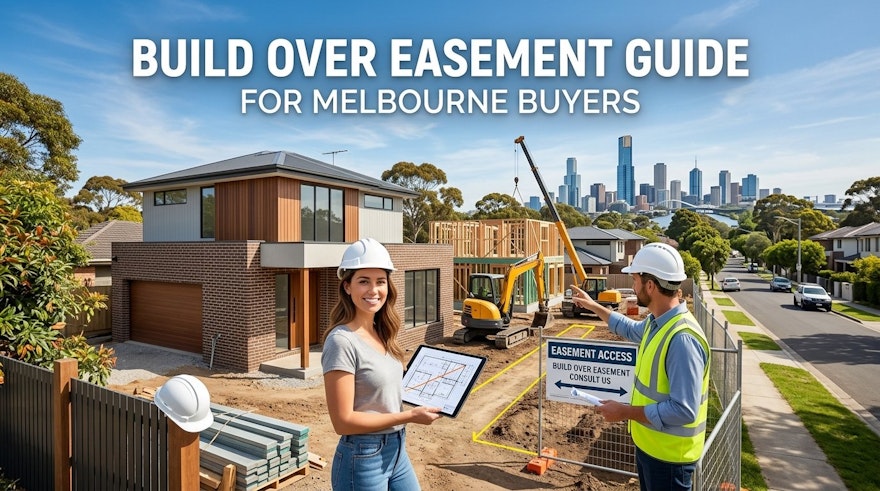
You’ve found the right house. The light is good, the floorplan works, and the backyard looks perfect for summer dinners after a long week in the CBD. Then your conveyancer calls and says the deck, shed or pergola may sit over a sewer easement.
That is the moment many Melbourne buyers realise an easement is not just a line on a plan. It can affect what you own, what you can keep, and what could become your problem the day settlement goes through.
The short answer: In Victoria, you usually need written consent from the relevant water corporation before building over an easement, or even close to certain water and sewer assets. Section 148 of the Water Act 1989 gives water authorities the power to act if works were done without consent, and fines can apply. For the 2025 to 2026 financial year, 20 penalty units equals $4,070.20. If the structure is already there when you buy, the practical risk usually sits with the owner of the land at settlement, which is why this issue needs to be picked up before you sign.
If you are staring at a contract pack on a Sunday night before auction, don’t brush this off as a technicality. A build over easement issue is one of those problems that can be manageable before signing and expensive after settlement.
What does build over easement mean for a Melbourne buyer?
It means part of the land is affected by someone else’s legal right, usually for sewerage, drainage or water infrastructure, and that right can limit what sits on top of it. If a structure is built over that area without consent, the buyer can inherit the headache.
An easement on a property title does not mean you cannot buy the property. It does mean you need to know exactly where the easement runs, what asset it protects, and whether anything has already been built in the danger zone.
In Melbourne, easements often run along the rear boundary, down a side boundary, or straight across a backyard where an owner later added a deck, studio, pergola or pool. On paper it can look harmless. On the ground, it can cut straight through the bit of land you care about most.
What counts as building over or near an easement?
More than most buyers expect. It is not just a house extension or a brick garage.
Depending on the asset and the authority involved, approval may be needed for decking, pergolas, sheds, retaining walls, driveways, paving, tanks, fences, carports and pools. Eaves and overhangs can matter too. Melbourne Water also applies a wider protection approach around its assets than the retail water corporations, so a structure can be a problem even when it is not sitting neatly inside the easement strip.
As a rough guide, Melbourne Water often looks at works over or within 5 metres of its easements or underground assets. Yarra Valley Water, South East Water and Greater Western Water work from the shared metropolitan guide that generally focuses on works over an easement or within 1 metre of a water corporation asset.
That is why a buyer should never assume, ‘It’s only a small deck,’ or, ‘It’s just a few pavers.’ Small structures can still create a real issue if they block access, load the pipe, or make future repairs harder.
Which water authority matters in Melbourne?
The answer depends on where the property is and what sits under the land. In some cases, more than one authority matters.
A simple way to think about it is this:
- Melbourne Water usually deals with major drains, trunk sewerage assets, waterways and larger regional infrastructure.
- Yarra Valley Water covers much of Melbourne’s north and east.
- South East Water covers the south, bayside and south east.
- Greater Western Water covers the west and north west.
This matters because the approval path, records and asset ownership can differ. A property in Brunswick, Glen Waverley, Mentone or Werribee may all have ‘an easement’, yet the right place to ask questions can be different in each case. A good conveyancer will not guess. They will check the title material, the certificates and the asset information.
What does Victorian law say about building over an easement?
The key point is simple: unapproved works over an easement can create a real legal and practical risk for a buyer.
Section 148 of the Water Act 1989 is the main starting point. In plain English, it says you cannot cause or permit certain structures or other works over an easement, or near protected water authority assets, without consent. Building surveyors also need the relevant service authority’s report and consent before issuing a building permit for building work over an easement vested in that authority.
For buyers, the conveyancing angle matters just as much. The Section 32 vendor statement should disclose easements affecting the land and any existing failure to comply with them. If there is a deck over a sewer easement and that problem has not been disclosed properly, there may be a pre-settlement right to challenge the position, including rescission in the right case. That is never something to do casually, and it should always be handled through your conveyancer or solicitor.
How do you check whether a deck, shed or pergola was approved?
Start with the paperwork, then compare it to the real property. That second step is where plenty of buyers save themselves.
Your contract pack should include title material, the plan of subdivision and a water authority certificate or statement that helps show easements and related encumbrances. If you want a plain English overview of these issues, it helps to understand the property encumbrances that can block your Melbourne purchase before you sign.
When we review these files, we are looking for three things:
- Where the easement sits
Does it run along the back fence, down the side, or through the middle of the yard? - What is built over it now
Is there a pergola, deck, spa, retaining wall, garage slab or extension sitting on the line? - What approval trail exists
Is there a build over easement approval, a delayed demolition order, permit history, engineering detail, or nothing at all?
That last one is the trap. If the structure is there but the paperwork is silent, that does not mean everything is fine. It can mean nobody asked permission when the works were done.
A careful buyer’s conveyancer will often compare the plan to sales photos, inspection notes and what is visible on site. If the backyard photo shows a big timber deck exactly where the sewer easement appears on the plan, questions need to be asked before the contract becomes your problem.
Why does the risk pass to the buyer on settlement?
Because this is usually a land problem, not just a builder problem. Once you own the property, you own the practical burden of dealing with it.
That is why these issues sit alongside other hidden liabilities that transfer with title. The authority is not chasing the owner from 12 years ago because you think they should. In the real world, they deal with the current owner of the land when access is needed, repairs are required, or a non-compliant structure has to go.
That can feel deeply unfair, especially where the deck or shed looked old enough to be ‘part of the house’. Still, from a buyer’s point of view, fairness does not fix the risk. Spotting it early does.
What should your conveyancer do before you sign?
A strong pre-contract review can do a lot of heavy lifting here. This is the best time to act, because you still have choices.
A practical review should:
- read the title and plan of subdivision closely
- identify any sewer, drainage or water easements
- compare the easement position against photos and site information
- ask the vendor’s representative for approvals, plans or related correspondence
- flag any missing material in plain English
- suggest special conditions if the issue can be managed rather than walked away from
Those special conditions can be very useful. Depending on the deal, they might require the vendor to obtain retrospective approval, remove the offending structure before settlement, or agree to a price adjustment that reflects the risk and likely rectification cost.
This is especially useful in Melbourne’s fast-moving market. When buyers are bouncing from open to open in Northcote, Bentleigh or Yarraville, it is easy to focus on the kitchen and miss the legal tripwire sitting in the backyard.
What if the problem is found just before settlement?
You still may have options, though they are narrower than they were before signing.
If the defect points to a disclosure failure in the vendor statement, your conveyancer may advise on rights available before settlement, including rescission in the right set of facts. Even where rescission is not the path taken, the issue can still create leverage for:
- a price reduction
- an undertaking by the vendor
- a retention arrangement
- an extension of settlement to allow more enquiries
- further engineering or building advice
After settlement, life gets harder. You may still have legal avenues, depending on what was said and what was disclosed, but they are usually slower, dearer and less clean than dealing with the issue before the keys are handed over.
How much can a build over easement problem cost in Melbourne?
The application fee is rarely the main problem. The bigger cost is often the work needed to make the structure acceptable, or the cost of removing it.
For Melbourne Water’s published 1 July 2025 to 30 June 2026 pricing, a residential build over application lists an initial fee of $257.05 and an inspection fee of $333.56, with additional build over works fees of $590.61 where extra works are needed. Security amounts can also apply, commonly $5,000, $10,000 or $20,000 depending on the scale and value of the works.
The heavier numbers usually come later. Buyers can be looking at costs for:
- engineering assessment and drawings
- survey work
- CCTV inspection of the asset
- altered footing design
- concrete encasement or asset protection work
- partial demolition and rebuild
- in some cases, sewer relocation
That is why an unapproved pergola is not always ‘just a pergola’. Once designers, surveyors, plumbers and engineers get involved, the bill can move quickly.
Where does this show up most in Melbourne?
Older suburbs are full of service easements, and plenty of structures were built in a more casual era.
We see this issue come up often in the inner north and inner west, where older sewer and drainage lines run through backyards behind period homes and post-war weatherboards. Suburbs like Brunswick, Coburg, Preston, Thornbury, Footscray, Newport and Yarraville can all produce this sort of question.
Middle-ring eastern suburbs such as Blackburn, Mitcham, Glen Waverley and Mount Waverley also throw up rear pergolas, paving and extensions over older service corridors. In bayside and the south east, pools, decks and landscaping can be the flashpoint. In growth areas, the issue can be less about a 1970s pergola and more about building too close to a drainage reserve or protected authority asset when owners add works later.
That does not mean these suburbs are risky by default. It just means a proper contract review is money well spent.
Frequently asked questions
What is a build over easement approval?
A build over easement approval is written consent from the relevant water corporation allowing certain works over an easement or near a protected asset. It usually comes with conditions, and those conditions can keep affecting the land after it is sold. Without approval, the owner may face demands to alter or remove the structure.
How do I know if there’s a sewer easement on a property I’m buying in Melbourne?
Check the title documents, plan of subdivision and water authority material in the contract pack. A sewer easement is often shown on the plan with dimensions and purpose, while the supporting certificate may reveal encumbrances, approvals or related notices. Your conveyancer should compare that paperwork with what is actually built on site.
Can you build over an easement in Victoria?
Yes, sometimes, though only with the right consent and only where the authority is satisfied the proposal protects its asset and future access. Light or removable works may be easier to approve than permanent masonry structures, pools or habitable additions. Every case turns on the asset, the clearance, the design and the authority involved.
What happens if I buy a house with a shed or pergola over an easement that was never approved?
The problem usually lands in your lap once you become owner. You may have to deal with the authority, fund advice, seek retrospective approval, alter the structure, or remove it if access is needed. If you have not settled yet and the defect was not disclosed properly, your conveyancer may be able to raise stronger contractual remedies.
What is a Delayed Demolition Order in Victoria?
A Delayed Demolition Order is a notice or arrangement that can allow a non-compliant structure to remain for the time being, while preserving the authority’s right to require demolition later if access to the asset is needed. In plain language, the structure stays until the day it gets in the way. Buyers need to treat that as a real future cost, not an abstract footnote.
How much does a build over easement application cost in Melbourne?
The answer depends on the authority and the type of work. Melbourne Water’s current published build over pricing includes an initial fee of $257.05 and inspection fees of $333.56 for the stated period, with extra fees and security amounts in some cases. The broader cost often comes from surveys, engineering, redesign and rectification work rather than the filing fee alone.
Can I rescind my contract if there’s unapproved building work over an easement?
Possibly, yes, if the vendor statement was defective and the facts support that step before settlement. This is a serious move and it should be handled through your conveyancer or solicitor, because the wording of the documents and the timing matter. Even where rescission is not used, the issue can still become a strong negotiation point before settlement.
Need a Section 32 review before you sign?
A build over easement issue is one of the clearer examples of why contract review matters. It can be spotted early, assessed calmly, and dealt with while you still have bargaining power.
If you are buying in Melbourne and want a second set of eyes on the paperwork, Pearson Chambers Conveyancing offers a complimentary Section 32 contract review. We can check the title, plan of subdivision and water authority material, explain the risk in plain English, and help you work out whether the property is still worth pursuing.
Email contact@pearsonchambers.com.au.
This is general information only and not personalised legal advice.