![[object Object]](https://umsousercontent.com/lib_lphGCikIbVHjRWIV/w8mzrofmgaa9b3om.png?w=52)
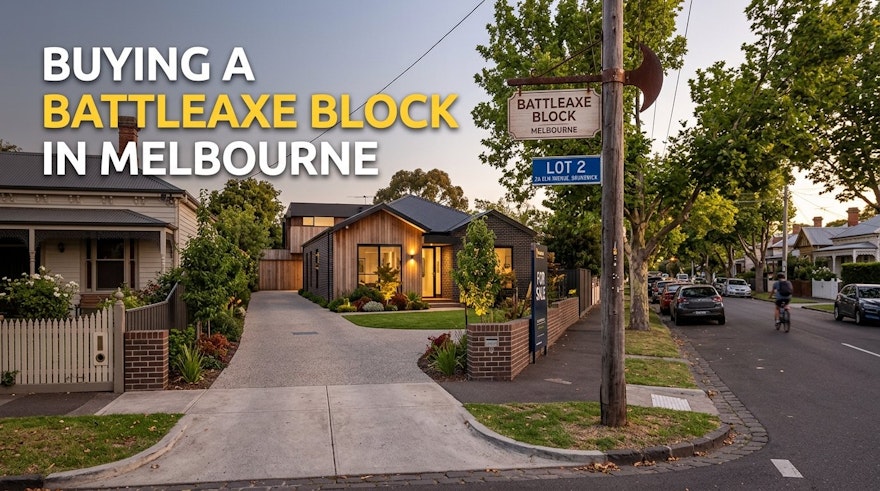
A battleaxe block is usually a home built behind another home, with a narrow strip of land connecting it to the street. On the plan it looks a bit like an axe, with the rear lot as the head and the driveway as the handle.
You see them across Melbourne’s middle suburbs where older, wider blocks were split over time. A weatherboard in Coburg might keep the front home and create a new dwelling at the rear. A larger Bentleigh block might do the same, giving buyers a way into the suburb without paying for a full street frontage.
This shape matters because advertised land size can be misleading. Part of the square metre figure may be tied up in the driveway handle, not in your backyard, entertaining area, or room for the kids to kick a footy.
What should you check before buying a battleaxe block?
The short answer is the paperwork, the access, and the true layout on the ground. A rear block can work well, but only if you have clear legal access, clear service rights, and clear rules about who maintains what.
Before you sign, ask your conveyancer to check these five things:
- the title search, so you can find encumbrances on a property early
- every registered easement on a property title, especially any right of carriageway
- the plan of subdivision, so you can see the lot boundaries, the handle width, and whether any area is common property
- the Section 32, so the title documents and disclosures match
- any owners corporation records if the driveway or services sit in shared areas
This is the sort of work buyers often miss when they are rushing from one Saturday inspection to the next. The house feels fine. The driveway looks fine. Then the paperwork tells a different story.
Which easements matter most on a battleaxe block?
The main ones are access easements, drainage easements, and service easements. Each one affects how you get to the property and what you can do with the land.
A right of carriageway is usually the big issue. It should spell out your legal right to pass over the driveway and may also say whether that right covers cars, people, deliveries, and access for trades. If the wording is weak, old, or missing, the rear lot can become a lot harder to use than it looked at inspection.
Drainage and service easements matter too. Pipes and cables for the rear lot often run past or under the front property. If those rights are not properly protected, repairs and future work can turn awkward very quickly.
Your conveyancer should not stop at the one line note on title. They should read the actual instrument, compare it to how the property is being used, and check whether fences, sheds, decks, or planting sit where they should not.
Does the plan of subdivision show the true size of a battleaxe block?
Yes, it is one of the key documents. A plan of subdivision shows how the land has been divided into lots and, where relevant, common property.
For a battleaxe block, this is where the lot size illusion often gets cleared up. A rear lot advertised at 500 sq m may include a long strip of driveway that you cannot really use as outdoor living space. On paper it still counts. In daily life, it does not feel like a backyard.
The plan also helps answer practical questions. Is the driveway part of your lot, or is it shared? Do the fences sit on the title boundaries? Is there enough width for normal car access, bins, deliveries, and day to day use? These are small questions until you are the person trying to reverse out on a wet Melbourne morning.
Who pays for a shared driveway on a battleaxe block?
The answer should be written down somewhere you can rely on. If the documents are silent, you may be stepping into a neighbour dispute waiting to happen.
Sometimes the arrangement is built into the subdivision documents. Sometimes a Section 173 agreement or another recorded document deals with maintenance and cost sharing. If the driveway is part of common property in strata, owners corporation rules and fees may come into play instead.
Older Melbourne rear lots can be messier. The access has been used for years, everybody has ‘always done it this way’, and nothing clear says who pays when the concrete sinks, roots crack the surface, or drainage fails. In that sort of case, your conveyancer may suggest a special condition in the contract so the issue is dealt with before settlement.
Does emergency access matter for a battleaxe block?
Yes, and buyers should check it before they are locked in. Access is not just about whether your hatchback fits down the side. It is also about whether emergency services can get in if there is a fire or major incident.
Where the driveway is longer than 30 metres, CFA guidance sets out width, clearance, surface, and load requirements for emergency access. That can matter for buyers in outer suburbs, bushfire affected areas, and some longer inner suburban rear lots where the handle runs deep behind another home.
It can also matter for insurance. Some insurers ask about vehicle access, driveway width, or whether there are any unusual access limits. You do not want to discover a problem after exchange, when removalists are booked and everyone is counting down to settlement.
What are the biggest traps when buying a battleaxe block?
The biggest traps are poor access rights, misleading lot size, weak driveway arrangements, and wrong assumptions about title structure. None of these are always deal breakers, though all of them deserve a proper read before you commit.
Watch for:
- a rear home using the driveway by habit, not by a registered legal right
- a square metre figure that looks generous until you subtract the handle
- services crossing another lot without clear easement protection
- a front owner parking bins, cars, or trailers where your access should be
- a driveway that needs work, with no clear rule about who pays
- a block sold as if it were freehold when shared areas are really part of an owners corporation setup
There is also the lifestyle side. Battleaxe homes can feel quieter because they sit back from the street. They can also feel tighter, darker, or harder to manoeuvre around, especially when guests arrive, deliveries turn up, or a moving truck is trying to find the right angle.
Why are battleaxe blocks often cheaper in Melbourne?
They are often cheaper because buyers are not just comparing bedrooms and bathrooms, they are comparing access, privacy, street appeal, parking ease, and future resale. A front home with its own driveway and clear street presence usually feels simpler.
That said, cheaper does not mean bad. For a first home buyer trying to stay in Brunswick East, Cheltenham, or the inner north, a rear block can be a smart buy. The trick is making sure the saving is not masking a title problem, a neighbour issue, or a maintenance fight you will inherit on day one.
Frequently Asked Questions
What is a battleaxe block in Melbourne?
A battleaxe block in Melbourne is a rear lot sitting behind a street facing home and reached by a narrow access handle. It is a common subdivision style across many middle ring suburbs where larger blocks have been split into front and rear homes.
Are battleaxe blocks cheaper than normal blocks?
They often sell for less than a comparable street front property in the same suburb because the access and layout are less straightforward. The exact gap changes from suburb to suburb and from property to property.
What easements should I check when buying a battleaxe block?
Check the right of carriageway or right of way first, then any drainage and service easements. Your conveyancer should read the full wording, not just the short title note, because the detail controls how the driveway and services can be used.
Can my neighbour block my driveway on a battleaxe block?
If you have a properly registered access easement, the front owner should not obstruct that access. If access is informal or badly documented, your position is much weaker and the dispute can become expensive very quickly.
Do I need a conveyancer to buy a battleaxe block?
No law says you must appoint a conveyancer for every Victorian purchase, though it is strongly recommended, and on a battleaxe block it is a very sensible step. Rear lot titles, easements, Section 32 disclosures, and shared driveway issues need a careful legal read before you sign.
Does a battleaxe block affect home insurance?
It can. Some insurers will ask about long or narrow accessways and whether emergency vehicles can reach the dwelling, so it is worth checking before you commit.
What is the minimum driveway width for a battleaxe block in Victoria?
There is no single answer that fits every site, because council and planning controls vary. As a practical check, many buyers start by looking at whether normal vehicle access works and, if the driveway runs longer than 30 metres, whether the CFA emergency access guidance is met.
Talk to us before you sign
Buying a battleaxe block can be a smart way into a suburb you might otherwise miss, though the paperwork needs to stack up. We can review the title, easements, access arrangements, Section 32, and subdivision documents so you know what you are really buying.
If you would like tailored guidance, contact Pearson Chambers Conveyancing for a complimentary Section 32 contract review.
Email: contact@pearsonchambers.com.au
This is general information only.