![[object Object]](https://umsousercontent.com/lib_lphGCikIbVHjRWIV/w8mzrofmgaa9b3om.png?w=52)
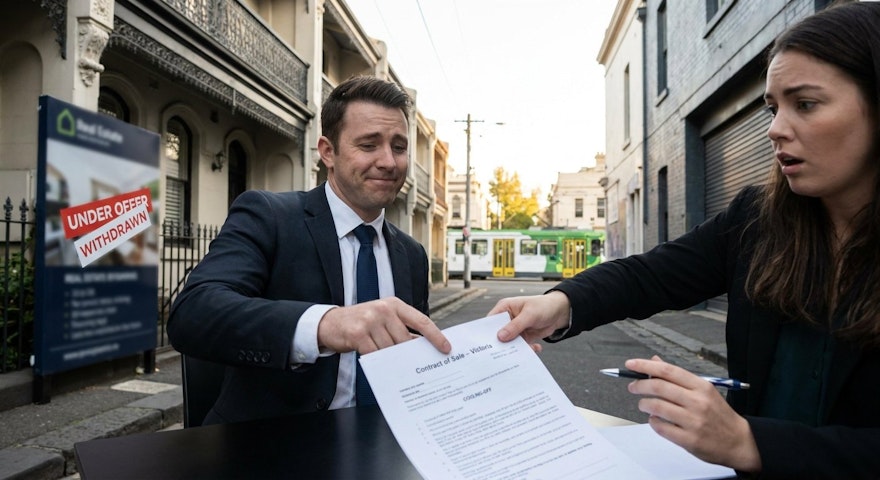
A Victorian buyer can generally withdraw a written offer at any time before the seller accepts it. Once the seller has accepted, usually by signing the Contract of Sale, withdrawal and cooling off become different questions: an eligible private sale buyer generally has three clear business days from the date they signed to cool off under the Sale of Land Act 1962, and the seller may keep the greater of $100 or 0.2 per cent of the purchase price.
What does your signature mean if the seller has not signed?
In a typical Victorian private sale, the buyer's signed Contract of Sale is a formal written offer. The property is generally treated as sold when both buyer and seller have signed, so the seller's acceptance is the key dividing line.
This is how a private treaty sale in Victoria usually moves from negotiation to a binding contract. Your signed offer will usually set out the price, deposit, settlement date, inclusions and conditions. The seller can accept those terms within minutes.
Do not assume there is no contract because your copy shows only your signature. The seller may have signed a separate counterpart, or the platform may not yet have sent the completed PDF. Your conveyancer needs to check the sequence and the contract terms.
A preliminary document may need separate treatment. A signed expression of interest or letter of offer in Victoria is not automatically the same as a formal Contract of Sale, yet its wording can matter. Send every signed document to your conveyancer.
How do you withdraw before the seller accepts?
Act at once and make the withdrawal clear in writing. Your conveyancer can identify the contract, check whether acceptance has occurred and send an unambiguous notice to the seller's representative and selling agent.
A sensible urgent sequence is:
- Stop signing or approving further documents.
- Send your conveyancer the complete contract, Section 32 and annexures.
- Forward the agent's messages and electronic signing records.
- Instruct them plainly to withdraw the offer immediately.
- Ask when the withdrawal was received and how any deposit will be returned.
Wording matters. 'We're having doubts' leaves room for argument. The safer message states that the buyer withdraws the offer for the identified property, effective immediately.
In our practice, we've seen this arise after a Sunday inspection when a buyer signed electronically, reread a special condition that evening and realised they had misunderstood it. The useful step was not guessing whether the vendor had signed. It was preserving the signing record and sending a clear withdrawal as quickly as possible.
Should you tell the real estate agent yourself?
You can alert the agent, but do not rely on a phone call alone. A verbal message can lead to a dispute about the words used, the time it was received and whether the seller accepted first.
Where possible, let your conveyancer handle the notice. They can send it to the correct people, keep proof of delivery and ask whether acceptance had already occurred.
If you cannot reach your conveyancer straight away, send the agent a brief written withdrawal, then seek help without delay. Keep sent emails, delivery receipts and signing records.
What if the seller signs at almost the same time?
The order of events may decide the legal path. If withdrawal reaches the seller before acceptance, the offer generally cannot then be accepted. If acceptance happened first, the buyer must examine cooling off, contract conditions or another right.
Your conveyancer may need to compare:
- the time the buyer signed and submitted the offer
- the time the withdrawal was sent and received
- the time the seller signed
- any platform audit trail or separate counterpart
- messages showing acceptance or delivery
- the contract's clauses about notices, electronic signing and communication.
Electronic signing can compress the sequence into minutes. Our guide to signing a Contract of Sale electronically in Victoria explains why the audit record matters alongside the PDF.
Avoid making admissions while timing is unclear. Give your conveyancer the evidence first.
Is withdrawing an offer the same as cooling off?
No. Withdrawal applies before the seller accepts; cooling off is a statutory way to end an accepted contract when the buyer and transaction qualify.
For many Victorian private sales of residential property and small rural property, the buyer has three clear business days to cool off. The period begins from the date the buyer signs the contract, not the date the seller signs or the date the completed contract arrives.
A cooling off notice must be written and given within time to the seller or the seller's agent. The seller may retain the greater of $100 or 0.2 per cent of the price. On a $900,000 purchase, that is $1,800.
Cooling off is not available for every purchase. Key exclusions include:
- a property bought at public auction
- a contract signed within three clear business days before or after a public auction for that property
- land used mainly for industrial or commercial purposes
- farming land over 20 hectares
- certain repeat contracts
- a buyer who is a company, estate agent or agent's representative.
A buyer who signs for a Richmond townhouse on Thursday may learn on Friday that the seller accepted straight away. Waiting until Monday could waste much of a period that began on Thursday. Read about the buying a house cooling off period, then have your own deadline calculated.
Can a finance or inspection condition let you end the contract?
Possibly, but only when the condition applies and its steps are followed. A finance clause, building inspection condition or other special condition is not a general exit because the buyer has changed their mind.
The clause may require notice by a precise deadline, an application to a named lender, evidence of refusal or a report identifying a specified defect. It may also prescribe the recipient and method of service.
Do not create a false finance problem or misuse an inspection condition. Tell your conveyancer what happened so they can test the clause and explain the risk of refusing to complete.
Once a binding contract exists, walking away without a valid right may expose the buyer to loss of deposit, default interest, resale losses and other claims allowed by the contract and law. The exact consequences depend on the document and what happens next.
What happens to the deposit if the offer is withdrawn?
If the seller does not accept the offer, Consumer Affairs Victoria says the deposit is returned to the buyer. Your conveyancer should still confirm who holds the money, what the payment was described as and when repayment will occur.
The position changes once a contract has been accepted. A valid cooling off notice permits the seller to retain the statutory amount. If the contract ends under a finance, inspection or other condition, repayment depends on that clause and whether the buyer complied with it.
An agent may call a payment a holding deposit, part deposit or initial deposit, while the contract may describe it differently. Send your conveyancer the receipt and trust account details. Our guide to who holds your deposit when you buy a house covers the usual Victorian arrangements.
Never send replacement bank details received by email without checking them independently. Urgent property transactions are a common setting for payment redirection fraud.
What should your conveyancer check urgently?
The first review should focus on contract status, exact timing and the safest notice available. A screenshot of the signature page is not enough.
Your conveyancer will usually want to check:
- the complete Contract of Sale and Section 32
- whether the seller signed or otherwise accepted
- electronic counterparts and platform timestamps
- the contract's notice and delivery clauses
- when the buyer signed and any cooling off deadline
- whether an auction exclusion applies
- finance, inspection and other special conditions
- deposit receipts and the stakeholder holding the money.
This review separates an offer that can still be withdrawn from an accepted contract that may end through cooling off, a condition or another right. Each route has different notice and deadline rules.
A title restriction, owners corporation issue, missing disclosure or harsh special condition may also call for a closer review of the Section 32 and contract.
How can buyers avoid this scramble next time?
Have the Contract of Sale and Section 32 reviewed before signing. A quick review can identify auction timing, cooling off exclusions, deposit terms, title restrictions and special conditions before the offer is capable of immediate acceptance.
Helpful habits include:
- do not sign merely to prove you are serious
- make sure every negotiated condition appears in the final contract
- include an offer expiry time where suitable
- read the cooling off notice before signing
- check whether an auction is scheduled or has just occurred
- save the final contract, emails and audit trail
- tell your conveyancer at once if your instructions change.
Melbourne sales can move from a Saturday inspection to an electronic offer before dinner. Speed does not replace checking the document. A short pause before signing is easier than untangling withdrawal, acceptance and cooling off times later.
Frequently asked questions
Can I withdraw after signing a Contract of Sale in Victoria?
A buyer can generally withdraw a signed offer before the seller accepts it. Give clear written notice immediately and ask your conveyancer to check whether the seller has already signed; if acceptance occurred first, cooling off or a contract condition may be the relevant option.
Is the contract binding if only the buyer has signed?
In a typical Victorian private sale, the buyer's signed contract is a written offer for the seller to accept. The status still needs checking because the seller may have signed a separate electronic counterpart that has not yet been returned to the buyer.
Does the cooling off period start when the seller signs?
No. For an eligible Victorian private sale, the three clear business day cooling off period starts from the date the buyer signs the contract. Do not wait for the fully signed copy before asking a conveyancer to calculate the deadline.
Can the seller keep my deposit if they never accepted?
If the seller does not accept the offer, the deposit should be returned to the buyer. Different rules apply if a binding contract was later ended by cooling off or under a contract condition.
Can an email withdraw my property offer?
A clear email can provide written evidence of withdrawal, but delivery, wording and timing matter. A conveyancer should check the contract's notice terms and make sure the message reaches the correct recipients as soon as possible.
What if I signed electronically and the seller's signature is not on my copy?
Do not assume the offer remains unaccepted. A separate counterpart or platform audit trail may record the seller's signature, so preserve every signing email and ask your conveyancer to confirm the exact sequence.
About the Pearson Chambers Conveyancing team
Pearson Chambers Conveyancing is a Melbourne focused team assisting Victorian residential buyers, sellers and property owners. We review Contracts of Sale and Section 32 statements, explain deadlines and conditions, and manage purchases through settlement. Checking whether a seller has accepted and identifying a buyer's safest next step are part of the contract work we handle every day.
Sources we consulted
- Consumer Affairs Victoria: Selling property by private sale
- Consumer Affairs Victoria: Buying property by private sale
- Consumer Affairs Victoria: Contracts and disclosure statements for estate agents
- Sale of Land Act 1962
- Electronic Transactions (Victoria) Act 2000
Need to withdraw your Victorian property offer?
If you've signed a Contract of Sale and the seller may not have accepted it yet, contact Pearson Chambers Conveyancing promptly. We can review the contract, Section 32, signing record and deadlines, then help you send the right notice or assess another available option. For your next purchase, we also offer buyers a complimentary contract and Section 32 review before signing.
Email contact@pearsonchambers.com.au.
General information only, current as at the date of publication. Victorian conveyancing rules and legislation change frequently. Please contact the Pearson Chambers Conveyancing team for advice on your specific contract.