![[object Object]](https://umsousercontent.com/lib_lphGCikIbVHjRWIV/w8mzrofmgaa9b3om.png?w=52)
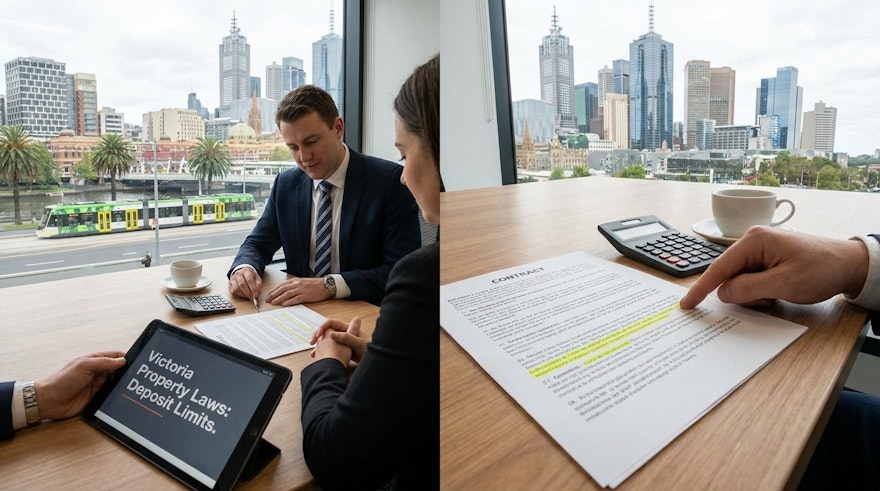
We get asked this by first home buyers, usually just after an offer has been accepted, or during the rush after a Saturday auction when the agent mentions a deposit bigger than planned.
The short answer: Yes, a vendor can ask for more than a 10 per cent deposit in Victoria, because there is no fixed legal cap on the deposit amount. Consumer Affairs Victoria treats 10 per cent as the usual deposit, not a legal limit, and the agreed amount depends on what the buyer and vendor put in the contract of sale. A deposit above 10 per cent can raise penalty and refund questions if the buyer defaults, so get the clause checked before you sign.
Is there a legal maximum deposit in Victoria?
No. Victorian property law does not set a maximum deposit for a residential sale.
The usual deposit is 10 per cent of the purchase price, paid when the buyer makes an offer or signs the contract. That number is common because agents, vendors and standard contracts are used to it, not because every buyer must pay it.
In a private sale, the deposit is part of the negotiation. You might agree to 10 per cent, ask for five per cent, offer a deposit bond, or agree to a larger amount if that makes your offer more attractive. The contract must then match what has actually been agreed.
At auction, the position feels less flexible. The contract is usually available before auction day and sets the deposit required if you are the successful bidder. You should ask for changes before bidding, not after the hammer falls.
Why would a vendor ask for more than 10 per cent?
A vendor usually asks for a larger deposit because they want extra comfort that the buyer will settle.
A bigger deposit can make an offer look stronger, especially when a Melbourne vendor is comparing several offers on the same apartment, townhouse or family home. If two buyers offer the same price, the buyer with fewer conditions and a larger deposit may look less risky to the vendor.
Some vendors also hope to use the deposit before settlement, often because they are buying another property. That does not mean they can simply take the money. Deposit release before settlement has its own rules, and a larger deposit means a larger sum may be at stake.
We've seen this come up after busy weekend inspections in suburbs where buyers feel they need to stretch every term to compete. The pressure is real, but the deposit clause is not the place to guess.
Can you offer less than 10 per cent in Victoria?
Yes. You can offer less than 10 per cent if the vendor agrees.
A five per cent deposit is common in private sales, particularly for first home buyers who are juggling savings, loan approval, stamp duty, moving costs and building inspection fees. Developers and vendors in off the plan sales may also accept a lower deposit or a different payment structure, but it needs careful review.
If your money is available for settlement but not sitting in your everyday account on signing day, a deposit bond may help. A bond is not cash. It is a guarantee that can be called on if you default, and the vendor must agree to accept it. Raise it early, especially before an auction, because many agents will not accept a bond without written approval from the vendor.
What is the risk of paying more than 10 per cent?
The risk is simple: if the contract becomes unconditional and you default, more of your money may be exposed.
A deposit is not just a booking fee. It is meant to show commitment, and it can be forfeited if the buyer fails to complete the contract. That is why the size of the deposit matters.
The 10 per cent figure has become the safe working number because courts have long treated it as a reasonable forfeitable deposit in land contracts. A much larger amount can be different. If it looks more like a punishment than a genuine deposit, a buyer who defaults may ask a court to return the excess under section 49 of the Property Law Act 1958 (Vic). That argument is not automatic, cheap or stress free.
So while a vendor can ask for more than 10 per cent, a buyer should pause before agreeing. If you forfeit your deposit, you may also face other claims if the vendor suffers extra loss, such as a resale shortfall or extra costs.
The deposit size does not change your statutory cooling off rights in a private sale. If the cooling off period applies and you end the contract within time, the seller may keep the greater of $100 or 0.2 per cent of the purchase price. The rest of the money paid should be refunded. Cooling off does not usually apply to auction purchases, or to sales within three clear business days before or after a public auction.
Where is the deposit held before settlement?
The deposit is usually held in trust until settlement, not handed straight to the vendor.
If an estate agent manages the sale, the buyer normally pays the deposit to the agent. The agent holds it in a trust account until settlement, or transfers it to the vendor's legal practitioner or conveyancer to hold in trust. If there is no agent, the money must usually be paid to the vendor's legal practitioner or conveyancer, or placed in a special purpose account in both the buyer's and vendor's names.
The person holding the deposit is a stakeholder. That means they hold the money for both parties, not just for the vendor. This is one of the main protections for buyers between signing and settlement.
The vendor may ask for early release under Section 27 of the Sale of Land Act 1962 (Vic). For that to happen, the contract must be unconditional, the buyer must be satisfied with the vendor's proof of debts, and the deposit cannot be released until at least 28 days after the contract was signed. The debts secured against the property must not exceed 80 per cent of the sale price if the vendor is relying on that pathway.
This is where a larger deposit becomes more sensitive. A 15 per cent deposit on a Melbourne home can be a very large sum to release before you own the property. In our practice, we slow down on these clauses and check the proof of debts carefully, because early release may help the vendor but it shifts risk onto the buyer.
Can a big deposit create a terms contract problem?
A large or staged payment can create trouble if it is not clearly structured.
A terms contract under the Sale of Land Act 1962 (Vic) is not the same as an ordinary contract with a simple deposit and final payment at settlement. The risk can arise if the buyer has to make extra pre settlement payments beyond the deposit and final balance, or if the buyer is allowed into possession before transfer.
This can happen quietly. For example, a vendor might ask for a deposit paid in unusual instalments, a large pre settlement payment described loosely as security, or early access to move in before settlement. Those arrangements may be workable, but they need proper drafting.
Most buyers think they are signing a standard contract. If the payment structure changes the legal character of the deal, you want to know before your money leaves your account.
What should your conveyancer check before you agree?
Your conveyancer should check the percentage, dollar amount, timing, release rules and default consequences before you sign.
For a deposit above 10 per cent, the review should cover:
- whether the amount is commercially sensible for your position
- whether the contract lets the vendor seek early release
- where the money will be held before settlement
- whether any deposit bond wording is accepted by the vendor
- whether staged payments could create terms contract issues
- what happens if finance, inspection or settlement problems arise
This is not about being difficult. It is about knowing exactly what you are risking. A quick review can lead to a cleaner clause, a lower deposit, a deposit bond, or clearer wording around release and default.
Frequently Asked Questions
Can a vendor ask for more than a 10% deposit in Victoria?
Yes. A vendor can ask for more than a 10 per cent deposit in Victoria because there is no law fixing the deposit amount. You can agree, negotiate a smaller figure, offer another form of security, or walk away before signing.
Is a 10% deposit a legal requirement when buying a house in Victoria?
No. A 10 per cent deposit is usual in Victoria, but it is not a legal requirement. In a private sale, buyers and vendors can agree on a different deposit amount and record it in the contract of sale.
Can I lose my whole deposit if I pull out of a purchase?
Yes, if the contract is unconditional and you default, the vendor may be able to keep your deposit after taking the proper steps under the contract. A deposit above 10 per cent may be open to challenge as a penalty, but getting money back through a court is uncertain and costly.
Where is my deposit held before settlement?
Your deposit is usually held in a trust account by the estate agent, conveyancer or legal practitioner until settlement. If there is no agent, the money is generally held by a legal practitioner or conveyancer, or in a special purpose account in both parties' names.
Can a vendor use my deposit before settlement?
Only in limited circumstances. Early release under Section 27 of the Sale of Land Act 1962 (Vic) generally requires an unconditional contract, proof of debts that satisfies the buyer, and at least 28 days to pass after the contract date.
Can I pay a deposit of less than 10% in Victoria?
Yes, if the vendor agrees. Many buyers ask for five per cent, particularly in private sales, first home buyer purchases and some off the plan contracts. The lower amount should be written clearly into the contract.
What is a terms contract, and how does a big deposit relate to it?
A terms contract is a contract with a different payment or possession structure from a standard sale. A large payment broken into extra instalments, or early possession before transfer, may raise terms contract issues under the Sale of Land Act 1962 (Vic).
About the Pearson Chambers Conveyancing team
Pearson Chambers Conveyancing is a Melbourne focused conveyancing team that helps buyers review contracts of sale and Section 32 statements before they commit. We work with first home buyers, upgraders and investors across Victoria, from inner city apartments to homes in the growth corridors. Deposit amount, deposit release and default risk are part of the day to day checks we make when reviewing purchase contracts.
Sources we consulted
- Consumer Affairs Victoria, Buying property by private sale
- Consumer Affairs Victoria, Property deposits for sellers
- Sale of Land Act 1962 (Vic)
- Property Law Act 1958 (Vic)
Talk to a conveyancer before you agree to a larger deposit
If a vendor has asked for more than a 10 per cent deposit, or you're not sure how much of your money is really at risk, talk to Pearson Chambers Conveyancing before you sign. We'll review the deposit clause, the Section 32 statement and the contract of sale, then explain your options in plain English.
We offer a complimentary Section 32 contract review for Melbourne and Victorian buyers.
Email contact@pearsonchambers.com.au.
General information only, current as at the date of publication. Victorian conveyancing rules and legislation change frequently. Please contact the Pearson Chambers Conveyancing team for advice on your specific contract.