![[object Object]](https://umsousercontent.com/lib_lphGCikIbVHjRWIV/w8mzrofmgaa9b3om.png?w=52)
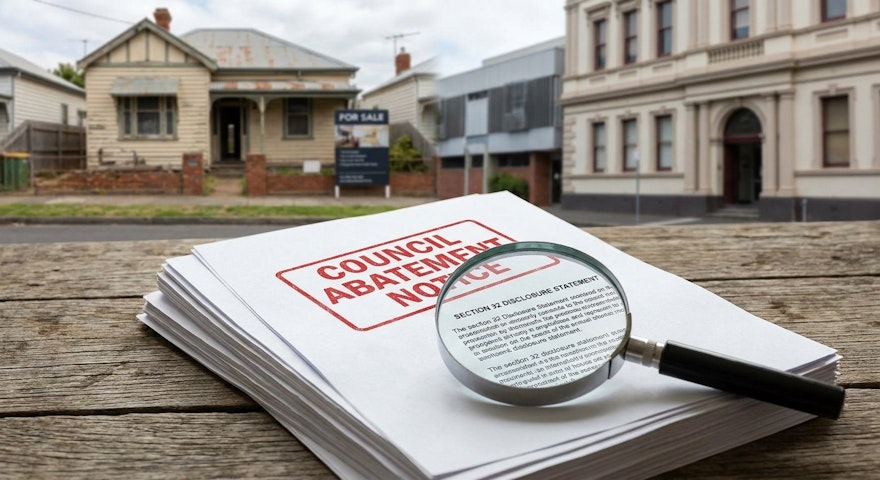
The property looks peaceful at the open inspection, then the Section 32 raises a council notice nobody quite explains.
The short answer: A council abatement notice is a written direction from a local council, municipal fire prevention officer, building surveyor or health officer requiring the owner to fix something on the land. It might deal with long grass, dumped rubbish, dangerous trees, blocked drainage, an unsafe structure or insanitary conditions. In Victoria, a vendor must disclose a current notice that directly affects the land in the Section 32 statement before you sign, and if a required notice is missed, section 32K of the Sale of Land Act 1962 (Vic) may give a buyer a right to rescind before settlement.
What is a council abatement notice in Victoria?
A council abatement notice is a formal written direction telling an owner or occupier to do work, stop an activity, or remove a hazard by a set date.
For Melbourne buyers, the examples are familiar: long grass on a vacant block in Wollert, dumped building materials in Clyde North, blocked stormwater in Reservoir, or hoarding at a long vacant house in the outer east. The risk is that the notice can turn into a cost, and sometimes a charge against the land.
Different laws sit behind different notices. Fire prevention notices are commonly linked to the Country Fire Authority Act 1958 (Vic), building emergency orders to the Building Act 1993 (Vic), and public health notices to the Public Health and Wellbeing Act 2008 (Vic). Local laws can also deal with drainage, rubbish and nuisance issues.
Do council abatement notices need to be disclosed in the Section 32?
Yes, a current council abatement notice that directly affects the land should usually be disclosed in the Section 32 vendor statement. Section 32D of the Sale of Land Act 1962 (Vic) requires the vendor to disclose certain notices, orders, declarations, reports and recommendations of public authorities or government departments that affect the land and are known, or should reasonably be known, to the vendor.
Two ideas matter. First, the notice must be current and tied to the property being sold. Second, the vendor cannot usually shrug and say they did not know if council served the notice on them, posted it to their rates address, or raised it in paperwork a reasonable owner would check.
In a good Section 32, look for the part dealing with notices, orders, declarations and authority proposals. If it says 'not applicable' but the land is clearly overgrown, vacant, fire prone or littered with rubbish, pause before signing.
What types of council notices should buyers watch for?
The notice type tells you what must be fixed, how urgent it is, and who may end up paying. Every live notice deserves a proper answer before contract.
Fire prevention notices are common on vacant blocks, rural residential land and larger outer suburban allotments. A municipal fire prevention officer can require the owner or occupier to reduce long grass, undergrowth, dead vegetation, rubbish or poor firebreaks.
Drainage and local law notices can involve blocked drains, stormwater run off, illegal connections, waste, odour or nuisance issues affecting neighbours.
Building emergency orders deal with safety risks from structures, walls, fences, balconies, outbuildings or other building work. These are different from outstanding rectification orders, which often arise in apartment or building defect settings.
Public health notices can arise where a property is insanitary, hoarded, vermin affected or left with accumulated waste. These are more common with long vacant houses and deceased estates.
Why can an old council notice become the buyer's problem?
A council notice can become the buyer's problem because some obligations and unpaid costs are connected to the land, not just the person who owned it when council acted. After settlement, council will often deal with the registered owner on title, which is now you.
If the owner ignores a notice, council may arrange the work, charge contractor and administration costs, and recover unpaid amounts in a way similar to rates or charges. That can affect settlement adjustments and future dealings with the property.
Picture a Saturday auction on a large block near the urban growth boundary. If a live fire prevention notice exists and nobody checks it before signing, the buyer may inherit the cutting, clearing and compliance paperwork, plus any unpaid council recovery cost already sitting against the property.
How do fire prevention notices affect Melbourne fringe properties?
Fire prevention notices are most common where land has grass, scrub, rubbish or vegetation that can create a fire threat. Buyers in Whittlesea, Hume, Nillumbik, Yarra Ranges, Macedon Ranges, Mitchell, Cardinia and Mornington Peninsula should be extra alert.
Before and during the Fire Danger Period, councils inspect higher risk land and issue directions if a property may endanger life or property. A notice may require slashing grass, clearing undergrowth, removing dead vegetation, taking away rubbish, or maintaining firebreaks.
Non compliance can bring fines, council works and recovery costs. For 2025 26, one Victorian penalty unit is $203.51, so a 120 penalty unit maximum is a little over $24,000. The exact outcome depends on the law used, the council and whether the owner fixes the issue on time.
How does a Land Information Certificate help?
A Land Information Certificate is one of the key documents your conveyancer uses to cross check council rates, charges and notices. It can disclose rates and charges, money owing to council, special charges, valuations, and certain continuing orders or notices.
This matters because the vendor's Section 32 may have been prepared weeks or months before you see the property. A fresh certificate gives your conveyancer a better chance of spotting a notice that appeared after the campaign started.
We've seen this come up where a property is listed in late winter, contracts are prepared in September, council inspects in October, and the buyer is due to settle in November. The paperwork just goes stale.
What should the vendor do if a notice arrives after the Section 32 is prepared?
The vendor should get advice and update the disclosure before the buyer signs, or before settlement if the contract has already been signed and the issue is material. A stale Section 32 is a real risk when council notices arrive during a campaign.
If the vendor amends or provides a supplementary Section 32, the buyer should not just file it away. Read what has changed, ask whether the notice has been complied with, and confirm who pays any council costs.
For sellers, the safest path is simple: tell your conveyancer as soon as council contacts you. Do not assume the agent will fix it after auction.
Can special conditions protect a buyer?
Yes, special conditions can protect a buyer when a notice exists, but they need to be specific. A vague promise that 'the vendor will deal with council' is rarely enough.
Depending on the notice, a buyer may ask for:
- Vendor compliance before settlement. The vendor must complete the required works, at their cost, and provide written council confirmation before settlement.
- A warranty about notices. The vendor warrants there are no current council abatement notices, building emergency orders, public health notices or unpaid council recovery costs affecting the land.
- A settlement hold back. Part of the purchase price is held until council confirms the notice has been complied with and all related costs are paid.
- A right to delay settlement or rescind. For serious notices, the buyer may need a clear right if the vendor cannot fix the issue in time.
What should buyers check before signing?
Before signing, check the notice disclosure, the age of the certificates, and what you saw at the inspection. Do not wait until the day before settlement.
Use this simple checklist:
- Read the notices, orders and authority proposal section of the Section 32. For a broader buyer checklist, our guide to Section 32 red flags is a useful starting point.
- Check whether a current Land Information Certificate is attached, and note its issue date.
- Ask the agent, in writing, whether any council notice has been issued since the Section 32 was prepared.
- Look back at your inspection photos. Long grass, rubbish piles, broken drainage and unsafe outbuildings are practical clues.
- Ask your conveyancer whether a special condition is needed before you make an offer or bid at auction.
At auction, you usually cannot add a condition after the hammer falls. Sort this out before you raise your hand.
What are your rights if the vendor fails to disclose a council notice?
If a required notice is not disclosed, section 32K of the Sale of Land Act 1962 (Vic) may allow a buyer to rescind before settlement. The timing is the catch: this right is a pre settlement protection, not a magic undo button after you have accepted title.
A court may refuse rescission in some situations, including where the vendor acted honestly and reasonably and the buyer is placed substantially as well as if the disclosure had been correct. A live council notice with real work, cost or penalty risk is not something to wave through without checking.
After settlement, the position is harder. You may need to look at misrepresentation, misleading conduct or contractual rights, all of which take time and money. It is far better to identify the issue before you sign.
Frequently Asked Questions
What is a council abatement notice on a Victorian property?
A council abatement notice is a written order requiring the owner or occupier to fix a problem on the land, such as overgrown grass, rubbish, blocked drainage, dangerous structures or insanitary conditions. In Victoria, these notices can arise under fire, building, public health, local government or local law powers. If the owner does not comply, council may arrange works, fine the owner, and seek to recover costs.
Does a council abatement notice transfer to the new owner at settlement?
A live council abatement notice can affect the new owner after settlement because the obligation and any unpaid recovery costs may be connected to the land. Once you are the registered owner, council is likely to deal with you about current compliance. That is why a buyer should check the Section 32 before signing.
Where in the Section 32 statement do council abatement notices appear?
Council abatement notices should usually appear in the part of the Section 32 statement dealing with notices, orders, declarations, reports, recommendations or approved proposals affecting the land. The wording may look technical, and the notice may be attached as a council document rather than described in plain English. If that section is blank but the property looks high risk, ask your conveyancer to check.
Can I cancel my contract if the vendor didn't disclose a council notice?
You may be able to rescind before settlement if the vendor failed to disclose a notice that should have been included in the Section 32 statement. Section 32K of the Sale of Land Act 1962 (Vic) sets out pre settlement rescission rights for missing or incorrect required information. After settlement, cancellation is much harder, so get advice as soon as the issue is found.
How do I check for outstanding council notices before I buy?
Ask your conveyancer to review the Section 32 and obtain or check a current Land Information Certificate from the relevant council. The certificate may show continuing local government notices, orders, charges and money owing against the property. You should also ask the agent in writing whether any new notice has been issued since the vendor statement was prepared.
What happens if I ignore a fire prevention notice on my property?
If you ignore a fire prevention notice, council may fine you, arrange the work itself, and seek to recover contractor and administration costs from you. Unpaid council recovery costs can create problems for future settlement or sale, so act before the deadline and keep proof of compliance.
Do I need a conveyancer to check a Section 32 for council notices?
You are not legally required to use a conveyancer, but council notices are easy to miss because they may be hidden in certificate wording or listed by legislation rather than plain English. A conveyancer can compare the Section 32 with council certificates, inspection clues and contract conditions. For a first home buyer, that review can be far cheaper than inheriting a clearing bill, fine or urgent works order.
About the Pearson Chambers Conveyancing team
Pearson Chambers Conveyancing works with Melbourne buyers and sellers across inner suburbs, growth corridors and outer fringe council areas. Our conveyancers review Section 32 statements, council certificates and contract conditions for first home buyers every day. Council abatement notices are a regular part of that work, especially when a property is vacant, overgrown, rural residential or close to fire prone land.
Sources we consulted
- Consumer Affairs Victoria, Conveyancing and contracts for sellers
- Sale of Land Act 1962 (Vic)
- Country Fire Authority Act 1958 (Vic)
- Local Government Act 2020 (Vic)
- Local Government (Land Information) Regulations 2021 (Vic)
- Victorian penalty units and values
Need help checking a Section 32 for council notices?
If you're looking at a Melbourne property and want a second set of eyes on the vendor statement before you sign, Pearson Chambers Conveyancing can help with a complimentary free Section 32 contract review.
Email: contact@pearsonchambers.com.au
General information only, current as at the date of publication. Victorian conveyancing rules and legislation change frequently. Please contact the Pearson Chambers Conveyancing team for advice on your specific contract.