![[object Object]](https://umsousercontent.com/lib_lphGCikIbVHjRWIV/w8mzrofmgaa9b3om.png?w=52)
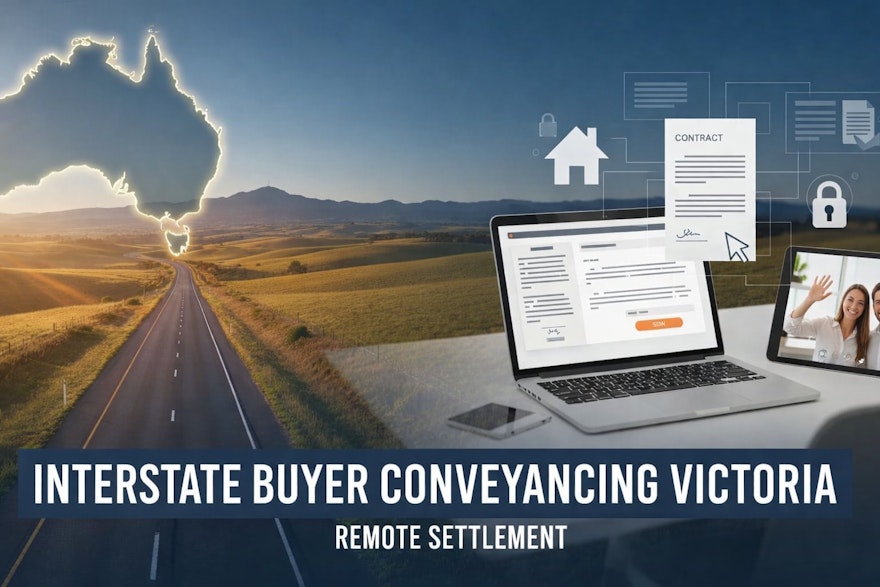
A few suburbs away from the Melbourne CBD, a Saturday open for inspection is wrapping up. Back in Brisbane, Sydney, Perth or Hobart, you’re watching the agent’s shaky video walk through and wondering if buying in Victoria from interstate is going to be a nightmare.
It doesn’t have to be.
Most Victorian settlements now run through an electronic platform, so nobody gathers in a city office passing around cheques. Your conveyancer can settle remotely, lodge the transfer and organise the money movements while you stay where you are. The trick is getting the Victorian details right long before settlement day, because the contract and disclosure documents here work a little differently to other states.
What ‘remote settlement’ means in Victoria
When people say ‘remote settlement’, they usually mean this: the legal and banking side of settlement is handled online through an electronic workspace that links your conveyancer, the seller’s representative, banks and Land Use Victoria. Documents are signed and lodged electronically, and funds move between accounts at the agreed time.
For an interstate buyer, that brings two big benefits:
You don’t need to fly to Melbourne for settlement.
You get a clear, trackable process, with less reliance on postage and physical paperwork.
There are still a few steps that need care, like identity checks, signing authorities and lining up cleared funds. A local Victorian conveyancer will manage that coordination and keep you away from last minute surprises.
Buying in Victoria from interstate: the real to do list
Distance is rarely the problem. The usual issues are timing, document handling and making sure you’ve understood what you’re signing.
Here’s what a smooth interstate purchase tends to look like in practice.
Contract review before you commit
In Victoria, the contract of sale is normally provided with a Section 32 Vendor Statement (often just called the ‘Section 32’). Together, those documents set the terms and disclose key information about the property.
If you’re used to another state where terms get negotiated later, Victoria can feel blunt. Once you sign, changes are hard to make without the seller agreeing, and that isn’t something you can bank on. It’s why a careful review up front matters, even when you’re trying to move fast.
If you’re buying your first place and doing it from interstate, the learning curve can be steep. Our guide on first home buyer conveyancing is a good starting point, then we can tailor the guidance to the property you’re looking at.
Due diligence you can do without being in Melbourne
You can still do the usual checks, you just need the right people on the ground.
Building and pest inspection: book a local inspector and ask for photos and a call to talk through the report.
Owners corporation review: for apartments and many townhouses, the owners corporation documents can tell you about fees, defects, cladding issues, pet rules and upcoming works.
Title and planning checks: your conveyancer can review title, easements, covenants, zoning and overlays, and explain what they mean in plain English.
Loan coordination: your lender and broker can work with your conveyancer to line up mortgage documents and settlement requirements.
A buyer in Adelaide can get just as much information as someone living in Fitzroy, as long as the checks are done early.
Identity and signing from interstate
Victorian conveyancing includes a formal identity verification step. Your conveyancer will guide you through what you need, and can often arrange a verification appointment in your home state or by an approved method.
You’ll also sign an authority that allows your conveyancer to act for you in the electronic workspace. From there, many documents can be signed electronically. Where wet signatures are required, your conveyancer will plan for courier or express post so deadlines don’t get missed.
Victorian differences that catch interstate buyers off guard
Interstate buyers often feel confident until a local rule pops up midway through the transaction. These are the common ones.
The cooling off period is shorter, and it has limits
Victoria has a cooling off period for many private sales. It’s a short window, and it doesn’t apply in every case. Auction purchases are the big exception, and there are other carve outs too.
If you’re relying on cooling off as a safety net, talk it through with your conveyancer before you sign. The better approach is to line up your finance checks and inspections early so you’re not scrambling to pull out.
Auctions and online bidding from interstate
Melbourne auctions can feel like sport, especially in the inner north on a windy Saturday with a crowd squeezed onto the nature strip. If you buy at auction, the deal is typically binding straight away and the cooling off rules usually won’t help you.
Interstate buyers often take one of three paths:
bid online where the agent offers an approved platform
appoint a trusted friend or family member to bid under written authority
use a buyer’s advocate who can inspect, report back and bid on your behalf
Whichever way you go, do the hard work before auction day. That means the Section 32 and contract reviewed, finance checked, and any building or owners corporation reports in your hands with enough time to read them.
Section 32 disclosure is a big deal
The Section 32 is designed to give buyers information that would be costly or difficult to uncover on their own. It typically covers things like title details, restrictions, services, outgoings, planning information and owners corporation details where relevant.
If the Section 32 is missing required information, or it’s inaccurate, it can affect the buyer’s rights. That’s another reason interstate buyers should treat contract review as the main event, not an afterthought.
Deposit release requests: the Section 27 notice
In Victoria, sellers sometimes ask for the deposit to be released before settlement using a Section 27 process. It’s not automatic, and you don’t have to sign off without understanding the position.
Your conveyancer can check the notice, explain the risk, and help you decide whether early release makes sense for you.
Fixtures, fittings and the ‘what stays’ question
When you’re buying from interstate, you can’t easily swing past the property to double check what’s staying. In Victoria, items attached to the property are usually included, while loose items are not. The contract should spell out anything extra that’s being sold with the land.
If the apartment in Docklands has a fridge you want kept, or the townhouse in Brunswick has a wall mounted television bracket you don’t want removed, it needs to be written into the contract.
Risk and insurance timing
Many Victorian contracts keep the risk with the seller until settlement, but contracts can vary. That affects when you should arrange building insurance. If you’re buying a house, it’s worth setting up cover so it can start on settlement day, and confirming the contract position in advance.
Apartments are different, because the building is usually covered by an owners corporation policy, while you insure contents and, at times, improvements.
A quick state comparison to set expectations
If you’ve bought property elsewhere in Australia, these general comparisons help explain why Victoria feels different. Always check the contract you’re signing, since individual terms can vary.
| Topic | Victoria | NSW and ACT | QLD and WA |
|---|---|---|---|
| Cooling off (private sale) | Often three business days | Often five business days | Often five business days |
| Seller disclosure | Section 32 Vendor Statement is standard | Different disclosure approach | Different disclosure approach |
| Settlement method | Electronic settlement is the norm | Mostly electronic | Mix of electronic and paper, depending on transaction |
| Early deposit release | Section 27 process may apply | Different rules | Different rules |
How an interstate purchase usually runs, start to finish
Most interstate buyers want a simple picture of what happens when. This is a typical sequence for a private sale with a standard settlement period.
Offer accepted and contract issued, with the Section 32 attached
Contract review, with any special conditions checked (finance, inspection, specific inclusions)
Inspections booked in Melbourne, reports reviewed, and follow up questions sent to the agent or seller’s representative
Finance approved and mortgage documents organised with your lender
Electronic workspace set up by the conveyancers and banks
Final searches and adjustments prepared (council rates, water, owners corporation fees)
Funds confirmed and cleared in time for settlement
Settlement completed electronically, transfer lodged, and your lender’s mortgage registered if relevant
Keys released by the agent once settlement has completed
The main pressure points are inspection timing, lender turnaround times and getting cleared funds ready. If you’re working across time zones, you want those steps locked in early.
Time zones and communication: small details that cause big stress
When you’re buying from Perth, Darwin or even Brisbane during daylight savings, the time difference can trip people up.
Settlement times are set to Melbourne time. Banks also have cut off times for moving funds, and those cut offs can fall awkwardly in another state. A morning deadline in Melbourne can land early in the day back home, right when you’re trying to get a call returned.
A Victorian conveyancer who deals with interstate clients will keep reminding you what time things happen locally and will plan around bank cut offs. It’s boring admin, but it’s the sort of boring you want.
What happens on settlement day when you’re not in Victoria
You won’t be logging into the settlement workspace yourself. Your conveyancer and your lender do that on your behalf.
On the day, the electronic workspace balances all the figures, lines up the payouts (including any existing mortgage on the property), and transfers funds to the right places. Transfer duty and registration fees are paid as part of the process. Once the transfer is lodged, Land Use Victoria updates the register and the agent can release keys.
From your end, the most common tasks are:
making sure your contribution funds are in the right account in time
being available by phone in case the bank or conveyancer needs a quick confirmation
arranging insurance to start when required
If you’re buying with a loan, your lender will also have their own settlement checklist, which your conveyancer can help you navigate.
Remote inspections that actually work
Plenty of interstate buyers buy well, even without stepping on the property before settlement. The buyers who feel calm are usually the ones who make a plan for inspections, rather than hoping for the best.
A few options that work in Melbourne:
Send a friend to the open for inspection on a video call and ask them to open cupboards, check water pressure and look for cracks.
Pay for a proper building inspection, then jump on a call with the inspector and ask what they’d fix first if it were their own place.
For apartments, ask for a copy of the owners corporation certificate and minutes, and look out for talk of concrete spalling, water ingress or special levies.
If you’re buying in a competitive pocket, consider a buyer’s advocate who can attend inspections and report back quickly.
It’s not about being paranoid. It’s about avoiding that sinking feeling after settlement when you realise you missed something you would have spotted in person.
Choosing a Victorian conveyancer when you live interstate
A conveyancer isn’t just ticking boxes. For interstate buyers, your conveyancer is also your local guide.
When you’re comparing firms, look for someone who:
works with Victorian contracts every day and knows what a normal clause looks like
is comfortable with electronic settlement and lender coordination
explains issues without drowning you in legal language
responds quickly, because Melbourne properties often move fast
will raise red flags early, before you pay money or sign authority forms
It’s also worth choosing someone who knows Melbourne property patterns. Inner city apartments have their own risks, outer suburb estates have theirs, and a weatherboard in the inner north can come with very different maintenance and planning considerations to a modern townhouse in the west.
Get your Section 32 reviewed before you lock anything in
Buying in Victoria from interstate can be smooth, but the contract review and preparation is where you win or lose peace of mind.
Pearson Chambers Conveyancing can guide you through the full process, from reviewing the Section 32 and contract conditions through to remote settlement. If you’re looking at a property and want to know where the traps are, get in touch for a complimentary Section 32 contract review.
Email: contact@pearsonchambers.com.au
This information is general only and isn’t a substitute for advice about your specific circumstances.