![[object Object]](https://umsousercontent.com/lib_lphGCikIbVHjRWIV/w8mzrofmgaa9b3om.png?w=52)
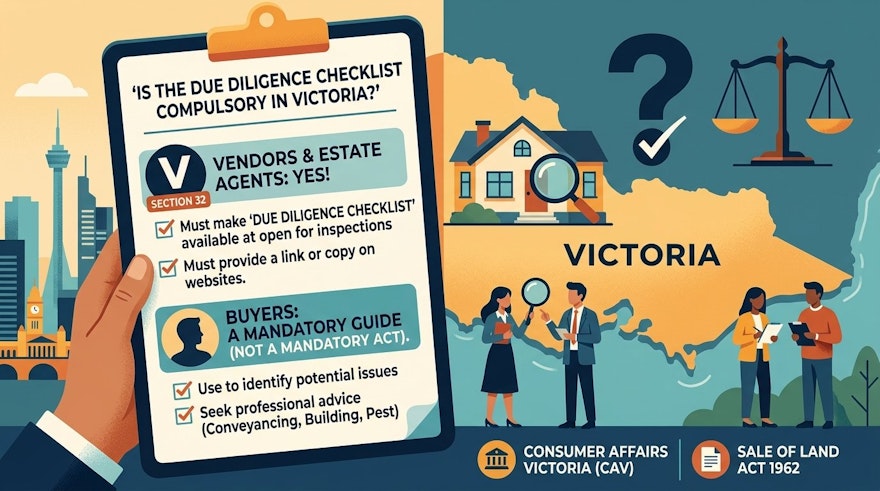
We get asked this by first home buyers who pick up the checklist at a Saturday open home and wonder whether it means the property has passed some kind of legal test.
The short answer: Yes, the due diligence checklist is compulsory in Victoria for residential property. Under sections 33A and 33B of the Sale of Land Act 1962 (Vic), the seller, or the licensed estate agent once one is engaged, must make the Consumer Affairs Victoria approved checklist available to buyers; failing to do so carries a 60 penalty unit fine, about $12,210.60 in 2025-26. The catch is that the checklist does not protect you on its own: if it is missing, that does not give you a right to cancel the contract, and it is not a substitute for a proper contract and Section 32 review.
Is the due diligence checklist compulsory in Victoria?
Yes. A due diligence checklist must be made available when residential land is offered for sale in Victoria. That covers vacant residential land and land with a home on it, so it applies to the houses, units, apartments and townhouses most Melbourne buyers inspect each weekend.
The duty starts when the property is offered for sale. If the seller has not engaged an estate agent, the seller carries the duty. Once a licensed estate agent is engaged, the agent takes over that obligation. At a typical Melbourne open home, that means the agent should have a copy available or a clear way for you to access it.
The checklist must be the approved Consumer Affairs Victoria version. It is the same checklist for every residential property, from a Southbank apartment to a weatherboard in Reservoir.
What does the agent have to do with the checklist?
The agent or seller must make the checklist available at inspections and online. In practice, you may see a paper copy on the kitchen bench, a QR code, or a link on the listing page.
The online rule matters because buyers often do their homework on a tram, after work, or between inspections. If the agent maintains a listing page, that page must include a copy of the checklist or a link to the Consumer Affairs Victoria checklist page.
If the rule is breached, the penalty is aimed at the seller or agent, not at fixing your contract. The fine is 60 penalty units. For the 2025-26 financial year, a Victorian penalty unit is $203.51, so the fine is about $12,210.60. That figure is indexed each financial year, so check the current rate if you need the exact dollar value.
Is the due diligence checklist legally binding?
No. The checklist is compulsory to provide, but it is not a contract document and it is not part of the Section 32 vendor statement. You do not sign it, the seller does not certify property-specific answers in it, and it does not create a buyer remedy if it is missing.
This is the point that can feel unfair. The law tells sellers and agents to provide the checklist, but it does not say a buyer can automatically rescind because the checklist was missing. The consequence sits in the regulatory space: a possible fine.
The Section 32 vendor statement is different. If you want a deeper plain-English guide to what a section 32 vendor statement must disclose, start there. The Section 32 contains property-specific disclosure, such as title details, planning information, outgoings, notices, services and owners corporation material where relevant. If it is false, incomplete or not properly given before signing, section 32K of the Sale of Land Act can give a buyer a rescission right, subject to limits and possible vendor defences.
That is why we treat the checklist as a prompt, not protection. It tells you what to ask about. It does not answer the questions.
Can I cancel a contract if I was not given the checklist?
No, not just because the due diligence checklist was missing. The Sale of Land Act creates a fine for failing to provide the checklist, but it does not give the buyer a direct cancellation right for that breach.
If you are worried after signing, look beyond the checklist. Your conveyancer should review the contract, the Section 32, the timing of disclosure, and any conditions that may still be active. You may also need to check your section 32 rescission rights in Victoria if the vendor statement was missing, late, false or incomplete.
Timing matters. A wrong step can put a buyer in breach, so do not send threats to the agent or vendor before getting proper advice.
What does the checklist actually cover?
The checklist covers common risks that may affect the land, the building, your budget and what you can do after settlement. It points buyers towards issues such as:
- urban living, noise and neighbouring uses
- owners corporations, shared areas, fees and rules
- growth areas and infrastructure contributions
- flood, fire and other location risks
- rural land, contamination and resource activity
- land boundaries, easements and encumbrances
- zoning, overlays and planning controls
- building permits, safety, pools, asbestos and owner-builder work
- water, sewerage, electricity, gas, phone and internet connections
That list is useful. It is also generic. The same questions apply whether you are looking at a CBD apartment, a townhouse in Coburg, or a vacant block in a growth corridor. The checklist will not tell you whether the easement runs through the back garden, whether a special levy is coming, or whether an overlay blocks the extension you had in mind.
How does a conveyancer turn the checklist into real protection?
A conveyancer turns each checklist prompt into a search, document review or contract condition before you sign. That is where the real protection sits.
For title issues, your conveyancer orders or checks a current title search and plan, then looks for easements, covenants, mortgages, caveats and boundaries. Old title searches can be stale, so a fresh check is safer.
For planning issues, your conveyancer reviews the planning information and can use the Planning Property Report to identify zones and overlays affecting that exact parcel. A heritage overlay in Carlton, a Bushfire Management Overlay near the fringe, or a Land Subject to Inundation Overlay can change your plans quickly.
For apartments, units and some townhouses, your conveyancer reviews the owners corporation certificate, rules, insurance, fees, arrears and any signs of disputes or special levies. If you are reading an owners corporation certificatefor the first time, do not stop at the fee figure. Minutes, insurance and repairs often say more than the annual contribution.
For building works, your conveyancer checks the Section 32 building permit disclosure, especially permits from the seven years before sale. Owner-builder work may also call for a defects report and domestic building insurance, depending on the facts.
For money risks, your conveyancer checks outgoings, land tax and clearance certificates where relevant, then explains what is adjusted at settlement and what remains the seller's problem.
In our practice, we have seen buyers feel reassured because the agent handed them the checklist, then discover later that an easement affects the backyard extension they had planned. The checklist mentioned easements, but nobody had checked the title and plan before the offer was signed. That is the gap a pre-contract review is meant to close.
What should Melbourne buyers do before signing?
Ask for the contract and Section 32 as early as possible, then send both to your conveyancer before you make an offer or bid at auction. The checklist can come too, but the contract pack is the part that needs careful review.
Use this simple order:
- Read the due diligence checklist and note anything that worries you.
- Ask the agent for the contract of sale and Section 32.
- Send the full contract pack to your conveyancer.
- Tell your conveyancer your plans, such as renovating, keeping pets, renting the property out, or building a studio.
- Get legal comments and any proposed special conditions before signing.
- Arrange building, pest or strata reports where needed.
- Confirm your cooling-off position before you sign anything.
For a private sale, Victorian buyers often have a three clear business day cooling-off period, but there are exceptions. You can read more about how cooling-off periods work in Victoria. For a publicly advertised auction, or a sale within three clear business days before or after one, cooling off usually does not apply. That is why buying at a Melbourne auction calls for the contract review before auction day, not after the hammer falls.
Frequently asked questions
Is the due diligence checklist compulsory in Victoria?
Yes. The due diligence checklist is compulsory for Victorian residential property sales. Under section 33B of the Sale of Land Act 1962 (Vic), the seller, or the licensed estate agent if one is engaged, must make the Consumer Affairs Victoria approved checklist available to prospective buyers from the time the property is offered for sale.
Is the due diligence checklist legally binding?
No. The due diligence checklist is not legally binding on the buyer or seller in the same way as the contract of sale. It is a general buyer prompt, not a signed contract term, and it does not form part of the Section 32 vendor statement.
Can I rescind the contract if I was not given the due diligence checklist?
No. Not receiving the due diligence checklist does not, by itself, give a Victorian buyer a right to rescind the contract. The seller or agent may face a regulatory penalty, but the buyer's cancellation rights usually need to come from the contract, cooling off, Section 32 problems or another legal pathway.
What is the difference between the due diligence checklist and the Section 32?
The due diligence checklist is a general list of questions that helps buyers know what to investigate. The Section 32 vendor statement is a property-specific disclosure document that the seller must provide before the buyer signs, and a false, incomplete or missing Section 32 can create rescission rights in some situations.
Who has to provide the due diligence checklist in Victoria?
The seller must provide the due diligence checklist unless a licensed estate agent is engaged. Once there is an agent, the agent must make the checklist available at inspections and online where the agent maintains a property listing.
Where can I find the official Victorian due diligence checklist?
The official Victorian due diligence checklist is published by Consumer Affairs Victoria. Agents often meet the online requirement by linking to the Consumer Affairs Victoria checklist page from the property listing.
Does ticking off the due diligence checklist mean I have done my due diligence?
No. Ticking off the due diligence checklist only means you have considered the questions. Real due diligence means checking the title, plan, Section 32, certificates, owners corporation material, planning controls and contract conditions before you sign.
About the Pearson Chambers Conveyancing team
Pearson Chambers Conveyancing is a Melbourne-focused conveyancing team helping first home buyers, sellers and investors with contract reviews, Section 32 checks and settlements across Victoria. We work with buyers across apartments, townhouses, units and family homes, including auction purchases and fast-moving private sales. The due diligence checklist sits right inside our day-to-day work because it raises the questions we then test through the contract, title, certificates and vendor statement.
Sources we consulted
- Due diligence checklist for home and residential property buyers
- Sale of Land Act 1962
- Buying property by private sale
- Penalties and values
- Planning property report
- Land registration
Need your contract and Section 32 checked?
The due diligence checklist is a helpful start, but it is not the safety net. Pearson Chambers Conveyancing can review your contract and Section 32 before you sign, explain what the documents mean, and flag the issues that should be dealt with before you commit.
Email contact@pearsonchambers.com.au.
General information only, current as at the date of publication. Victorian conveyancing rules and legislation change frequently. Please contact the Pearson Chambers Conveyancing team for advice on your specific contract.