![[object Object]](https://umsousercontent.com/lib_lphGCikIbVHjRWIV/w8mzrofmgaa9b3om.png?w=52)
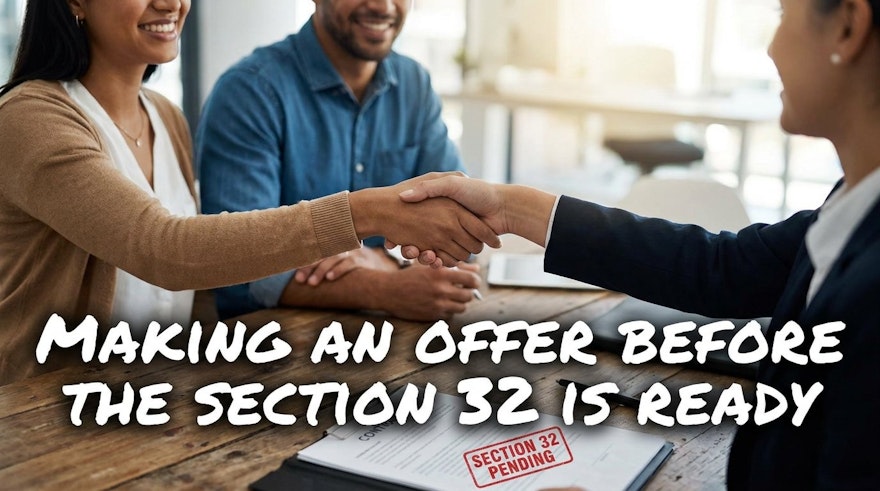
We get asked this most weekends, usually after a buyer has found a promising Melbourne property and the agent says, ‘Make an offer now, the Section 32 is coming.’ It sounds like a small timing issue, but signing too early can turn Saturday excitement into Monday stress.
The short answer: In Victoria, a formal written offer is usually made by signing the contract of sale. Section 32 of the Sale of Land Act 1962 requires the vendor to give you a signed vendor statement before you sign that contract, so you should not sign first and read the disclosure later. You can express interest, discuss price and prepare your conditions while you wait.
What counts as making an offer in Victoria?
A formal offer to buy a Victorian property is commonly a contract of sale signed by the buyer. The vendor can accept it by signing, at which point the contract becomes binding and enforceable.
That surprises buyers who expect a separate offer form. In a typical Melbourne private sale, the contract records the price, deposit, settlement date, inclusions and conditions such as finance or a building inspection.
Verbal discussions and emails can still help with negotiation. You might tell the agent, ‘I’m prepared to offer $820,000, subject to reviewing the contract and Section 32.’ That shows genuine interest without placing your signature on legal terms you haven’t checked.
Why must the Section 32 come before you sign?
Victorian law requires the vendor to give the purchaser a signed Section 32 statement before the purchaser signs the contract. The timing matters because the statement is designed to disclose property information before you commit.
A Section 32 vendor statement may contain title details, mortgages, easements, covenants, zoning, outgoings, bushfire information, authority notices and owners corporation material. The exact contents depend on the property.
These details can affect what the property is worth to you and whether it suits your plans. An easement may sit where you hoped to build a studio, while an apartment’s owners corporation records may reveal fees or proposed works that change your budget.
The safe sequence is simple:
- Receive the contract and signed Section 32.
- Have both documents reviewed.
- Ask questions and negotiate any changes.
- Sign only when you understand the property and the terms.
Why might the Section 32 not be ready yet?
A Section 32 may be delayed while the vendor’s conveyancer gathers searches, certificates and property information from different bodies. There is no universal preparation time, and a property can be advertised while the documents are still being assembled.
Common items include a current title search, plan of subdivision, council and water information, land tax material and owners corporation documents. A straightforward house may move quickly. An apartment with an active owners corporation, recent building work or unusual title dealings may take longer.
From the vendor’s side, the key rule is that marketing can begin, but a purchaser must not sign before receiving the required disclosure. Our guide on selling a Victorian property without a Section 32 explains that distinction in more detail.
A delay isn’t automatically a red flag. It is a reason to slow the signing process, not speed it up.
What does the agent mean by ‘get your offer in’?
The agent may be asking you to sign a contract, even when the language sounds informal. Ask exactly what they want from you before agreeing.
You may hear comments such as:
- ‘The Section 32 will be ready tomorrow.’
- ‘Another buyer is about to sign.’
- ‘Just sign now so the vendor knows you’re serious.’
- ‘We can fix the paperwork later.’
A competing buyer does not remove the vendor’s disclosure duties. You can say: ‘I’m ready to move quickly once my conveyancer has reviewed the complete documents.’
In our practice, we’ve seen pressure peak late on Saturday when buyers are tired from inspections and worried someone else will secure the property. Pausing to check the paperwork is sensible, not a missed legal shortcut.
Is signing ‘subject to the Section 32’ safe?
A special condition may provide protection only if it is carefully drafted for the exact situation. A loose phrase such as ‘subject to satisfactory Section 32’ can create arguments about what ‘satisfactory’ means, who decides and how long the buyer has to act.
It also does not replace the vendor’s legal duty to provide the signed statement before the purchaser signs. Consumer Affairs Victoria states that the seller’s disclosure obligations cannot be removed by a contract term.
Before relying on any special condition, have your conveyancer draft or review it. In most ordinary purchases, the cleaner course is to wait for the documents, review them, then sign.
Should you pay a holding deposit while waiting?
Paying money before a contract is signed does not, by itself, guarantee that the vendor will sell to you or stop considering other buyers. The effect of any payment depends on the written terms attached to it.
Before transferring money, ask for written confirmation of:
- the purpose of the payment
- whether it is fully refundable if no contract is signed
- who will hold the money
- whether the property will remain on the market
- how the payment will be treated if contracts are later signed.
Do not rely on a quick assurance beside the agent’s signboard. Check bank details through a trusted phone number before transferring money.
A written expression of interest can show that you are serious without putting money into an uncertain arrangement.
What can you safely do while the Section 32 is being prepared?
You can keep the purchase moving without signing an incomplete deal. The aim is to be ready when the documents arrive.
- Put your interest in writing. Tell the agent the price and broad terms you are considering, while stating that any formal offer is subject to receiving and reviewing the contract and Section 32.
- Request drafts early. Ask for the contract, title and any available attachments, even if some certificates are still outstanding. Your conveyancer may be able to flag issues straight away.
- Prepare your conditions. Decide whether you need finance, building and pest, sale of another property or a particular settlement date. Conditions need to be settled before you sign.
- Progress finance and inspections. Speak with your broker or lender, confirm your borrowing position and organise inspections where appropriate.
- Send the final bundle for review immediately. Buyers often lose time after the documents arrive, not because they refused to sign before disclosure was ready.
This preparation can make you a strong buyer. You can respond quickly without treating speed as a substitute for care.
What if you have already signed without receiving a Section 32?
Get advice promptly. A missing, false or incomplete Section 32 may give a purchaser rights under the Sale of Land Act 1962, including a possible right to rescind in certain circumstances, but the legal tests and timing matter.
Do not assume the contract is automatically cancelled. Do not wait for settlement week either. Keep the contract, emails, electronic signing records and any version of the Section 32 you later received, then send the full file to a Victorian conveyancer or property lawyer.
Your adviser can check what was supplied, when it was supplied, what is missing and whether the issue is material.
Does the cooling off period protect you if you sign too early?
For many private sales of residential property in Victoria, a cooling off period of three clear business days applies from the date the buyer signs. A buyer who validly cools off receives a refund less $100 or 0.2 per cent of the purchase price, whichever is greater.
On an $800,000 purchase, 0.2 per cent is $1,600. That may be far less than completing the wrong purchase, but it is still a real cost.
There are exceptions. Cooling off does not apply to a property bought at public auction or within three clear business days before or after a publicly advertised auction. Other exclusions can apply based on the property or buyer. Our guide to the cooling off period in Victoria explains the main rules.
Three clear business days can disappear quickly while you arrange advice, finance and inspections. Treat cooling off as a limited safety net, not your document review plan.
What changes if the property is going to auction?
Auction buyers should complete their legal, finance and building checks before bidding. There is no cooling off period after an auction purchase, and the successful bidder generally cannot add new conditions once the auction has finished.
The contract and Section 32 should be available before auction day. If you are considering buying at auction in Melbourne, send the documents for review early enough to ask questions and request any agreed changes before you bid.
Once the hammer falls at a Saturday auction in Coburg, the mood moves quickly from excitement to signatures and the deposit. That is not the moment to discover an easement or a settlement term you do not understand.
How can a conveyancer help before you make an offer?
A conveyancer can review the Section 32 and contract while the deal is still negotiable. That is when advice has the most practical value.
A pre-signing review may cover:
- whether the title and plan match the property being sold
- easements, covenants, caveats and other title restrictions
- zoning, overlays and disclosed notices
- owners corporation fees, rules and certificates
- deposit, settlement and default terms
- finance or inspection conditions
- unusual special conditions favouring the vendor
- whether your renovation, tenancy or future use plans raise extra questions.
Once both parties have signed, your choices are usually limited to the contract and any statutory rights. Before signing, you can still ask questions, alter conditions, change your price or walk away.
Frequently asked questions
Can I make an offer before the Section 32 is ready?
You can express interest, discuss a price and outline proposed conditions, but a formal written offer in Victoria is usually made by signing the contract of sale. The vendor must give you the signed Section 32 before you sign, so wait for the disclosure and have it reviewed first.
How long does it take to prepare a Section 32 in Victoria?
There is no fixed preparation period. Timing depends on the property and how quickly title, council, water, tax and owners corporation information can be obtained, so ask the agent when the complete signed statement is expected.
Is a holding deposit binding before the Section 32 arrives?
A payment alone does not guarantee the sale or stop the vendor dealing with another buyer. Before paying, get written terms covering refunds, who holds the money, whether marketing continues and what happens if no contract is signed.
What happens if I signed a contract but never received a Section 32?
You may have rights under the Sale of Land Act 1962, including a possible right to rescind in certain circumstances. The result depends on the documents, timing and legal tests, so obtain advice straight away and preserve all records.
Can an agent ask me to sign subject to the Section 32?
An agent can propose a special condition, but the vendor’s disclosure duty cannot simply be contracted away. A vague condition may not protect you as expected, so have it drafted or reviewed by your conveyancer before signing.
Does the cooling off period protect me if I sign before review?
It may protect some private sale buyers for three clear business days from the date they sign, with a deduction of $100 or 0.2 per cent of the price, whichever is greater. Cooling off has important exceptions, including auction purchases and contracts signed within three clear business days before or after a public auction.
Should I have the Section 32 reviewed before making an offer?
Yes. A pre-signing review helps you understand the property, identify contract risks and request suitable conditions while the deal is still open to negotiation.
About the Pearson Chambers Conveyancing team
Pearson Chambers Conveyancing is a Melbourne focused team helping first home buyers, homeowners and investors across Victoria. We handle contract reviews and settlements for buyers dealing with private sales, auctions, apartments, townhouses and family homes. Reviewing the Section 32 before a buyer signs is part of our day to day work.
Sources we consulted
- Conveyancing and contracts for sellers, Consumer Affairs Victoria
- Buying property by private sale, Consumer Affairs Victoria
- Buying property at auction, Consumer Affairs Victoria
- Contracts and disclosure statements for estate agents, Consumer Affairs Victoria
- Sale of Land Act 1962, Victorian Legislation
Talk to Pearson Chambers Conveyancing before you sign
Found a Melbourne property you’re serious about? Send the contract and Section 32 to Pearson Chambers Conveyancing before placing your signature on the offer. We provide a complimentary Section 32 contract review and explain the points that matter in plain English.
Email: contact@pearsonchambers.com.au
General information only, current as at the date of publication. Victorian conveyancing rules and legislation change frequently. Please contact the Pearson Chambers Conveyancing team for advice on your specific contract.