![[object Object]](https://umsousercontent.com/lib_lphGCikIbVHjRWIV/w8mzrofmgaa9b3om.png?w=52)
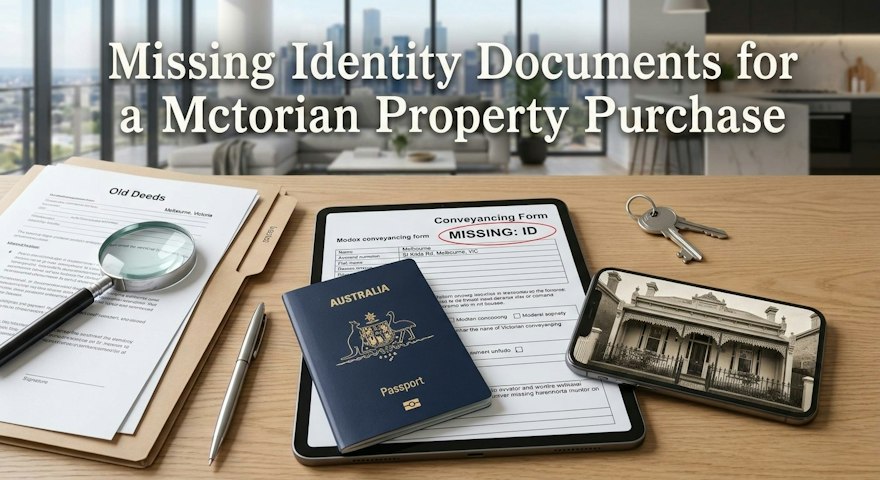
Your property purchase identity checklist asks for a birth certificate you can't find, and you don't have a passport to use instead. With settlement approaching, the missing paperwork needs a clear next step.
The short answer: Missing a usual identity document doesn't automatically prevent verification for a Victorian property purchase. Your conveyancer can assess another permitted document combination or other reasonable steps, but must be satisfied that your identity has been verified. An Identifier Declaration may be available in specific circumstances, but it isn't an automatic exemption or a declaration you can supply on its own.
Another document combination may solve the problem
Verification of identity, often called 'VOI', checks that you are the person you claim to be for the conveyancing transaction. A passport isn't required in every permitted combination.
One recognised route is the Verification of Identity Standard. It uses document combinations rather than a points total. For Australian citizens or residents, the verifier starts with Category 1 and must be reasonably satisfied that an earlier category can't be met before moving to a later one.
For example, Category 3 combines an Australian driver's licence or government Photo Card with:
a full birth certificate, citizenship certificate or descent certificate; and
a Medicare, Centrelink or Department of Veterans' Affairs card.
Any necessary change of name or marriage certificate is also required. A licence and Medicare card alone don't complete Category 3. Category 2 can be used without a driver's licence if the required passport or specified ImmiCard and supporting documents are available.
Tell your conveyancer which original documents you hold and which are unavailable so they can assess the complete combination before verification.
An Identifier Declaration has strict conditions
An Identifier Declaration may help when earlier categories can't be met. It is a statutory declaration from an eligible person who knows you, used with the supporting documents required for the category.
For Australian citizens or residents, Category 5(a) can be considered when Categories 1 to 4 can't be met. It requires the declaration, a full birth certificate or citizenship or descent certificate, and a Medicare, Centrelink or Department of Veterans' Affairs card, plus necessary name evidence.
If Category 5(a) can't be met, Category 5(b) may be considered. It uses a declaration from a person in a specified occupation, together with the required card and necessary name evidence. This may provide a route when a birth certificate isn't available, but acceptance isn't guaranteed.
The declarant must:
be an adult;
have known you for more than one year;
be neither your relative nor a party to the transaction; and
have their own identity verified under the Standard without using Category 5.
Both of you must attend the same face to face, in person interview. For Category 5(b), the declarant must also be in one of the specified occupations as defined in the Standard, such as a doctor, nurse, police officer, licensed conveyancer, legal practitioner or public servant. A job title alone doesn't satisfy the category or remove the other conditions.
Arrange the declaration through your conveyancer rather than assuming someone you know will qualify.
Other reasonable steps require an individual assessment
The Standard is one permitted way to take reasonable steps to verify identity, but it isn't the only one. If none of its combinations works, your conveyancer can assess whether another method amounts to reasonable steps in your circumstances.
That assessment is fact specific and may involve further documents, enquiries or other evidence explaining your identity and why the usual documents aren't available. Your conveyancer must retain supporting evidence for the alternative reasonable steps assessment.
The Standard requires a face to face, in person interview and original documents. A different reasonable steps route needs its own justified assessment and supporting evidence. A photocopy, video call or collection of household records doesn't automatically establish compliance.
Under the Victorian Participation Rules, your representative must undertake further steps if a document appears not genuine, the likeness or identity is doubtful, or it would otherwise be reasonable to do so.
Check expiry dates before relying on an old document
Under the Standard, documents must be current. There is a limited exception for an Australian passport that hasn't been cancelled and was current within the preceding two years.
That exception doesn't extend to an expired foreign passport or driver's licence. Tell your conveyancer the document type and expiry date so they can assess whether another combination or further steps are needed.
Resolve the evidence before registry documents are signed for you
Your conveyancer needs to satisfy the applicable identity requirements before digitally signing land registry documents for you. This is separate from your signing the contract of sale.
A Client Authorisation gives your representative authority, within its scope, to act in the electronic conveyancing transaction, including signing registry documents and authorising lodgement and financial settlement. Guidance says it should ideally be signed at the same time as VOI. If the steps occur separately, reasonable steps are needed to ensure the identified client signs the authorisation.
Your conveyancer or lender may also request information for separate customer due diligence requirements. Completing land registration VOI doesn't by itself complete every other identification request. Ask which check remains outstanding and what evidence is needed.
Give your conveyancer a useful evidence list
Start with an inventory rather than preparing a declaration yourself. Include:
the original identity documents you hold and their expiry dates;
the documents you can't provide and why;
details of any replacement application already made;
details of a possible eligible declarant, if your conveyancer says Category 5 may be relevant; and
your contract dates and any outstanding lender requests.
Use the document sharing method your conveyancer requests. If settlement is close, ask them to review the relevant contract dates while the identity issue is resolved so the evidence requirements and purchase timetable can be considered together.
About the Pearson Chambers Conveyancing team
Pearson Chambers Conveyancing assists with Victorian residential purchases, sales and title transfers. For a purchase involving missing identity documents, the team can assess the conveyancing evidence requirements and coordinate the remaining transfer and settlement steps.
Sources we consulted
Land Services Victoria: verification of identity responsibilities
Victorian Participation Rules, Version 7: identity requirements and document categories
ARNECC Guidance Note 2: reasonable steps and verification of identity
Discuss the identity documents for your purchase
Contact Pearson Chambers Conveyancing at contact@pearsonchambers.com.au to discuss the available documents and the conveyancing steps for your purchase. If you're still deciding whether to sign, ask about our complimentary contract and Section 32 review.
General information only, current as at the date of publication. Victorian conveyancing rules and legislation change frequently. Please contact the Pearson Chambers Conveyancing team for advice on your specific contract.