![[object Object]](https://umsousercontent.com/lib_lphGCikIbVHjRWIV/w8mzrofmgaa9b3om.png?w=52)
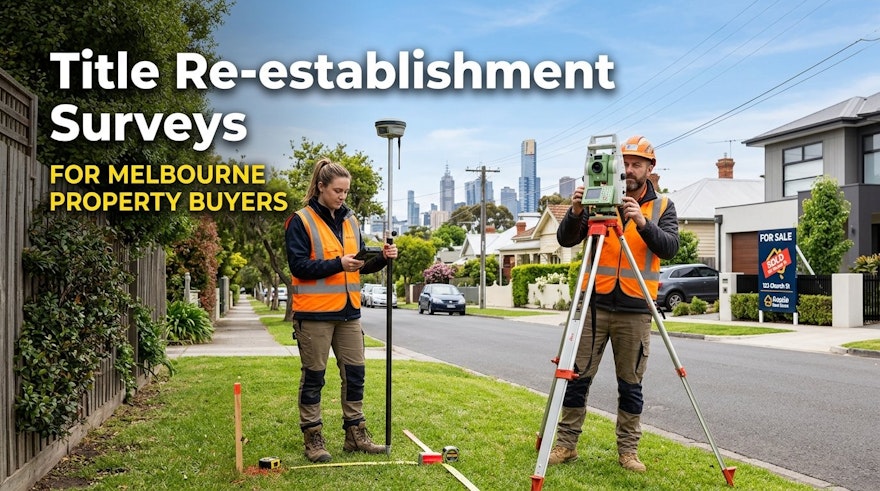
You inspect a place in Ivanhoe, Montmorency or Ringwood and everything feels fine. The fence looks straight, the garage looks neat, and the backyard seems to match the plan in your head. Then your conveyancer reviews the paperwork and spots something that does not sit comfortably with the dimensions on title. That is when buyers learn a hard truth: a fence is not the boundary just because everyone has treated it that way for years.
The short answer: In Victoria, a title re-establishment survey is a cadastral boundary survey carried out by a licensed surveyor under the Surveying Act 2004 (Vic) and the Surveying (Cadastral Surveys) Regulations 2025. It checks where the legal title line sits against the fence, driveway, shed, retaining wall and other features on the ground. For a straightforward Melbourne suburban block, buyers often budget about $800 to $1,500 or more, and many survey plans come back within roughly a week of the site visit. If you are buying at auction, the survey needs to be arranged before bidding, because there is no cooling-off period at auction, or within three clear business days before or after it.
For some buyers, a re-establishment survey is money very well spent. For others, it is not needed at all. The key is knowing when the risk is real.
What is a title re-establishment survey in Victoria?
A title re-establishment survey is a formal check of your legal boundaries. A licensed surveyor examines the title documents, historical survey material and the physical site, then works out where the boundary line should sit on the ground.
That matters because title diagrams and plans give you boundary information, but they do not guarantee that the existing fence, wall or garden edge is in the right place. In Victoria, only a licensed surveyor can determine the actual location of a property boundary. Your building inspector cannot do it. Your conveyancer cannot do it. The agent certainly cannot do it while waving a brochure at an open home on a rainy Saturday morning.
The end result is usually a survey plan showing the legal boundary in relation to what is physically there. Depending on the site, the surveyor may also place marks or pegs where practical.
When should Melbourne buyers get a title re-establishment survey?
You do not need one for every purchase. You should think seriously about one when the paperwork and the land do not seem to match, or when the block has features that make boundary drift more likely.
Common warning signs include:
- an older title in suburbs like Brunswick, Northcote, Camberwell, Kew or Essendon
- a fence line that looks oddly angled, stepped, or out of square with neighbouring lots
- a garage, shed, pergola, retaining wall or driveway built hard against a side boundary
- a sloping site where cut-and-fill works or retaining walls may have changed the feel of the edges
- a fresh subdivision where new fences have gone up quickly
- a narrow inner-suburban block where even a small strip of land affects access, parking or future building plans
- a rear laneway, side path or garden strip that seems to have been absorbed into one property over time
Buyers are often surprised by how often these issues show up on perfectly ordinary homes. It is not just big development sites or acreage in the outer fringe. Sometimes it is a weatherboard in Preston, a brick veneer in Doncaster, or a townhouse in Box Hill with a shared driveway and one fence built on old assumptions.
What can your conveyancer spot before you sign?
Your conveyancer can often spot the warning signs early, but they cannot confirm the boundary without a survey. The early job is to identify risk and tell you whether a survey is worth arranging before you are locked in.
That review usually starts with the title search and the wider set of conveyancing searches. Those checks can reveal easements, restrictions, notices, prior dealings and other encumbrances on the property, but they still do not prove the fence is sitting on the legal line.
Your conveyancer will usually compare:
- the title and plan of subdivision
- the Section 32 vendor statement
- easements and any registered dealings
- photographs, plans, and what you observed on inspection
- physical clues that suggest a mismatch between occupation and title
Some title issues are manageable. Others can turn into encumbrances that can block your purchase or at least complicate settlement. The point of the pre-contract review is to catch the risk while you still have room to negotiate.
What does a title re-establishment survey actually show?
It shows where the legal boundary is, not where everyone assumes it is. That distinction is the whole game.
A typical survey plan can show:
- boundary lines and dimensions
- the position of fences relative to those lines
- whether buildings or structures cross the boundary
- whether a driveway, path, retaining wall or garden bed sits over the line
- easements and how they sit against existing improvements
- whether the lot on the ground appears different from the lot described on title
This is where the problem becomes real for buyers. A fence can be 100 mm out and make little day-to-day difference. Or it can be 300 mm out on a narrow block and wreck your plans for side access. On another property, a neighbour’s shed may sit over the line. On a sloping block in Warrandyte or Montrose, a retaining wall may be the real issue. On a small inner-city site, the missing strip might be the only place bins, bikes or a car can fit.
Does the contract protect you if the fence is wrong?
Usually not as much as buyers hope. Many standard Victorian contracts used in residential sales include an identity clause or similar wording dealing with small errors or misdescriptions in measurements and area.
In plain English, that means you should not assume you can sign first and argue about the boundary later. If you had the title information before signing and did not investigate a clear risk, your options may be narrower than you expect.
This is why timing matters so much. In a private sale, your conveyancer may be able to negotiate a special condition making the contract subject to a satisfactory title re-establishment survey within an agreed period, often around 14 to 21 days. That can give you a clean exit if the survey comes back with something unacceptable.
At auction, the position is tougher. There is no cooling-off period at auction, or within three clear business days before or after the auction. You also cannot wait until after the hammer falls and then ask for a survey condition to be added. If the boundaries worry you, the checking has to happen first.
What happens if the survey finds an encroachment?
Once a survey shows an encroachment, the issue moves from guesswork to decision-making. Your next step depends on what has crossed the line, by how much, and whether the problem changes the value or use of the land.
The usual options are:
- Renegotiate the price. If the boundary problem affects value, useable area or future plans, a price adjustment may make sense.
- Require the vendor to deal with it before settlement. That might involve removing a structure, reaching an agreement with the neighbour, or starting a proper boundary adjustment process.
- Proceed with eyes open. Sometimes the issue is small, understood, and acceptable once the risk is priced in.
- Walk away if the contract allows it. This is where a well-drafted survey condition can save a buyer from a very expensive mistake.
You may also need to think about adverse possession. In Victoria, long, exclusive occupation of land for at least 15 years can create a serious problem, especially where a fence, side strip, shed or driveway has sat in the wrong place for decades. It is not every encroachment, and it is not automatic, but it is real enough that buyers should not brush it off as a neighbourly quirk.
There is also a statutory margin of error in the written description of boundaries under section 272 of the Property Law Act 1958. Still, buyers should not treat that as permission for a fence or structure to sit over the true title line. If a building or improvement is close to the edge, get the survey and deal with facts, not assumptions.
How much does a title re-establishment survey cost in Melbourne?
For a standard residential block, buyers often hear figures around $800 to $1,500, sometimes more. Older titles, sloping land, awkward access, irregular shapes, heavy site coverage, or more complex historical records can push the price higher.
Timing also varies. Many straightforward metropolitan jobs come back within a few business days to about a week after the fieldwork, but complex sites can take longer. If you are buying under a tight contract deadline, your conveyancer should coordinate the timing early so the survey is ordered before your protection window closes.
The cheapest quote is not always the best value. Boundary work is legal work done through surveying. If a problem later lands in a dispute, accuracy matters far more than shaving a small amount off the invoice.
Can you check the boundaries yourself before ordering a survey?
You can do a rough sense-check, but you cannot verify the boundary yourself. The do-it-yourself version is useful for spotting red flags, not for making final decisions.
Before signing, you can:
- compare the plan in the contract documents with the shape of the land on inspection
- look at where fences, garages, driveways and retaining walls sit
- check whether access widths and setbacks feel plausible for the lot dimensions
- review aerial imagery and planning maps
- ask whether the vendor has a recent boundary survey or survey plan
That can help you decide whether to spend money on a survey. It cannot settle a dispute and it does not replace licensed survey work.
Do you need a title re-establishment survey for every Melbourne property purchase?
No, most buyers do not. Many Melbourne purchases go through without any boundary issue at all.
Where the title is recent, the lot is straightforward, the fences look consistent with the plan, and there are no structures crowding the edge, a survey may not be needed. Your conveyancer may simply tell you there is no obvious reason to order one.
The survey becomes more worthwhile when the block is older, odd-shaped, steep, tightly built, newly subdivided, or visually inconsistent with the paperwork. In those cases, spending money before signing can spare you a far bigger fight after settlement.
That is the real value of the survey. It does not create a problem. It reveals one while you still have choices.
Frequently asked questions
Do I need a title re-establishment survey before buying a property in Melbourne?
Not always. Your conveyancer will usually recommend one only where the title, plan, site layout, fence line or nearby structures create a real boundary question. Older properties, tight urban blocks, sloping land and recent subdivisions are the common trouble spots.
How much does a title re-establishment survey cost in Victoria?
For a straightforward Melbourne residential block, buyers often budget around $800 to $1,500 or more, depending on the age of the title, site complexity and access. Larger, irregular or steeper sites can cost more, so it is sensible to get a quote early if contract timing is tight.
What happens if the title re-establishment survey finds the fence is on the wrong boundary?
Your conveyancer can help you decide whether to renegotiate, ask the vendor to fix the issue, proceed with the risk understood, or walk away if the contract allows it. The right answer depends on the size of the encroachment, whether structures cross the line, and whether future use of the property is affected.
Can I get a title re-establishment survey done before auction day?
Yes, and if you are worried about the boundary, that is usually the safest time to do it. Auction buyers do not get a cooling-off period, so boundary checks need to happen before bidding, not after.
Who can perform a title re-establishment survey in Victoria?
Only a licensed surveyor can legally determine and re-establish property boundaries in Victoria. A conveyancer can identify the risk and advise you when to order the survey, but they cannot carry out the survey itself.
What is the difference between a title re-establishment survey and a building inspection?
A building inspection looks at the condition of the improvements, such as defects, maintenance issues and structural concerns. A title re-establishment survey looks at the legal boundary and whether the physical features on the land match the title.
Can my conveyancer add a boundary survey condition to the contract?
Yes, in a private sale your conveyancer can often negotiate a special condition making the contract subject to a satisfactory title re-establishment survey. The wording matters, so it should be drafted carefully and agreed before the contract becomes unconditional.
Talk to us before you sign
If something about the block feels off, trust that instinct and get it checked early. A fence that has been there for years can still be wrong. A neat side path can still be on the neighbour’s land. A garage that looks harmless can still become your problem the day you settle.
At Pearson Chambers Conveyancing, we review contracts, titles, plans and Section 32 statements with boundary risk in mind. If a title re-establishment survey is worth doing, we will tell you plainly. If it is not, we will tell you that too.
Contact Pearson Chambers Conveyancing for a complimentary Section 32 contract review before you sign.