![[object Object]](https://umsousercontent.com/lib_lphGCikIbVHjRWIV/w8mzrofmgaa9b3om.png?w=52)
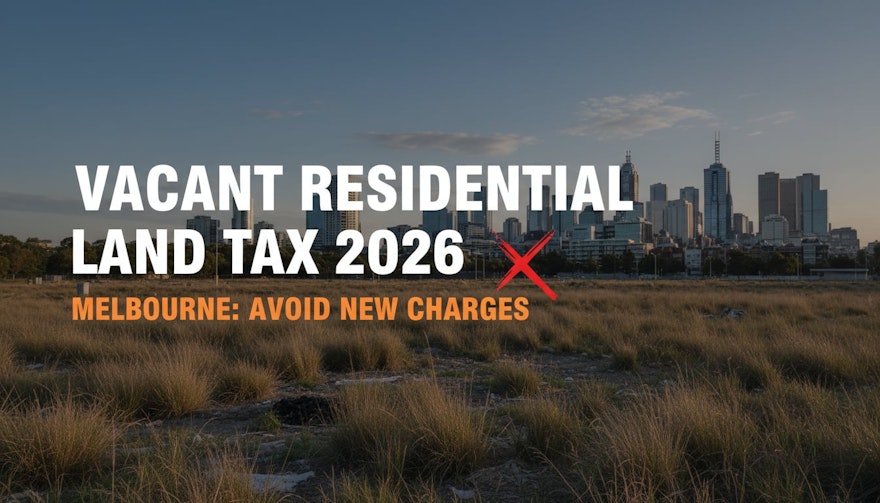
If you’ve ever stood on a windy Saturday morning kerb in Melbourne, looking at a block you’re ‘definitely’ going to build on one day, you’ll know how fast the years slide by. Plans change. Builders get booked out. A planning question lands, then another. Before you know it, the land is still sitting there, and a new tax is on the horizon.
From 1 January 2026, Victoria’s vacant residential land tax (VRLT) is set to catch a wider group of owners: certain undeveloped land in metropolitan Melbourne that has remained undeveloped for a continuous period of five years or more, where the land is capable of residential development. The five year period can run before 1 January 2026, so long held sites are very much in the frame.
This is general information only, not legal advice. The details can turn on zoning, ownership, and what has really happened on the land. Still, a clear overview can save a lot of stress.
VRLT in plain words
VRLT is an annual Victorian tax aimed at pushing residential land back into use. It’s assessed by looking at how the land was used in the previous calendar year. So what you did (or didn’t do) in 2025 can lead to an assessment in 2026.
VRLT sits alongside the usual holding costs, including your land tax obligations. Investors often plan for stamp duty and the loan, then get caught off guard by ongoing taxes that follow ownership.
What changes in 2026 for vacant land
Many people link VRLT with empty homes. The 2026 change brings a new category into play: certain undeveloped land in metropolitan Melbourne.
VRLT can apply from 1 January 2026 where land:
is in a zone other than a non-residential zone
is capable of residential development, and
has remained undeveloped for a continuous period of five years or more.
Two details matter.
‘Undeveloped’ is wider than you might expect. It can be a bare block. It can also be land with a residence that is partly built but has not been occupied. So ‘we’ve started building’ doesn’t automatically take the site out of the VRLT net.
The five year period may already be running. If the land has been sitting there since 2020 with no real progress, it may already meet the test.
‘Capable of residential development’: the hidden trap
Investors often look only at the headline zoning and assume they’re safe if the land is mixed use or has a commercial flavour. VRLT looks at whether the land is capable of residential development, and the zoning test is framed as ‘a zone other than a non-residential zone’. That can bring in land where residential use is permitted, even if other uses are permitted too.
On the flip side, some sites have real constraints: a restrictive covenant, an environmental issue, a right of way that makes access messy, or planning controls that leave no workable building envelope. Where land is genuinely not capable of residential development, there may be an exemption, but you’ll want proper evidence rather than a hunch.
If you’re buying, treat this as part of property due diligence. It’s not only about the title and the building envelope. It’s also about whether the site is developable in the way VRLT expects, and whether you’re stepping into a ticking five year clock.
How the tax is calculated, and why it bites
VRLT is calculated as a percentage of your land’s capital improved value (the value used for land based state assessments). The percentage can rise when the same land stays liable in consecutive years. Current settings use progressive rates: one per cent in the first year, then two per cent in the second consecutive year, and three per cent in the third consecutive year.
Even at one per cent, Melbourne land values make it feel sharp. On a block assessed at $500,000, one per cent is $5,000. If it stays liable year after year, the percentage can rise, which can turn a ‘patient’ holding into a pricey one.
This is also part of the bigger picture of Victorian property tax obligations that investors need to budget for across the life of a property, not just at purchase.
Practical ways to avoid the new charges
There’s no magic workaround. The safest position is that the land is not caught, or it’s covered by a genuine exemption, and you can prove it.
Get the site moving, not just planned
If you’ve held a site for years and the intention has always been to build, VRLT is a prompt to turn ‘one day’ into a real timeline.
That often starts with:
getting town planning advice
lodging a genuine planning permit application where needed
sorting title issues, easements and services early.
From 2026, there is also an exemption linked to land with a residence that was under construction, under renovation, or uninhabitable at any time during the previous year. It can help where a build has started and then stalled. It still calls for real permits and real work. A token job is unlikely to hold up if the State Revenue Office asks questions.
Check whether the five year period has been broken
The undeveloped land rule looks for a continuous five year period. In some situations, a genuine change in ownership can break that period.
This is where people can get burned by assumptions. Transfers inside families, trust changes, and restructures can have tax and conveyancing consequences beyond VRLT. If you’re considering a sale or a restructure mainly to manage tax exposure, get advice before you move pieces around.
Land that can’t be developed for residential use
If the land is truly not capable of residential development, there may be an exemption. This comes down to evidence: planning advice, council correspondence, reports, and formal documents showing the barrier to lawful residential development.
We’ve seen this play out with narrow lots in the inner suburbs, blocks affected by overlays, and sites where covenants restrict what can be built. The earlier you uncover those issues, the easier it is to plan your next step.
Adjoining land next to your home (or a holiday home)
If you own a home and an adjoining piece of undeveloped residential land used for private enjoyment, there can be an exemption. Think of the extra lot next door used as a garden or for a pool, not as a separate investment.
A genuine holiday home can also be exempt where you or close relatives use it for at least four weeks in a calendar year, and from 2026 adjoining undeveloped land can be exempt in certain circumstances. Keep records. A simple diary of stays is often the easiest start.
Work accommodation
There is an exemption for a property used by an owner (or certain beneficiaries) for work purposes, where it is used for at least 140 days in a calendar year to attend a workplace in Victoria, and the person has a home in Australia. This tends to be relevant where an owner keeps a small city base, not where they hold a bare block.
The notification deadline: don’t miss 15 February
If you own vacant residential land, you’re expected to notify the State Revenue Office by 15 February, including where you believe an exemption applies. This deadline catches people who assume exemptions ‘just apply’ without paperwork.
A few practical tips:
If you own property under different ownerships (for example, in your name and in a trust), expect separate notifications.
Keep records that support any exemption claim for five years.
If your circumstances change, don’t assume an old notification covers the new position.
If you’re preparing for settlement, it also helps to understand how taxes and outgoings are adjusted. Investors often forget the everyday outgoings like council rates until they appear on an adjustment statement.
Melbourne examples that tend to trigger questions
The inner north ‘one day we’ll develop it’ block. Bought in 2019 or 2020, sitting behind a fence near the tram line. No permits lodged, no real movement. These sites can be at risk because the five year test can already be met.
The growth corridor lot put on pause. A block in Casey, Cardinia or Melton that was meant to be a build and sell, but the build never started. This is where a clear development plan, or a clear exemption position, matters.
The half built job. Demolition done, slab poured, then the builder disappeared. People assume ‘we started’ ends the risk. It might not. If the residence has not been occupied, the land can still fall within the undeveloped category, so it’s worth getting advice on what exemption may apply for the relevant year and what proof you’ll need.
Buying and selling with VRLT in the background
If you’re buying a vacant block or a site with a demolished dwelling, you want to know what you’re stepping into. A contract review can help flag whether there are outstanding issues and whether the land is likely to be within the VRLT net.
Stamp duty relief is a separate topic. For buyers who qualify, first home buyer concessions can ease the up front cost of buying. They don’t remove VRLT if the land later sits unused, and they don’t replace the need to plan for ongoing holding costs.
On the selling side, outstanding state taxes can affect clearance processes and settlement planning, so it pays to get your documents in order early.
A calm next step if you’re worried
If this is ringing a bell, start with three questions:
Is the land in one of the 31 metropolitan Melbourne councils?
Has it stayed undeveloped for a continuous five year stretch, or is it heading that way?
If it is caught, which exemption fits your facts, and what documents can you point to?
That’s where good conveyancing support can take the pressure off.
Talk to Pearson Chambers Conveyancing
If you’re holding vacant land, buying a development site, or selling a property that might be caught by VRLT, get in touch with Pearson Chambers Conveyancing. We can talk you through the practical steps and, where a contract is involved, we offer a complimentary Section 32 contract review so you know what you’re signing and what you’re taking on.
Email contact@pearsonchambers.com.au.
This article is general information only and isn’t legal advice.