![[object Object]](https://umsousercontent.com/lib_lphGCikIbVHjRWIV/w8mzrofmgaa9b3om.png?w=52)
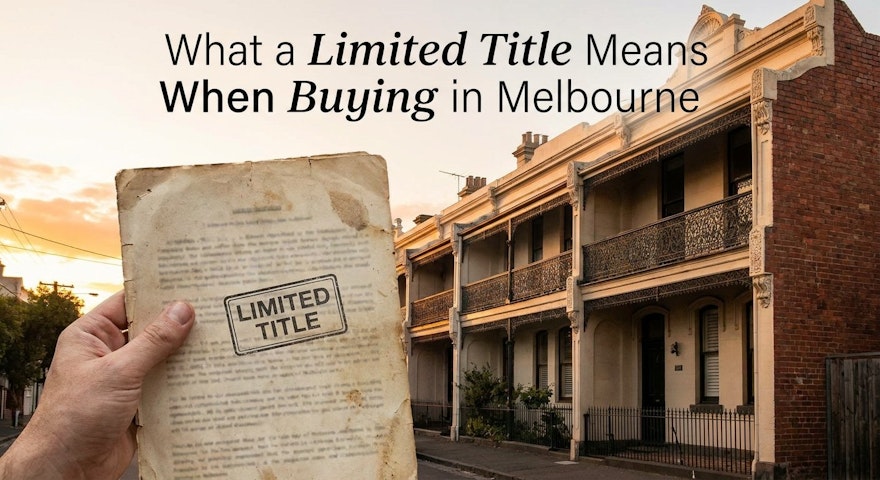
We wrote this because the words ‘limited title’ can make an otherwise straightforward Melbourne purchase feel suddenly risky. It’s a recurring question when buyers review the title for an older terrace, worker’s cottage or weatherboard home before making an offer.
The short answer: In Victoria, ‘limited title’ commonly refers to a provisional folio carrying a warning about title dimensions, subsisting interests or both under the Transfer of Land Act 1958. The property can still be transferred and mortgaged, but the warning narrows the protection usually associated with registration. Under section 26Y, a provisional folio becomes an ordinary folio 15 years after creation; before that point, the registered proprietor may seek removal of a dimensions warning under section 26P using a licensed surveyor’s plan.
What is a limited title in Victoria?
A limited title means the Victorian Register doesn’t fully confirm one part of the title’s history or boundaries. The more precise Victorian terms are ‘provisional folio’, ‘warning as to dimensions’ and ‘warning as to subsisting interests’.
The warning doesn’t automatically stop a sale or mortgage. It identifies a specific issue that hasn’t received the same investigation as it would on an ordinary folio, so the buyer needs to understand it before signing.
Why do some Melbourne properties have a limited title?
Most limited titles began when land moved from Victoria’s old general law deed system onto the modern Register. Where that conversion happened without a fresh survey or full investigation of the old documents, the Registrar could create a provisional folio and record a warning.
These titles are more likely on older land in established suburbs such as Fitzroy, Carlton, Collingwood, Richmond, Footscray and Williamstown. A period house doesn’t prove the title is limited, but early subdivisions make the warning less surprising.
What does a warning as to dimensions mean?
A warning as to dimensions means the measurements shown came from the old general law description and weren’t based on survey information investigated by the Registrar of Titles. Put simply, the paper measurements may never have been checked against the fences, walls, laneways and buildings on the ground.
An old fence isn’t automatically the legal boundary. It may have been replaced off line, or a laneway or side strip may have been treated as part of one property for years. The Fifth Schedule distinguishes this dimensions warning from a warning about older interests.
What does a warning as to subsisting interests mean?
A warning as to subsisting interests means the title was based on general law documents the Registrar didn’t fully investigate. An older mortgage, easement or other interest may still matter, so your conveyancer should check the folio history, the 15-year rule and any supporting documents rather than guessing.
Does a limited title matter when buying a Melbourne property?
Yes, but the practical risk depends on the warning, the folio’s age and what’s happening on the land. Many established-home purchases can proceed once those points are understood.
1. The fences may not match the title
A dimensions warning means the occupied boundaries may not precisely match the title description. Any difference could affect a driveway, side path, garage or future extension.
Where the site looks inconsistent with the title diagram, a licensed surveyor can carry out a title re-establishment survey. That survey can show whether there is a genuine boundary encroachment rather than relying on where the fence happens to sit.
2. The usual title protection has an important exception
Section 26K deals with warnings on provisional folios. Where land was incorrectly included because parcels or boundaries were wrongly described, registration doesn’t simply defeat every competing interest in that land. In everyday terms, buying the property doesn’t automatically turn a mistakenly included strip into yours.
3. Subdivision plans need early checking
Section 26L generally prevents land in a provisional folio from being subdivided or consolidated while it remains in that folio. There is an exception where the folio contains only the statutory dimensions warning, but buyers planning a dual occupancy, townhouse development or boundary realignment should have the exact folio status checked before signing.
4. Your lender may ask questions
A limited title doesn’t automatically prevent finance, but lender and valuer requirements vary. They may want the warning explained, a survey or confirmation that the 15-year rule has applied, so raise it early.
5. Your renovation plans can change the risk
A warning matters more when you plan to build close to a side boundary, widen a driveway, replace a garage or subdivide. A small discrepancy that has caused no trouble for an established home may become a large problem once architectural plans depend on every centimetre.
What is the 15-year rule for a provisional folio?
Section 26Y says a provisional folio becomes an ordinary folio 15 years after it was created, unless an ordinary folio has already been created. Land Use Victoria has also explained that warnings remaining on older folios or diagram sources may be historical and no longer have legal effect once the 15-year period has passed.
No survey occurs on the 15-year anniversary. The legal status changes, but the fence stays where it was. Your conveyancer should check the creation date, and a survey may still be worthwhile where the physical boundary matters.
How can a limited title warning be removed?
Before the 15-year period expires, the registered proprietor may apply under section 26P to remove a warning relating to title dimensions. The application must include a plan of survey, with field records, certified by a licensed surveyor. The Registrar may remove the warning after being satisfied that the surveyed land represents the land genuinely occupied under the provisional folio.
Once 15 years has elapsed, Land Use Victoria says a section 26P application won’t be accepted because the folio has become ordinary and the warning no longer has effect. If there is still a real boundary discrepancy, a different boundary amendment process may be needed.
Further work is more likely to be worthwhile when a fence looks wrong, boundary works or subdivision are planned, or a neighbour has raised a concern. It isn’t an automatic pre-settlement job for every buyer.
What should your conveyancer check before you sign?
Your conveyancer should identify the warning, check the folio’s age and compare the title documents with the property you inspected. A proper title search is the starting point.
The practical review usually includes:
- Reading the current register search statement. Is the folio provisional or ordinary, and which warning appears?
- Checking the creation date. Has the 15-year rule already taken effect?
- Comparing the title plan with the Section 32. Do the lot shape, measurements, easements and access points line up?
- Looking at the physical occupation. Are fences, garages, driveways or retaining walls hard against a questionable boundary?
- Confirming finance requirements. Does the lender or valuer want a survey or further explanation?
- Protecting the buyer before commitment. In a private sale, that may mean negotiating a survey condition. Before auction, the investigation needs to happen before bidding because the contract can’t be made conditional after the hammer falls. Our guide on using a conveyancer before an auction explains why timing matters.
In our practice, we’ve seen buyers assume the word ‘warning’ means the property is unsaleable. Often the issue is narrower: an old-deed conversion that calls for interpretation, with a survey only where the site or the buyer’s plans justify it.
Title insurance may cover some unknown risks, depending on the policy, but it doesn’t replace a survey for a visible or known concern.
Frequently asked questions
What is a limited title in Victoria?
A limited title commonly means a Victorian provisional folio with a warning about dimensions, subsisting interests or both. It usually arose when general law land was converted without a complete survey or investigation, but it doesn’t automatically prevent a sale or mortgage.
Can I get a mortgage on a limited title property?
Often, yes, but lender requirements vary. The bank or valuer may ask for an explanation, confirmation that the 15-year rule has applied or a survey, so raise the issue before making an unconditional offer.
Does a limited title reduce a property’s value?
Not automatically. Value is more likely to be affected when the warning points to an unresolved boundary problem, interferes with future development or creates lender concern. An established home with settled occupation may still sell normally once the title position is understood.
How do I remove a limited title warning in Victoria?
Before the provisional folio becomes ordinary, the registered proprietor may use the section 26P process for a dimensions warning, supported by a plan certified by a licensed surveyor. After 15 years, the warning may already have lost effect under section 26Y, so the correct next step depends on whether there is an actual boundary issue to fix.
Is a limited title the same as a provisional folio?
They’re closely related, but ‘provisional folio’ is the more precise Victorian term. ‘Limited title’ is common shorthand for a folio where the Registrar’s investigation or guarantee is qualified by a warning. The exact wording on the current register search statement is what matters.
Should I get a survey before buying a limited title home?
Not every limited title requires a survey. A survey is more useful where fences look inconsistent with the plan, structures sit close to boundaries, the block is narrow or irregular, or you plan building or subdivision works. Ask before signing, and certainly before bidding at auction.
About the Pearson Chambers Conveyancing team
Pearson Chambers Conveyancing is a Melbourne-focused conveyancing team that helps Victorian buyers, including first home buyers, understand contracts and complete settlements every day. We review titles, plans, Section 32 vendor statements and unusual folio notations in plain English. Working out what a limited title warning means for the particular property is part of the team’s day-to-day contract review work.
Sources we consulted
- Transfer of Land Act 1958 (Vic)
- Property and land titles information, Land Use Victoria
- Customer information bulletin 187, Land Use Victoria
- Due diligence checklist for home and residential property buyers, Consumer Affairs Victoria
Worried about a limited title warning?
Send the contract and Section 32 to Pearson Chambers Conveyancing before you sign or bid. Our free Section 32 and contract review can help you understand whether the warning is historical, routine or a reason to arrange further checks.
Email contact@pearsonchambers.com.au.
General information only, current as at the date of publication. Victorian conveyancing rules and legislation change frequently. Please contact the Pearson Chambers Conveyancing team for advice on your specific contract.