![[object Object]](https://umsousercontent.com/lib_lphGCikIbVHjRWIV/w8mzrofmgaa9b3om.png?w=52)
You’ve done the Saturdays. The packed opens. The coffee in one hand, phone in the other, refreshing listings on the 59 tram ride home. Then you finally land a place, maybe a weatherboard in the inner north or a tidy townhouse out in the middle ring. You negotiate hard, sign the contract, pay the deposit, and start picturing where the sofa will go.
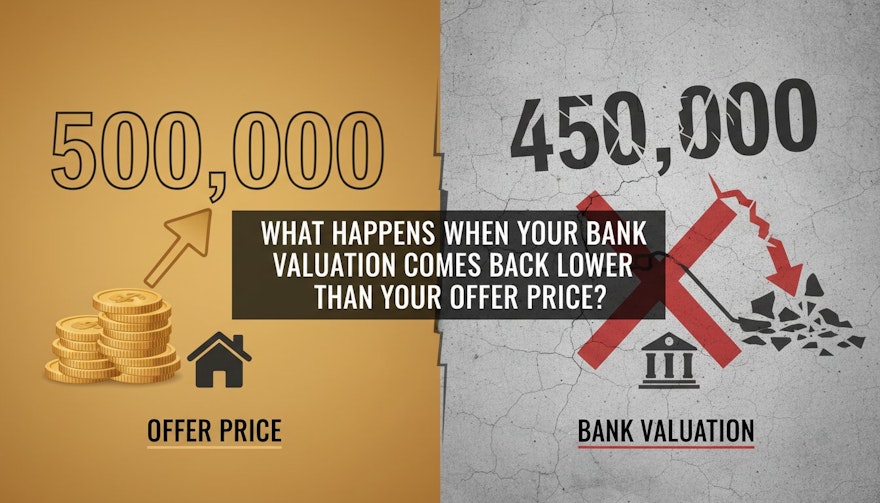
Then your broker calls: the bank’s valuation has come in lower than what you’ve agreed to pay.
It’s a gut punch moment. People often describe it as feeling like the ground shifts under their feet. You haven’t changed your mind, the vendor hasn’t changed the deal, and yet the money you expected to borrow has suddenly shrunk.
Let’s walk through what it means in real terms, what it can do to your contract, and what you can do next.
What a low valuation actually changes
When a lender values the property, they’re deciding what it’s worth as security for the loan. If their valuer says the home is worth less than your offer price, the lender usually bases the loan amount on the lower figure.
So the issue isn’t that you can’t buy the property. It’s that the funding plan you thought you had may no longer stack up.
Here’s a simple example.
Purchase price: $850,000
Bank valuation: $800,000
Your loan: 80% loan to value ratio
You might have expected to borrow 80% of $850,000, which is $680,000. If the bank uses the $800,000 valuation, 80% is $640,000.
That leaves a $40,000 gap, and it’s on top of whatever deposit you were already putting in.
For many buyers, it’s not the size of the gap that hurts most. It’s the timing. You’re suddenly trying to find extra funds while your contract clock keeps ticking.
Why banks can come in low in Melbourne
A bank valuation isn’t a “what would buyers pay on a sunny Saturday” assessment. It’s usually cautious, sales driven, and anchored to comparable results.
A few Melbourne patterns show up again and again:
Auctions push prices beyond recent sales
Auction competition can move faster than comparable sales data. If the last similar home in your street sold three months ago for less, the valuer may lean on that.
Unique homes are hard to compare
A renovated Victorian terrace in Brunswick with a studio out the back, or a split level in Northcote with a clever extension, can be tricky to match. Valuers don’t love “one of a kind” when they need clear comparisons.
The market shifts between signing and valuation
Even a short run of softer sales can affect what a valuer is willing to support, especially if listings are sitting longer than they were a season ago.
Off the plan and some apartments can be stricter
With certain apartments (particularly where there are many similar units in the same building), valuers can be conservative if nearby sales don’t back up the contract price.
None of this means you’ve done something wrong. It means the bank is protecting itself first, and you’re left to bridge the difference.
Where this hits your contract (and why timing matters)
A low valuation becomes a legal problem when it threatens your ability to settle on time.
What matters most is what you signed, and what deadlines you’re now up against.
If you have a finance condition
If your contract is conditional on finance, your subject to finance clause may give you a pathway to ask for more time, renegotiate, or end the contract if you can’t get approval on the terms set out.
The detail matters. Some finance conditions require you to apply promptly, take genuine steps to obtain finance, and give written notice by a specific date. Miss that date, or handle it casually, and you can lose the protection you thought you had.
If you bought at auction (or close to auction conditions)
Auction purchases in Victoria are commonly treated like unconditional offers, meaning there’s usually no finance condition to fall back on. If your valuation comes in low after an auction, you’re often left solving the shortfall rather than stepping away.
That’s why low valuations after auction can feel so brutal. The contract doesn’t pause while you regroup.
If you’re worried about this scenario, it’s also worth reading about what can happen when finance falls through after auction, because valuation shortfalls are one of the ways buyers end up under real pressure.
Cooling off isn’t a reliable back up plan
In Victoria, cooling off rights exist for many private sales, but there are key exceptions and costs. It’s not something to bank on when a valuation comes in short, especially if you’re anywhere near auction timing or buying through certain structures.
The better move is to focus on your contract conditions and act quickly.
The first steps to take (before the panic sets in)
When people hear “low valuation”, they often jump straight to “I need another lender” or “I need to renegotiate”. Those can be options, but start with these three moves:
Get the numbers in writing
Ask your broker or lender for the valuation figure and any notes the valuer has provided. You’re looking for what they relied on, and what they may have missed.
Work out the exact shortfall
Don’t guess. Calculate the difference between what you can borrow at the valuation figure and what you need to settle at the contract price. Include any changes to lender’s mortgage insurance if your loan to value ratio shifts.
Check your contract dates immediately
Find the finance date (if you have one), the settlement date, and any special conditions about extensions or notices. If you’re not sure what you’re looking at, this is where a conveyancer earns their keep.
In practice, speed matters. Not because you should rush into bad decisions, but because many solutions need time, and time is often what you don’t have.
Your options when the valuation is low
There isn’t one “right” answer. The best path depends on your contract, your funds, and how flexible the vendor is willing to be. Here are the main options buyers use, and what to watch for.
Ask for a valuation review (and do it properly)
A valuation can sometimes be reconsidered, especially if the valuer missed a strong comparable sale, a key renovation, or a feature that genuinely affects value.
A review has the best chance when you can provide:
recent comparable sales that are genuinely similar (not just the nicest home in the suburb)
evidence of improvements that are permanent and approved (think structural renovation rather than styling)
clear details that affect value, like land size, car access, orientation, or a well run owners corporation for an apartment
Your selling agent may help with comparable sales, but your broker is often the one who knows what will actually move the needle with the lender.
A review won’t always change the result, and it may only shift it slightly. Even a small change, though, can reduce the gap enough to make your loan workable.
Try another lender (without losing your footing)
Different lenders can have different valuers, panels, and appetites. A second valuation might come back closer to your contract price.
The trade off is time and process. New applications, documents, and credit checks can chew up days quickly, and you may need to negotiate an extension if settlement is near.
If you’re taking this path, keep your conveyancer involved so you don’t accidentally breach the contract while you chase a better valuation.
Cover the shortfall with extra funds
Sometimes the simplest fix is the hardest one: you add more cash.
Buyers fund the gap in different ways:
savings set aside as a buffer
equity from another property (where available)
family support (gift or loan)
restructuring the deposit plan across accounts
Be careful with last minute family arrangements. If it’s a loan, the lender may want to see it documented. If it’s a gift, the lender may want a declaration. If it’s money arriving late, it can affect settlement timing.
Also remember that some costs don’t shrink just because a valuation is low. Stamp duty is based on the purchase price set out in the contract, not the bank’s valuation.
Adjust the loan structure
Depending on your circumstances, your broker may talk to you about options like lender’s mortgage insurance, a guarantor arrangement, or changing the loan to value ratio target.
These choices can help bridge a gap, but they can also increase risk for you or your family. A guarantor option, for example, can involve a family member offering their property as extra security. That’s not a quick “tick the box” solution. Everyone needs to understand what’s on the line.
Renegotiate the price or terms with the vendor
If the valuation is genuinely out of step with the market, renegotiation may be possible, especially in a private sale where the vendor is motivated and doesn’t want the property back on the market.
This is where the way you approach the conversation matters. Going in with “the bank says it’s worth less, so you have to drop the price” usually gets backs up.
A calmer approach is to explain:
the lender will only fund based on the lower figure
you’re committed to buying, but the finance gap is real
the same issue may affect the next buyer too, especially if they’re borrowing
If you’re early in the purchase journey, it helps to understand the basics of making an offer on a house, because smart negotiation starts well before you’re under stress.
Sometimes the solution isn’t a price drop. It might be an extension to your finance date, a longer settlement so you can reshuffle funds, or a smaller adjustment that makes the deal workable for both sides.
Use your finance condition to end the contract (where available)
If your contract is subject to finance and you genuinely can’t obtain approval on the required terms due to the valuation, you may be able to end the contract by following the notice requirements.
This is not a casual “text the agent and walk away” situation. The contract usually sets out how notice must be given and by when. You also need to be able to show you took real steps to obtain finance.
Handled well, a finance condition can protect you. Handled poorly, it can leave you exposed.
What can go wrong if you get this wrong
Low valuations become expensive when buyers assume they’re protected and stop paying attention to the contract mechanics.
A few traps we see:
Letting the finance date pass while you ‘wait and see’
People hope the bank will reconsider, or the broker will find a magic solution. Meanwhile the deadline passes. Suddenly the contract is unconditional and the stress jumps.
Treating auction like a normal purchase
Many buyers plan as if they’ll have time to sort finance after signing. Auctions rarely work that way.
Focusing only on the shortfall and forgetting settlement logistics
Even if you can scrape together the funds, you still need them available in time, in a form the lender accepts, with documents done, and transfer arrangements ready for settlement.
Not thinking about the costs if the deal collapses
If a purchase falls over, there can still be expenses: loan application costs, building inspections, and professional fees. It’s worth understanding conveyancing fees if sale falls through so you’re not caught off guard while you’re already disappointed.
A few Melbourne scenarios that make valuations tricky
You don’t need to have done something reckless for this to happen. Plenty of sensible buyers get caught by valuation quirks.
The renovated inner north classic
Two similar terraces, same street, but one has a deep extension and a proper second living zone. The buyer pays the premium because they can see the value. The valuer leans on older sales that don’t reflect the upgrade.
The off the plan apartment timing gap
A buyer signs last year, the market softens a touch, and now the bank values based on current comparable sales, not the contract price agreed months earlier.
The “it’s the only one like it” home
A property with an unusual layout, a steep block, or a studio above the garage can be perfect for the right buyer. It can still be hard to value.
How to reduce the risk before you sign
You can’t control the valuer, but you can set yourself up so a low valuation doesn’t become a crisis.
A few habits that help:
Get the Section 32 and contract reviewed before you sign, so you know what protection you do and don’t have.
Keep a buffer. Even a small reserve can take the pressure off if a gap appears.
Don’t treat pre approval as a guarantee. Pre approval is about you; valuation is about the property.
When you’re bidding at auction, set a ceiling that still makes sense if the bank comes in a bit conservative.
If you’re buying an apartment or off the plan, be extra cautious about how valuations can behave.
What to do if your valuation has already come back low
If you’re in this situation now, here’s a steady way to move forward:
Today: confirm the valuation figure, calculate the gap, and check your contract dates.
Next few days: ask your broker about a review and alternative lenders, and get advice on whether an extension is needed.
At the same time: speak with your conveyancer about your finance condition (if you have one) and the safest way to communicate with the agent and vendor.
Most people feel embarrassed when this happens, as if they’ve misread the market. Don’t. Valuations are cautious by design. What matters is how you respond, and whether you protect your deposit and your position under the contract.
We can review your contract and help you make the next call
Every contract has its own deadlines and special conditions, and the right move depends on what you’ve signed and where you’re up to in the process.
If your bank valuation has come back low, or you want to reduce the risk before you sign, contact Pearson Chambers Conveyancing for a complimentary Section 32 contract review. We’ll help you understand your options and the steps that protect you.
Email contact@pearsonchambers.com.au.
This information is general only and isn’t legal advice.