![[object Object]](https://umsousercontent.com/lib_lphGCikIbVHjRWIV/w8mzrofmgaa9b3om.png?w=52)
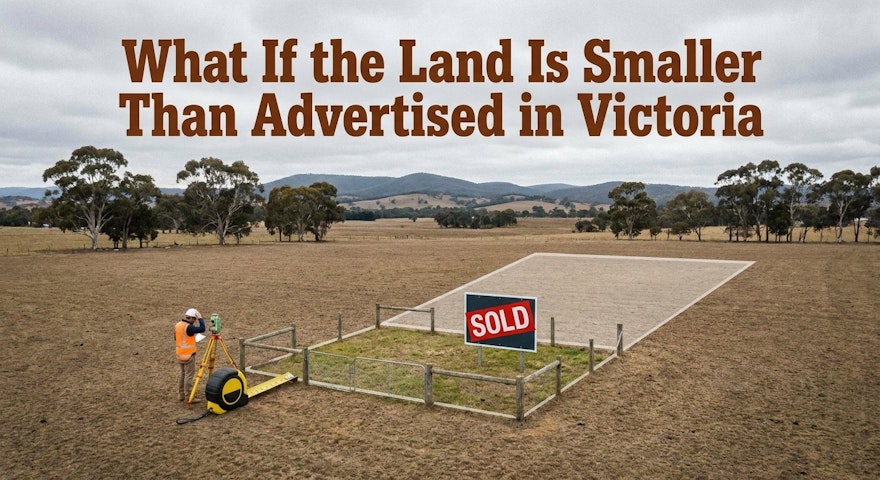
In Victoria, rely on the Certificate of Title and registered Plan of Subdivision, not the agent’s brochure, because General Condition 7 in the standard LIV/REIV contract usually stops a buyer claiming compensation for a deficiency in area. A serious shortfall may still justify rescission if the property is materially different from what was sold, and private-sale buyers may also have three clear business days to cool off under section 31 of the Sale of Land Act 1962, with the vendor keeping the greater of $100 or 0.2 per cent of the price. Check the title and plan before you sign, especially before an auction.
Is the advertised land size legally binding in Victoria?
The advertised land size is usually marketing, not the legal description of what you’re buying. The legal land is the parcel described on the title, by volume and folio, lot number and plan number.
That matters because listings often round numbers. A property in Reservoir might be promoted as ‘about 600 sqm’ when the title plan shows 558 sqm. A townhouse courtyard in Brunswick might look private at inspection, but part of the area may be common property or affected by an easement. A block in Melbourne’s outer suburbs might include a driveway or drainage area in the quoted figure, even though that space is not useful backyard land.
The safest check is to order or review a current title search, then read it with the plan attached to the Section 32 vendor statement. The listing tells you what caught your eye. The title and plan tell you what you are actually buying.
Where do you find the true land area?
The true land area is found by reading the Certificate of Title with the registered Plan of Subdivision. The plan usually shows the lot area, boundary dimensions, easements, restrictions and any common property.
For a standalone house, the plan may be fairly simple. For a unit, townhouse or apartment, it can be trickier. You may need to check whether a courtyard, car space, storage cage, balcony, garden strip or shared driveway is part of your lot, part of common property, or a separate accessory lot.
This is also where buyers need to separate two different problems. A smaller paper area means the registered lot is smaller than the listing suggested. A boundary problem means the physical fences or buildings do not match the legal boundary. If the issue is physical, such as a neighbour’s garage sitting across the boundary, your conveyancer may suggest a re-establishment survey by a licensed surveyor.
What does the Victorian contract say about smaller land size?
The standard Victorian Contract of Sale of Land usually gives the vendor strong protection for small area mistakes. General Condition 7, often called ‘Identity of the land’, says an omission, mistake or deficiency in the area, description or measurements of the land does not invalidate the sale.
In plain English, that means a buyer usually cannot point to a small difference in square metres and demand money back. The condition also commonly prevents the buyer from objecting, claiming compensation, or forcing the vendor to amend title because of that deficiency.
Older articles sometimes call this clause General Condition 3, because that was its number under an earlier standard form. If you’re reviewing a current LIV/REIV contract, look for General Condition 7 instead. The wording is there to remind buyers of a practical truth: check the title and plan before you sign, not after settlement.
Can you cancel the contract if the land is smaller than advertised?
You may be able to cancel if the shortfall is material enough that the property is not, in substance, what you agreed to buy. This comes from the rule often linked to Flight v Booth, which can apply where the misdescription changes the subject matter of the contract.
There is no magic percentage. A shortfall of one or two square metres on a large suburban block is unlikely to matter. A smaller percentage may matter if the missing land is the very part you cared about, such as the only usable rear yard, the planned car space, or the area needed for a future extension.
Think of it this way. Losing a thin strip behind a fence line may not change the purchase in any real way. Losing enough backyard to affect a planned unit development in Coburg, or finding that the private courtyard of an off-the-plan apartment is smaller than represented, is a different conversation.
The key question is not just ‘how many square metres are missing?’ It is ‘would a reasonable buyer still say this is the same property bargain?’
What should you do before signing?
Before signing, compare the listing, contract, title, plan and Section 32. This is the moment when the problem is easiest to fix, because you still have choice and bargaining power.
A practical pre-signing check looks like this:
- Check the land description in the contract particulars.
- Match the volume, folio, lot and plan number against the title.
- Read the plan for the lot area, boundary dimensions and easements.
- Compare the plan with the agent’s brochure and floor plan.
- Ask whether any courtyard, car space, driveway or storage area is common property.
- Raise any mismatch with your conveyancer before auction or before signing a private-sale contract.
In our practice, we’ve seen this come up most often where an advertised area was rounded up, or where a buyer assumed every fenced space was theirs. Sometimes the difference is harmless. Sometimes it changes the feel of the property, especially for buyers who need space for a dog, a second car, or a future extension.
What if you discover the problem after signing?
If you bought by private sale, move fast. The Victorian cooling-off period is three clear business days from when you sign, and it can be the cleanest way to step away if the size problem worries you.
Cooling off comes at a cost. The vendor may keep the greater of $100 or 0.2 per cent of the purchase price. That can still be far cheaper than being locked into the wrong property.
Cooling off does not apply to every purchase. It does not apply if you buy at auction, or within three clear business days before or after a public auction. That is why Melbourne auction buyers should have the contract, title and plan checked before they bid. Once the hammer falls, the usual safety net is gone.
If cooling off is not available or has passed, speak to your conveyancer urgently. You may need advice about whether the shortfall is serious enough to justify rescission, whether the vendor gave a misleading description, or whether the better move is negotiation.
What if the property is off the plan?
Off-the-plan buyers have a separate statutory protection when the plan changes. Under section 9AC of the Sale of Land Act 1962, a vendor must notify the buyer of certain amendments to the plan of subdivision, and the buyer may have a right to rescind if the change materially affects the lot.
This is where off-the-plan buyer rights matter. Developers often include tolerance clauses allowing some movement in area, commonly expressed as a percentage. A tolerance clause does not mean every change is harmless. The effect of the change still matters.
For example, a Southbank apartment that loses usable living space, balcony depth or a car space arrangement may feel very different from the plan you signed. The notice from the developer is the trigger to get advice, because time limits can be tight.
Can the agent be responsible for the wrong land size?
An agent may be exposed if the advertised size was misleading, but that is usually a separate issue from conveyancing under the contract. A misleading conduct complaint or claim depends on what was said, whether it was wrong, whether you relied on it, and what loss followed.
For buyers, the first priority is usually practical: check the documents, protect the cooling-off window, and decide whether the contract itself gives you a path out. If the agent’s advertising caused real loss, your conveyancer can point you towards the right next step, which may involve a lawyer.
How do you reduce the risk as a Melbourne buyer?
The best protection is to check the title and plan before your offer becomes binding. Do not rely on a floor plan, brochure, agent estimate or old real estate listing, especially where land size is one of the reasons you’re buying.
Be extra careful if:
- the listing uses words like ‘approx.’ or ‘about’
- the block is irregularly shaped
- the property has a shared driveway
- a townhouse includes courtyards or common property
- the title shows easements
- you are buying off the plan
- you are bidding at auction
- the land size affects future renovation, subdivision or parking plans
A contract review before signing can save weeks of stress later. It gives you a clear answer while you still have room to move.
Frequently asked questions
Can I get out of a contract if the land is smaller than advertised in Victoria?
Sometimes. The standard Victorian contract usually says a deficiency in area does not let the buyer object or claim compensation, but that is not always the end of the matter. If the shortfall is material enough that the property is not really what you agreed to buy, you may have a right to rescind. Get advice quickly, because cooling-off and rescission rights depend on timing.
Where do I find the real land size when buying a property?
The real land size is found on the Certificate of Title and the registered Plan of Subdivision attached to the Section 32 vendor statement. The plan can show area, boundary dimensions, easements, restrictions and common property. The agent’s listing size is marketing, so check it against the title and plan before you sign.
What is General Condition 7 in the contract of sale?
General Condition 7 is the ‘Identity of the land’ clause in the standard Victorian Contract of Sale of Land. It generally says a mistake or deficiency in the land’s area, description or measurements does not invalidate the sale, and the buyer cannot claim compensation for it. Older material may call this General Condition 3, which was the numbering in earlier contract forms.
How much smaller does the land have to be before it matters?
There is no fixed square metre or percentage test. The issue is whether the shortfall is material, which means it changes the substance of what was sold. A small loss of unusable land may not matter, while a smaller percentage loss affecting a backyard, car space or planned extension might.
Does the cooling-off period help if I spot a size problem after signing?
Yes, if it is a private sale and you are still within time. In Victoria, eligible buyers have three clear business days after signing to cool off by written notice, with the vendor keeping the greater of $100 or 0.2 per cent of the purchase price. Cooling off does not apply to auction purchases or sales within three clear business days before or after a public auction.
Is a smaller block the same as an encroachment?
No. A smaller block is usually a title and contract issue, where the registered land area is smaller than the advertised area. An encroachment is a physical boundary issue, such as a wall, fence or garage crossing the legal boundary. A conveyancer can review the title issue, while a licensed surveyor is usually needed to confirm the physical boundary.
About the Pearson Chambers Conveyancing team
Pearson Chambers Conveyancing is a Melbourne-focused conveyancing firm helping buyers and sellers across Victoria with contracts, Section 32 statements and settlements. We work with first-home buyers, apartment purchasers, townhouse buyers and families moving between suburbs every week. Checking whether the land on the title matches the property being sold is part of what the PC team does day to day.
Sources we consulted
- Consumer Affairs Victoria, Due diligence checklist
- Consumer Affairs Victoria, Buying property by private sale
- Land Use Victoria, Plans of subdivision
- Sale of Land Act 1962 (Vic)
- Property Law Act 1958 (Vic)
Talk to us before you sign
If the land size in the listing does not match the title, or you simply want someone to check the contract before you commit, Pearson Chambers Conveyancing can help. We offer a complimentary Section 32 contract review and will explain the title, plan and contract risks in plain language.
Email: contact@pearsonchambers.com.au
General information only, current as at the date of publication. Victorian conveyancing rules and legislation change frequently. Please contact the Pearson Chambers Conveyancing team for advice on your specific contract.