![[object Object]](https://umsousercontent.com/lib_lphGCikIbVHjRWIV/w8mzrofmgaa9b3om.png?w=52)
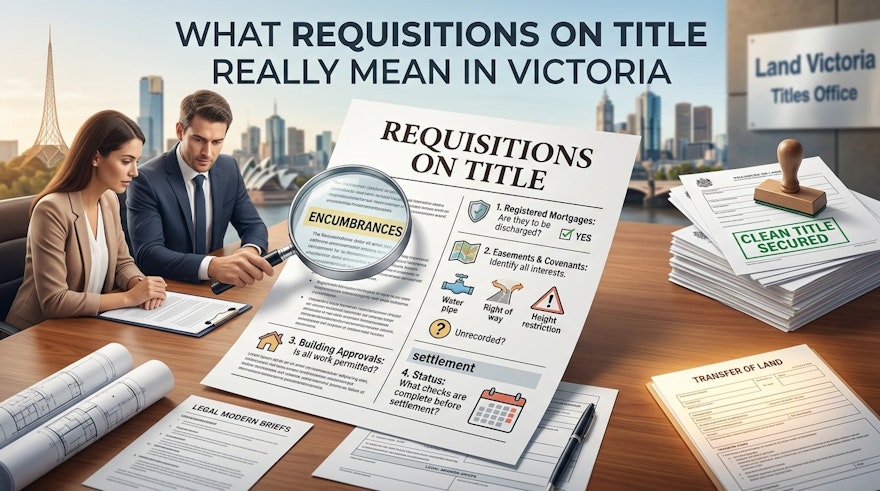
We get asked this by home buyers who have found an interstate checklist saying their conveyancer should be ‘lodging requisitions on title’ within 21 days. It sounds like something has been missed, so it’s worth clearing up.
The short answer: In Victoria, requisitions on title are formal written questions or objections about the seller’s title, but they rarely apply to ordinary home purchases now. For most Torrens title land, the standard Contract of Sale of Land replaces the old requisitions process with vendor warranties, while the Section 32 vendor statement must disclose key title information before you sign. A 21 day objection process still matters for rare general law land, not the average Melbourne house, townhouse or apartment.
What is a requisition on title?
A requisition on title is a formal question a buyer asks about the seller’s ownership and ability to transfer the land. An objection on title goes further: it says there is a defect that needs to be fixed before settlement.
The idea comes from older conveyancing, when land ownership was proved through bundles of paper deeds. A buyer’s solicitor had to trace the chain of ownership and ask careful questions to check that the seller could pass good title.
Victoria now uses the Torrens title system under the Transfer of Land Act 1958 for almost all residential land. The Victorian Register records who owns the land and what is registered against it, such as mortgages, caveats, easements and covenants. Once the Register became the main proof of ownership, long lists of requisitions lost much of their old role.
Do Victorian buyers still lodge requisitions on title?
For most Melbourne purchases, no. If you’re buying ordinary Torrens title land, the standard Victorian contract generally replaces the buyer’s right to make requisitions with the seller’s warranties.
That’s why a guide from New South Wales, or an older legal textbook, can send Victorian buyers down the wrong track. You may still hear people use the word ‘requisitions’ loosely, but the formal process is not part of a standard Torrens title purchase in the way many buyers expect.
We’ve seen this cause confusion after auctions in suburbs like Brunswick, Reservoir and Werribee, where buyers sign on a Saturday, then panic on Monday after reading a checklist that doesn’t match Victorian practice.
What replaced requisitions on title in Victoria?
Three protections now do most of the work: the Section 32 vendor statement, the contract warranties and your conveyancer’s title searches.
The Section 32 statement comes first. Under the Sale of Land Act 1962, the seller must give the buyer a signed vendor statement before the buyer signs the contract. It should include key title information, including mortgages, covenants, easements, zoning, outgoings and other property matters.
The contract warranties come next. The seller promises, in broad terms, that they have the right to sell and can transfer the property at settlement as the contract requires. Put simply, the seller must be able to hand over clean, registrable ownership, which is why buyers often ask us what clear title means in Victoria.
The third layer is practical checking. Your conveyancer reviews the title, plan, contract and vendor statement before you sign, then runs a fresh search before settlement to see whether anything new has appeared.
What does the Section 32 tell you about title?
The Section 32 is the buyer’s first real look at the legal shape of the property. It should help you see what you’re buying before you commit, not after.
A well prepared Section 32 usually includes the title search and plan, plus details about mortgages, covenants, easements, restrictions, planning matters, notices, outgoings and owners corporation details where relevant. For an apartment in Southbank or a townhouse in Coburg, that can matter just as much as the price and settlement date.
This is where hidden burdens can show up. A drainage easement may limit where you can extend. A restrictive covenant may affect future building plans. Owners corporation rules may matter if you’re buying in a larger block near the CBD.
In our practice, we’ve had clients come to us when a title looked simple at first glance, but the plan showed an easement running through the exact part of the backyard where they hoped to build. That’s not a requisition issue. It’s a pre signing review issue.
How does your conveyancer check the title now?
Your conveyancer checks the title before you sign and again before settlement. Those two checks serve different purposes.
Before signing, the aim is to understand what is already on title. Your conveyancer compares the title search, plan, Section 32 and contract to pick up mortgages, caveats, easements, covenants, notices, restrictions and mismatched details. If you’re unsure how to find encumbrances on a property, this review is where those issues usually come to light.
Before settlement, your conveyancer runs a fresh title search. That search may reveal a caveat, writ, mortgage dealing or other registration that appeared after the contract was signed. It is a simple step, but it can save a buyer from a very messy settlement day.
A workspace activity check in an electronic settlement platform is not the same as reading a current title search. If you’re comparing the conveyancing searches you actually need, a final title search sits near the top of the list.
When do requisitions and objections still matter?
Requisitions and objections still matter for rare general law land. This is land that has not been fully brought under the Torrens system.
For general law land, the standard Victorian contract keeps a specific objection process. The buyer is generally treated as accepting the seller’s title after 21 days from the day of sale unless the buyer has reasonably objected or required a defect to be fixed. If the seller can’t satisfy the objection, the contract can be brought to an end under the contract process.
Most buyers will never come across general law land, especially when buying a typical suburban house, townhouse or apartment. If it does appear, the 21 day clock needs prompt attention. That is not a place for guesswork.
What counts as a title defect?
A title defect is a problem that stops the seller from giving the buyer the title promised in the contract. It is not the same as a minor paperwork issue.
Common examples include:
- a caveat that has not been withdrawn before settlement
- a seller’s mortgage that is not ready to be discharged
- an undisclosed easement, covenant or restriction
- a person signing who is not the registered owner or properly authorised
- a deceased owner’s estate not being in order
- a serious mismatch between the plan and the land being sold.
Caveats are a common settlement headache. A caveat may be lodged by a former partner, lender, builder or other person claiming an interest in the land. If one appears late, your conveyancer may need to push the seller about removing a caveat before settlement.
What happens if the seller can’t give clear title?
If the seller can’t give the title promised at settlement, the buyer may have rights under the contract and, in some situations, under the Sale of Land Act 1962.
The right response depends on the problem. If the Section 32 was false, incomplete or not properly given, a buyer may have a rescission right under section 32K, subject to the limits in that section. If the seller simply cannot settle because a mortgage, caveat or other issue is blocking transfer, the contract’s default process may apply.
That process commonly involves a default notice giving the other side 14 days to fix the breach. If settlement is running late, buyers often hear this discussed alongside a notice to complete at settlement.
These steps are time sensitive. Don’t rely on a casual email from an agent saying, ‘It’ll be fine.’ Get your conveyancer to review the contract and the title issue properly.
What should Melbourne buyers do before signing?
The safest move is to have the Section 32 and contract reviewed before you sign, especially before an auction. Once the auctioneer’s hammer falls, the contract is usually unconditional.
Before signing, ask your conveyancer to check:
- whether the seller is the registered owner
- whether any mortgages, caveats, easements or covenants appear on title
- whether the Section 32 discloses the title issues properly
- whether the plan matches what you think you’re buying
- whether any owners corporation documents raise practical concerns
- whether special conditions shift risk onto you.
Melbourne buyers move quickly. Weekend inspections, Tuesday night contract reviews and Saturday auctions are normal here. A short review before signing can be the difference between buying with confidence and discovering a title restriction after your deposit is paid.
Frequently asked questions
What are requisitions on title in Victoria?
Requisitions on title are formal written questions a buyer raises about the seller’s ownership and ability to transfer the land. In Victoria, the standard contract usually replaces requisitions with vendor warranties for ordinary Torrens title land, so the formal process no longer applies to most home purchases.
Do I need to lodge requisitions on title when buying a house in Victoria?
For standard Torrens title land, you usually do not need to lodge requisitions on title in Victoria. The Section 32 vendor statement, contract warranties and title searches now carry most of that protective role. The 21 day objection process is mainly relevant to rare general law land.
What is the difference between a requisition and an objection on title?
A requisition is a formal question about the title, while an objection challenges a defect and asks the seller to fix it. For rare general law land, a buyer may need to raise a reasonable objection within the contract deadline to preserve their rights.
What replaced requisitions on title in Victoria?
The Section 32 vendor statement, the contract’s vendor warranties and current title searches replaced the old requisitions process for most Victorian purchases. These tools help buyers check ownership, registered interests, disclosed restrictions and the seller’s ability to transfer the property at settlement.
What happens if the seller can’t give clear title at settlement?
If the seller can’t give clear title at settlement, the buyer may be able to use the contract’s default process, which often involves a 14 day notice period. If the problem comes from a false, incomplete or missing Section 32, section 32K of the Sale of Land Act 1962 may also be relevant.
Is a title search the same as requisitions on title?
No. A title search shows what is recorded on the Victorian Register, including the owner, mortgages, caveats, covenants and other encumbrances. Requisitions are formal questions to the seller, while a title search is the practical record check your conveyancer uses before signing and settlement.
About the Pearson Chambers Conveyancing team
Pearson Chambers Conveyancing works with Melbourne buyers across apartments, townhouses, family homes and investment properties throughout Victoria. Our team reviews contracts, Section 32 statements, titles and settlement documents for first home buyers every day. Requisitions may be old language, but checking whether a seller can transfer clean, registrable title is still part of our daily work.
Sources we consulted
- Sale of Land Act 1962
- Transfer of Land Act 1958
- Consumer Affairs Victoria, Conveyancing and contracts for sellers
- Land Use Victoria, Property and land titles information
- Land Use Victoria, Land registration glossary
- Real Estate Institute of Victoria, VicForms
Need help checking the title before you sign?
If you’re buying in Melbourne or elsewhere in Victoria, Pearson Chambers Conveyancing can review your contract and Section 32 before you commit. We’ll explain what is on title, what has to be cleared before settlement, and what needs a closer look.
Contact Pearson Chambers Conveyancing for a complimentary Section 32 contract review.
Email: contact@pearsonchambers.com.au.
General information only, current as at the date of publication. Victorian conveyancing rules and legislation change frequently. Please contact the Pearson Chambers Conveyancing team for advice on your specific contract.