![[object Object]](https://umsousercontent.com/lib_lphGCikIbVHjRWIV/w8mzrofmgaa9b3om.png?w=52)
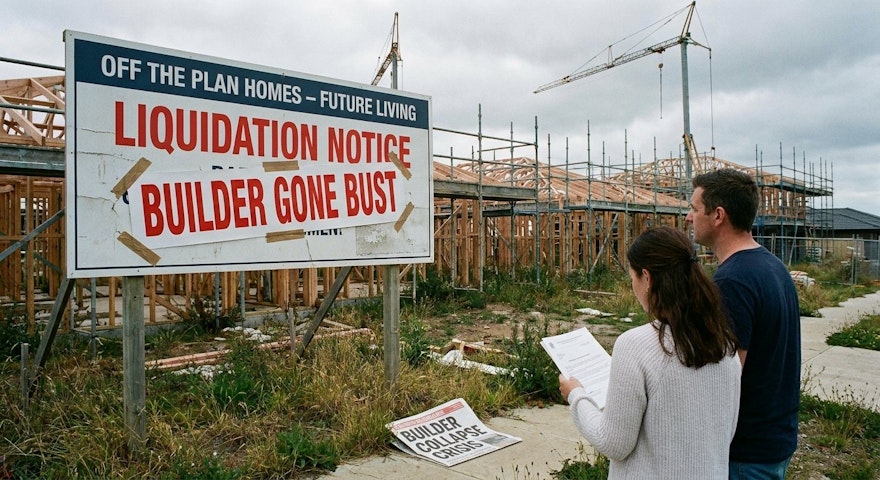
We get asked this by Melbourne buyers more often than you might think, especially people juggling delayed apartment projects, townhouse developments, or house and land packages on the city fringe. When a builder or developer falls over, the legal paperwork suddenly stops feeling abstract and starts feeling very personal.
The short answer: In Victoria, an off-the-plan deposit is usually capped at 10 per cent and held in trust, so if the contract ends it is generally outside the insolvent company's ordinary asset pool. If you signed a separate domestic building contract for work over $16,000, the builder should have taken out Domestic Building Insurance before taking any money, and an insolvency claim usually needs to be lodged within 180 day of you becoming aware of the insolvency. Whether you can end the deal straight away depends on who has collapsed, what your contract actually says, and whether the sunset date has passed.
Does builder liquidation automatically end your off-the-plan contract?
No, not always. A builder going into administration or liquidation does not automatically tear up every off-the-plan contract connected to the project.
The first question is whether your legal contract is with the builder, the developer, or both through separate documents. In plenty of Victorian projects, especially apartment developments and estate builds, the buyer signs a contract of sale with the developer and the developer separately hires the builder. If the builder collapses, the developer may still be able to appoint a replacement and keep the project moving. If the developer collapses, that is a different problem entirely.
Administration can be a rescue process, while liquidation is the winding up stage. A builder in administration may not yet be insolvent and may still continue to operate while the process plays out, so the first job is to work out which entity is in trouble and what stage it is actually in.
We've seen this catch buyers in Melbourne's growth corridors and inner north apartment projects where the glossy sales material made the whole development look like one business, but the contract trail told a different story. Pull out the contract of sale, any building contract, the deposit receipt, and the company names on each document before you assume the whole deal is dead.
Is your deposit safe if the builder has gone under?
Usually, the off-the-plan sale deposit is better protected than buyers expect. In Victoria, off-the-plan deposits are generally no more than 10 per cent of the purchase price and are held in trust until the plan of subdivision is registered.
That matters because trust money is not usually treated like the developer's general trading money. If the contract is validly brought to an end, the deposit should ordinarily be returned rather than swallowed up with ordinary unsecured debts.
But there are two catches. The first is structure. If you paid a separate deposit under a domestic building contract, that payment may sit in a different basket from the land sale deposit. The second is form. If you used a deposit bond or a bank guarantee instead of cash, you need to read the instrument and the contract together because the rights and triggers are different from cash held in trust.
Also look beyond the headline deposit. Extra payments for upgrades, colour selections, site costs, variations, or bespoke finishes may not enjoy the same protection. If money was paid directly to a builder or supplier outside the sale deposit structure, it may need to be claimed through insurance or lodged in the insolvency as an unsecured debt.
Does Domestic Building Insurance cover you when the builder collapses?
Sometimes yes, sometimes no. Domestic Building Insurance, or DBI, is the main safety net for residential building work in Victoria, but it only helps if it actually applies to your deal.
For domestic building work over $16,000, the builder must take out DBI and give you the policy and certificate before taking a deposit or any other money. If the builder later dies, disappears, or becomes insolvent, DBI can respond. For current policies, the cover can go up to $300,000, and claims for incomplete work may be limited to 20 per cent of the contract price.
The trap is assuming DBI covers every off-the-plan purchase. It doesn't. If you bought an off-the-plan apartment from a developer and you do not have a separate domestic building contract with the builder, DBI is usually not your fallback. Your protections are more likely to sit in the sale contract, the trust status of your deposit, and your rights if the project stalls or fails.
Timing matters as well. If DBI does apply, the claim normally needs to be lodged within 180 day of you becoming aware of the builder's insolvency. That window passes quickly when buyers are waiting for administrator updates, hoping another builder will step in, or trying to decide whether the project can still be saved. In our practice, we would rather see a buyer start the DBI process early and pull back later than miss the deadline while everyone waits for the dust to settle.
What if the builder took money without DBI?
That is a serious red flag. In Victoria, a builder doing work over $16,000 is meant to have DBI in place before taking a deposit or any other money.
If there is no policy, your position becomes harder. You may still have rights against the builder, the administrator, and in some cases other parties involved in the project, but you do not have the clean insurance path buyers assume is there. Victoria has also run customer support schemes for some approved liquidated builders where DBI was missing, and those settings have changed over time. Do not assume you are in or out based on old news reports. Check the current Consumer Affairs Victoria guidance straight away.
What happens if the developer, not the builder, has collapsed?
If the developer has collapsed, DBI is usually not the answer. Your main protections are the trust held deposit, the wording of the contract of sale, and the timing rights built into the off-the-plan deal.
If another entity takes over, buyers are sometimes asked to sign fresh documents, side deeds, or a deed of novation. That can work, but only if the new party is sound, the price and inclusions still make sense, and you are not giving up rights for free.
We've had clients come to us after receiving paperwork that looked like a simple administrative update, when in reality it reset dates, softened default rights, or changed who was carrying the build risk. Treat every document sent after the collapse as a live contract review exercise, not a routine formality.
Can you get out under the sunset clause?
Often yes, but not always straight away. The sunset clause sets the outside date for the plan of subdivision to be registered, or for the project to reach the point the contract requires.
For buyers, this clause can be the cleanest exit when a project has stalled. If the sunset date has passed and the project has not reached the contractual milestone, the buyer may usually end the contract and recover the deposit. If the project is simply dragging on rather than formally collapsing, our guide on off-the-plan settlement delays explains the next steps buyers often weigh up.
The vendor side is tighter than it used to be. In Victoria, a developer cannot simply lean on the sunset clause to walk away because the market has moved. A vendor wanting to rescind under a residential off-the-plan sunset clause generally needs the buyer's written consent after at least 28 days' written notice, or a Supreme Court order.
If the sunset date is still well into the future, you may not yet have that clean termination path. You might still have other rights under the contract, but they depend on the wording in front of you.
What should you do in the first week after hearing about a collapse?
Act quickly, but stay methodical. The first week is about confirming facts, protecting deadlines, and stopping yourself from signing the wrong thing in a rush.
- Confirm who has actually gone into administration or liquidation. Check the company name against ASIC's published insolvency notices and make sure it matches the entity on your contract, not just the trading name on a billboard or brochure.
- Pull together the contract pack. You want the contract of sale, the Section 32, any domestic building contract, deposit receipts, the DBI certificate if you have one, and any recent notices from the developer, builder, or administrator.
- Confirm where the deposit sits. Ask the estate agent, conveyancer, or legal practitioner holding the trust money for written confirmation of the trust account details and amount held.
- Work out whether DBI applies and start the claim if it does. Do not wait for six rounds of updates if the 180 day window is running.
- Register in the insolvency if you are owed money outside the protected deposit. Extras, upgrade payments, variation costs, and direct builder payments may need to be lodged as unsecured claims.
- Do not sign a novation, variation, extension, or deed until someone has read it properly. A replacement builder can be good news, but only if the new deal is still fair.
What happens to stamp duty and the First Home Owner Grant?
In many failed off-the-plan matters, the deposit is the first financial worry and stamp duty is not yet payable. Duty is usually paid at settlement, so if settlement never happens, there is often no duty to unwind.
If duty has already been assessed or overpaid, a refund or reassessment may be available through the State Revenue Office, and the SRO allows refund claims up to five years after the overpayment date. This tends to matter in unusual files, for example where the deal has been reworked midstream or settlement timing has created an earlier assessment.
The First Home Owner Grant is usually simpler. In most cases it is tied to settlement or completion, so if the purchase never completes there is often nothing to repay. If a grant has already been paid and you later cannot meet the residency rule, at least one applicant living in the home for 12 months starting within 12 months of settlement or completion, the SRO expects written notification within 14 days and repayment of the grant.
There is one more Melbourne specific wrinkle worth checking in 2026. Victoria's temporary off-the-plan duty concession applies to eligible strata apartments and townhouses for contracts signed from 21 October 2024 to 20 October 2026. If a failed project later turns into a replacement contract or a fresh purchase, check the duty position again before you sign because the tax outcome can shift with the structure and the date.
FAQ
What happens to my deposit if my off-the-plan builder goes into liquidation?
If your off-the-plan contract is with a developer, the sale deposit is usually held in trust and should not ordinarily be available to the developer's general creditors. If you also paid money under a separate domestic building contract, that part needs to be checked on its own facts. Where DBI applies, it may help with some losses after builder insolvency, but it is not a blanket answer for every off-the-plan purchase.
Can I walk away from the contract if my builder goes into liquidation?
Possibly, but not automatically. The cleanest path is often the sunset clause once the sunset date has passed and the project has not reached the required stage. If that date has not arrived, your rights depend on the contract wording, the identity of the insolvent party, and whether another contractual breach gives you a termination right.
What is Domestic Building Insurance and who pays for it?
Domestic Building Insurance is the insurance a builder must take out for residential work over $16,000 in Victoria before taking a deposit or other money. The builder arranges it and the cost is usually built into the overall contract price. It can respond if the builder dies, disappears, or becomes insolvent.
How long do I have to claim on DBI after my builder goes into liquidation?
Usually 180 days from when you became aware of the builder's insolvency. That deadline comes around quickly, so check the policy position as soon as you hear there is an insolvency event.
What if my builder didn't take out DBI before collecting my deposit?
That is a serious compliance problem and it leaves you in a weaker position than most buyers expect. Victoria has run support schemes for some approved liquidated builders where DBI was missing, but the eligibility rules have shifted over time. Get current advice quickly and ask for written proof of whether any policy was ever issued for your property.
Does the First Home Owner Grant have to be repaid if my builder goes into liquidation?
Not usually if the grant has never been paid because settlement or completion did not happen. If it was paid and you later cannot meet the residency requirement, the SRO expects written notice within 14 days and repayment. The position should be checked early if the project is failing.
Should I sign a deed of novation if the administrator finds a replacement builder?
Maybe, but only after a proper review. A novation can keep the project alive, but it can also move risk back onto you by changing dates, pricing, inclusions, or termination rights. Never treat it as routine paperwork.
About the Pearson Chambers Conveyancing team
Pearson Chambers Conveyancing is a Melbourne conveyancing team that works with buyers across Victoria on contract reviews, Section 32 checks, off-the-plan purchases, and settlement issues. We spend our days looking at the clauses and documents that decide whether a buyer is protected or exposed, especially when a build goes off track. Builder and developer collapse files are not abstract to us, they sit squarely inside daily conveyancing work.
Sources we consulted
- Buying off-the-plan
- Sale of Land Amendment Act 2019 - Legislation update
- Domestic building insurance and insolvency
- Implied warranties and domestic building insurance
- Understanding the First Home Owner Grant
- Understanding the off-the-plan duty concession
Talk to a Melbourne conveyancer
If your builder or developer has gone under and you are not sure whether your deposit, your dates, or your rights are still intact, get the paperwork checked before you make the next move. Pearson Chambers Conveyancing offers a complimentary Section 32 contract review for Melbourne buyers, and we can review the contract, the trust position, the DBI paperwork, and any novation or rescission documents you have been sent.
Pearson Chambers Conveyancing
Email: contact@pearsonchambers.com.au
General information only, current as at the date of publication. Victorian conveyancing rules and legislation change frequently. Please contact the Pearson Chambers Conveyancing team for advice on your specific contract.