![[object Object]](https://umsousercontent.com/lib_lphGCikIbVHjRWIV/w8mzrofmgaa9b3om.png?w=52)
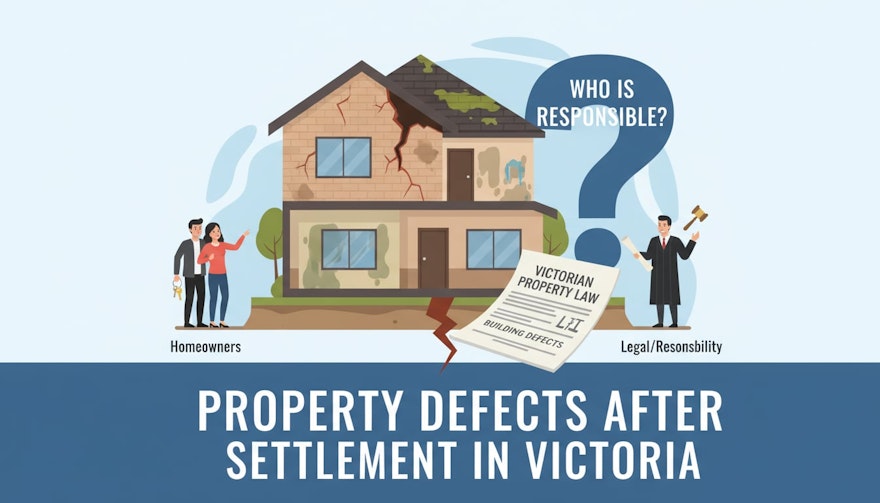
You’ve made it through the inspections, the contract, the loan documents, the settlement nerves, the key handover. You finally collapse on the couch in your new place… and then the Melbourne weather does what it does. A heavy downpour hits, and a damp patch appears in the ceiling. Or you run the washing machine for the first time and find the laundry drain backs up. Or a hairline crack in a bathroom tile turns into a proper split once the house starts living its normal life again.
It’s a common question we hear: ‘Is this on me now, or can I go back to the seller?’ The answer depends on what the problem is, when it started, what the contract says, and whether any legal protections sit outside the contract.
The quick answer people don’t love hearing
After settlement, the buyer is usually responsible for defects. In plain terms, once you own the property, you also own the problems that come with it.
That’s why it helps to understand your post-settlement responsibilities before you assume the seller has to fix anything.
Still, ‘usually’ is doing a lot of work in that sentence. There are real exceptions, especially where:
the property was not in the same condition at settlement as it was when it was sold
the seller (or agent) misled you, or hid something they knew
the defect relates to recent building work where statutory protections apply
you’re in an apartment or townhouse and the issue sits in common property
a professional report missed something serious and you relied on it
Let’s unpack it in a practical way.
What settlement changes, and why the timing matters
Settlement is the point where money changes hands and the transfer is lodged for registration. It’s the legal handover, not the day you first fell in love with the place at an inspection.
If you want the step by step version of what’s happening in the background, the ownership transfer process is a good reference. The key point for defects is this: once settlement is done, the property is yours, and most contract based arguments about condition get much harder.
There’s also a practical reason defects pop up right after you move in. You start using everything. You run the shower twice a day, not once at an open for inspection. You turn on heaters, run dishwashers, open and close windows, and discover the little quirks that weren’t obvious on a sunny Saturday in Fitzroy.
Defect, damage, or ‘not as promised’? These are different problems
People use the word ‘defect’ for lots of things. Legally and practically, it helps to split issues into three buckets.
1) Damage or missing items right around settlement
This is the time sensitive stuff. Think broken window, new hole in a wall, water damage from a burst pipe during the move out, missing light fittings, or the seller leaving a garage full of junk.
These situations often need action straight away, and they’re not the same as a hidden building defect. If you’re dealing with something urgent in the first day or two, start here: immediate post-settlement damage.
2) A latent defect that existed before you bought (but you only discover later)
Classic examples are waterproofing failures, subfloor moisture, past movement in footings, or a slow roof leak that only shows up when the rain comes in sideways.
This is where buyers often feel stuck, because the standard position is ‘you bought what you inspected’. That said, the story changes if the seller actively misled you or covered up a known issue.
3) Something the contract (or marketing) led you to believe was true
For example, the advert says ‘recently renovated with permits’, or you’re told ‘no water issues’, or a feature is described in a way that doesn’t match reality.
These cases can overlap with misrepresentation or misleading conduct, and they’re very fact specific.
The general rule after settlement: you inherit the good and the bad
Most Victorian contracts are drafted so the property is sold in its present condition, subject to fair wear and tear. Once settlement passes, you generally can’t demand that the seller pays for repairs just because you discovered a problem later.
This is also where people get caught by the less obvious responsibilities that come with ownership, not just bricks and mortar. Rates, services, compliance items, owners corporation obligations, and other practical burdens can land on the buyer once title changes. If you’re trying to get your head around that bigger picture, it’s worth reading about the hidden liabilities that transfer so you don’t treat a defect in isolation.
So, if you buy an older weatherboard in Brunswick and three months later you learn the stumps need work, that’s commonly your cost. If you buy a brick veneer in Glen Waverley and discover the gutters overflow in a storm, you’ll normally organise the fix.
That’s the baseline. Now let’s talk about when the baseline shifts.
Exception one: the property wasn’t in the same condition at settlement
Buyers often assume they only have rights before settlement. In Victoria, you do have a right to check the property in the week before settlement, and you’re entitled to expect it to be in the same condition as when it was sold, allowing for fair wear and tear.
This is why the final inspection process matters so much. It’s your best chance to spot damage, missing items, or something that has stopped working since you signed.
The tricky part is timing. If you discover an issue after settlement that was present before settlement, the seller may still dispute it, and the evidence gets messy fast. That’s not the end of the road, but you’ll need to show:
what the condition was at the time of sale (photos, inspection reports, video walk throughs)
what you saw at the pre settlement inspection (notes, photos, time stamps)
what changed and when (fresh photos, trades reports)
A practical example: a buyer settles on a townhouse in the inner north, then finds a split flexible hose under a vanity has flooded the cabinet. If the hose failed after the seller moved out, it can be hard to prove fault sits with the seller. If the cabinet is already swollen and mouldy, and there are signs it has been leaking for months, the argument looks different. Evidence is everything.
Exception two: new builds and recent renovations can carry protection past settlement
If the problem relates to domestic building work, the law can give you rights that continue after settlement, and often follow the property if it’s sold again.
This most often comes up with:
newly built homes
off the plan apartments and townhouses
major extensions or renovations done by a registered builder
waterproofing works (bathrooms, balconies)
structural work
Victoria has statutory warranties for domestic building work. In broad terms, they set a minimum standard for how building work must be carried out and can apply for up to 10 years from completion (often tied to the occupancy permit or certificate of final inspection).
There’s also domestic building insurance that may respond in certain situations, depending on the policy and the rules that apply to the work. The detail matters, so we keep this part general on purpose.
What this means in real life:
If you buy a two year old townhouse in Clayton and discover a serious waterproofing failure, you may have a pathway to pursue the builder under statutory warranties.
If you buy an apartment in Footscray where defects affect the building’s external envelope, the owners corporation may be the party with standing to take action, even though you’re the one living with the leak.
If you suspect the defect relates to building work, it’s worth finding out:
when the work was completed
who the builder was
whether there were permits and compliance documents
whether the issue is within your lot or in common property (for strata)
Exception three: misleading conduct, half truths, and concealment
Not every defect creates a claim against a seller. A seller isn’t required to guarantee an older home is perfect. A house in Melbourne’s older suburbs can be charming and imperfect in equal measure.
The line is crossed when there’s misleading conduct. Common examples include:
being told there are ‘no issues’ when the seller knows there have been repeated leaks
fresh paint applied to hide water staining, with no disclosure of the cause
claiming permits exist for works when the paperwork doesn’t support that
statements that are so specific you can reasonably rely on them, and they turn out to be false
Section 32 (the vendor statement) also matters. It has prescribed disclosures, and if information that should be there is missing or wrong, that can create rights for a buyer. These cases are detail heavy, so get advice early rather than arguing with the agent by text message.
One Melbourne flavoured scenario we see: a buyer asks at an inspection in a leafy street in Camberwell, ‘Any issues with water?’ They’re told ‘none at all’. After settlement, the first big storm reveals water coming in around a window. If the seller had prior repair invoices for that same area, the buyer’s position can look stronger. If there’s no history and it’s a new failure, the buyer may be left to fix it.
Exception four: strata properties and the owners corporation piece
Apartments, units, and many townhouses come with an extra layer: the owners corporation. A defect might be your responsibility, the owners corporation’s responsibility, or shared in a practical sense even if one party takes the lead.
A simple rule of thumb:
Inside your lot is usually yours (internal fixtures, appliances, internal walls, flooring).
Common property is usually the owners corporation’s job (roofing, external walls, common pipes and cabling in many cases, foyers, stairwells, shared drainage).
The grey zones are where stress lives:
balcony membranes and balustrades
water ingress that shows inside your unit but starts outside it
window frames (sometimes common property, sometimes not, depending on the plan)
pipes that service more than one lot
If you discover a defect in a strata building after settlement:
check the plan of subdivision (it defines what is common property)
notify the manager or committee in writing
ask whether the building insurance might respond
keep your own insurer in the loop if there’s internal damage
If the defect is a building wide issue (cladding, major waterproofing, structural cracking), the owners corporation often needs to coordinate the response. Individual owners can still feel the impact through levies and disruption, so it’s worth understanding the process early.
Exception five: you relied on a professional report that missed something serious
Sometimes the strongest route isn’t against the seller. It’s against the professional whose job was to identify risk, or at least warn you of it.
This might involve:
a building and pest inspection that failed to report obvious signs of movement or moisture
advice that didn’t flag missing permits for recent works
a strata report that missed major owners corporation issues that were already on the agenda
These claims can be complex and time sensitive. Don’t assume you have years to sort it out. Preserve the documents, keep your communications, and get proper advice on prospects.
What to do the moment you find a defect after settlement
When you’re staring at a new leak in your ‘new’ home, it’s hard to be methodical. A calm plan saves time and money.
In the first two days
Make it safe. If there’s electrical risk, turn power off at the switchboard and call a licensed electrician. If there’s water, stop it at the mains if needed.
Prevent more damage. Buckets, towels, temporary tarps, shutting off a valve. Insurers expect you to take reasonable steps.
Photograph and film it. Wide shots, close ups, and something that shows scale (a ruler, a coin, your hand). Turn on time stamps if your phone allows it.
Write a short note while it’s fresh. Date, time, what happened, weather, what you observed, what you did.
Over the next week
Check your documents. Contract, Section 32, any special conditions, building inspection report, strata report (if relevant).
Work out what you’re dealing with. Is it an owners corporation issue? A building warranty issue? A straight insurance claim?
Get an expert opinion where needed. A licensed plumber’s report, waterproofing assessment, or engineer’s opinion can make or break the next step.
Notify the right party in writing. Builder, owners corporation, insurer, or the seller’s conveyancer (depending on what you’re alleging). Keep it factual and calm.
If the issue links to domestic building work and you’re not getting traction, there are Victorian dispute resolution pathways that can help resolve building disputes without going straight to court. The right pathway depends on the type of work and the nature of the defect.
How to avoid being caught in the first place
You can’t eliminate risk in property. You can reduce surprises.
Before you sign
Treat the Section 32 as a starting point, not a comfort blanket. Get it reviewed.
Arrange a building and pest inspection for houses and older townhouses.
For apartments, organise a strata report and read it with care. Look for recurring water ingress, upcoming works, special levies, and building defect chatter.
Ask direct questions in writing where you can. If an answer matters, you want a record.
Be extra cautious at auctions, where contracts are often unconditional. Your checks need to happen before you bid.
In the week before settlement
Do a proper pre settlement inspection. Turn taps on, flush toilets, test lights, check appliances included in the sale, open windows, check for new damage.
Take photos, even if everything looks fine. They can be surprisingly helpful later.
If something is wrong, raise it straight away, in writing, and get advice before you settle.
A practical bottom line for Melbourne buyers
If you discover a defect after settlement in Victoria, start from the assumption that you’ll be managing it, then check whether an exception applies:
Was the property in a different condition at settlement?
Is the defect tied to domestic building work with statutory protections?
Were you misled, or was something concealed?
Is it common property in a strata building?
Did a professional report miss an obvious warning sign?
If you’re not sure which category you’re in, don’t guess. The early steps, photos, reports, and wording of your first emails can shape what happens next.
Want a second set of eyes before you commit?
If you’re buying in Melbourne and you want to reduce the risk of nasty surprises after settlement, we can help you read the fine print and spot the usual traps before you sign.
Pearson Chambers Conveyancing offers a complimentary Section 32 contract review.
Email contact@pearsonchambers.com.au.
This article is general information only and isn’t legal advice. For guidance on your circumstances, speak with a qualified professional.