![[object Object]](https://umsousercontent.com/lib_lphGCikIbVHjRWIV/w8mzrofmgaa9b3om.png?w=52)
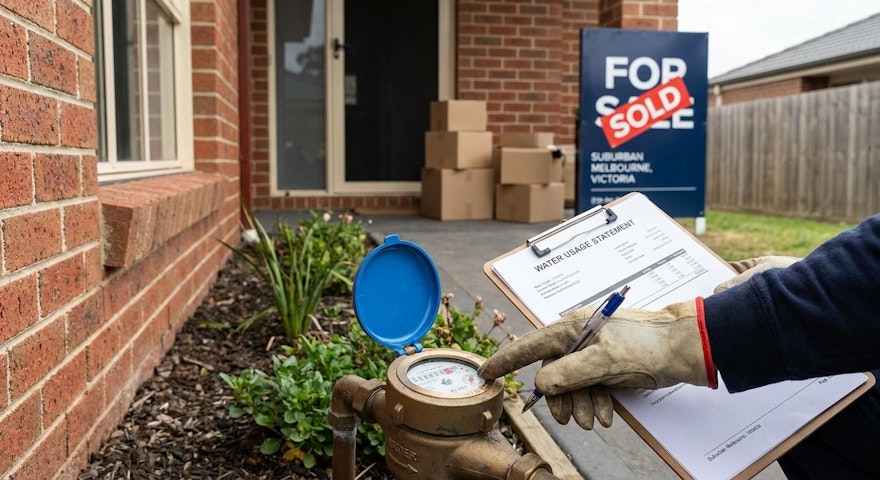
We get asked this when a buyer's first water bill arrives after settlement and the numbers don't feel right. It is a small line item beside stamp duty, loan funds and keys, but it can still sting if it was not handled before settlement.
The short answer: In Victoria, the seller is usually responsible for water charges up to and including settlement day, and the buyer is responsible from the day after settlement. Fixed service charges are adjusted by days of ownership, while metered usage should be dealt with through a water information statement under section 158 of the Water Act 1989 (Vic) and, where the retailer process calls for it, a special meter reading close to settlement. If arrears are missed, sections 274(4A) and 275 of the Water Act can make unpaid water charges a charge on the land, which means the new owner may have to pay them.
Who pays for water at settlement in Victoria?
The seller pays for the period they owned the property, including settlement day, and the buyer pays from the next day. That is how outgoings are usually adjusted under the standard Victorian contract of sale, and it is the same general rule Consumer Affairs Victoria uses for rates and other charges at settlement.
Your conveyancer sets this out in the statement of adjustments, which is the calculation showing the final amount payable at settlement.
A water bill usually has two parts:
- fixed service charges, such as water service, sewerage service, waterways and parks charges
- metered usage, meaning the water that has actually passed through the meter
Fixed charges are usually split by days. Usage needs a closer look, because people do not use water evenly.
Why does metered water usage need special handling?
Metered water usage should not be guessed by simply dividing a quarterly bill across days. A family watering a garden through a dry February in Preston may use far more than a single owner who barely turns on the taps during winter.
That is why your conveyancer checks the retailer's settlement process. Depending on the water retailer, the usage figure may come from a special meter reading taken close to settlement, or from usage data and updates included with the water information statement.
The goal is simple: the seller pays for the litres used before the property becomes yours.
Can an unpaid water bill follow the property?
Yes. Unpaid water charges can follow the land if they are not cleared at settlement.
Under the Water Act 1989 (Vic), amounts owed to a water authority can become a charge on the property. A person who becomes the owner must pay an amount that is a charge on that property. In plain English, the debt can sit with the land, not just with the person who ran the tap.
This is why a title search is not enough. Water arrears do not appear on the certificate of title in the way a mortgage or caveat might. The water authority has to be checked separately. It works a little like a property clearance certificate for land tax: looking only at the title does not solve the risk.
What is a water information statement?
A water information statement is the water authority document that shows water related information for the land. Under section 158 of the Water Act, a person may apply to the authority for an information statement for land in that authority's district.
For a buyer, the statement helps your conveyancer check:
- outstanding water and sewerage charges
- whether the property is connected for water and sewerage services
- tariffs or charges that apply
- authority notices, works or other matters affecting the land
- water or sewer mains that may affect building or landscaping plans
You may see a water information statement in the Section 32 vendor statement, because vendors commonly attach one when disclosing outgoings. For a settlement, your conveyancer will usually want current figures, not a stale copy prepared at the start of the sales campaign.
We've seen this come up when a townhouse in Melbourne's west had an older water statement in the Section 32, then a later bill landed before settlement. The fix was not dramatic, but it did need fresh figures and a clean adjustment before funds were released.
Does every Melbourne water retailer require a special meter reading?
No. The correct process depends on which water retailer services the property, and you do not choose that retailer yourself. Location decides it.
Yarra Valley Water services much of Melbourne's north and east. For those properties, a special meter reading is commonly used so the final sale amount reflects actual usage instead of an estimate.
South East Water services the south east, bayside south and the Mornington Peninsula. Its process has moved away from a separate special read for settlement, because usage data and financial updates are used to help calculate the final position.
Greater Western Water services Melbourne's west and north west, including growth areas around Wyndham, Melton and Sunbury. It uses information statements and may use a special read depending on the property. Buyers in that area should allow time for settlement searches, especially where retailer processing has been slower after the 2024 billing system issues and the later customer redress package.
The safest rule is not to assume. Your conveyancer should check the retailer's live process during your settlement file.
Why are water rates and council rates adjusted differently?
Water usage is billed after the water has been used, while many fixed charges are billed ahead for a period. That is why council rates and the fixed water service charge are billed in advance, but metered water usage usually has to be reconciled against the actual or best current reading.
This can feel backwards when you first see the adjustments. The buyer may reimburse the seller for fixed charges covering the period after settlement, while the seller may have money deducted for water usage or arrears from before settlement.
Both can be correct at the same time. One line deals with future ownership. The other deals with past consumption.
What does your conveyancer do before settlement?
Checking water is part of what your conveyancer handles in the lead-up to settlement day. It is quiet admin, but it protects the buyer from paying for water they did not use.
For a standard Melbourne purchase, your conveyancer will usually:
- Identify the correct water retailer for the property.
- Order or review the water information statement.
- Check for arrears, notices, encumbrances and current charges.
- Work out whether a special meter reading or financial update is needed.
- Add the water figures to the statement of adjustments.
- Arrange for unpaid water amounts to be paid from the seller's settlement funds.
- Lodge the notice of acquisition or notice of disposition so the account closes in the seller's name and opens in yours.
This is also why timing matters. A special read ordered too early can be out of date by settlement, especially in a 60 or 90 day settlement after a Saturday auction. It is usually ordered close enough to settlement to catch real usage, while still leaving time to agree the figures.
What happens if the water is not sorted before settlement?
The problem may not show up until weeks later. By then, the seller has moved, the agent has closed the file, and the buyer is left staring at a water bill that does not match their time in the property.
The cleanest fix is to deal with it before settlement. Once settlement has happened, you may need to ask the retailer for account records, check the settlement statement, contact the seller's representative and work out whether the arrears or usage was missed. That is slower than deducting the right amount from the seller's funds on the day.
Most water surprises we see are not huge legal battles. They are messy admin problems: an estimate used instead of a reading, a late bill missed, or an older information statement treated as current. Still, no buyer wants that hanging over the first few weeks in a new home.
What should buyers check before signing?
Before you sign, ask for the water information statement and read it with the Section 32, not as a throwaway page at the back. Look for arrears, unusual notes, sewer mains, easements and whether the property is separately metered.
This is especially sensible if you are buying:
- an older house with a large garden
- a renovated home where plumbing work may have changed
- an apartment or unit with shared infrastructure
- a property in a growth corridor with new titles or recent subdivision
- a vacant or investment property where bills may have been missed
You do not need to solve the water adjustment yourself. You do need to make sure someone is checking it before you are legally locked in.
Frequently asked questions
Who pays for water used before settlement in Victoria?
The seller usually pays for water used up to and including settlement day, and the buyer pays from the day after settlement. Your conveyancer records this on the statement of adjustments, using the water information statement and any special meter reading or retailer update needed for the property.
Do I have to pay the previous owner's unpaid water bill?
You may have to pay it if it is not cleared at settlement. Under the Water Act 1989 (Vic), unpaid water amounts can become a charge on the property, and the new owner can be liable for a charge on that property. This is why arrears should be identified and paid from the seller's funds at settlement.
What is a special water meter reading at settlement?
A special water meter reading is a reading taken close to settlement, outside the normal quarterly billing cycle. It helps measure the seller's water usage up to settlement so the adjustment is based on actual usage rather than a rough estimate.
Does every water retailer need a special meter reading before settlement?
No. The process differs between Yarra Valley Water, South East Water and Greater Western Water. Some properties need a special read, while others rely on updated financial information or usage data in the information statement. Your conveyancer should check the current retailer process for the property address.
Is the water information statement the same as a council rates certificate?
No. A water information statement comes from the water authority and deals with water, sewerage, charges, arrears and related property information. A council rates certificate comes from the local council and deals with council rates and charges. A careful settlement check looks at both.
Will a title search show unpaid water charges?
No. A title search will not reliably show unpaid water charges. Water arrears are checked through the water authority, usually by ordering or reviewing the water information statement before settlement.
About the Pearson Chambers Conveyancing team
Pearson Chambers Conveyancing is a Melbourne focused conveyancing team working with first home buyers, sellers and property owners across Victoria. We review contracts and Section 32 statements every day, including the water information statements and settlement adjustments that can otherwise be easy to miss. Sorting water charges before settlement is part of the day to day work we do for buyers who want the numbers checked before they commit.
Sources we consulted
- Water Act 1989 (Vic)
- Consumer Affairs Victoria, property settlement
- Land Use Victoria, property information certificates
- Essential Services Commission, Greater Western Water redress package
Get the water checked before settlement
If you're buying in Melbourne and want the water, rates and other settlement adjustments checked before you sign or settle, Pearson Chambers Conveyancing can help. We offer a complimentary Section 32 contract review for Melbourne buyers, and we can explain what the water information statement means for your property.
Email contact@pearsonchambers.com.au.
General information only, current as at the date of publication. Victorian conveyancing rules and legislation change frequently. Please contact the Pearson Chambers Conveyancing team for advice on your specific contract.