![[object Object]](https://umsousercontent.com/lib_lphGCikIbVHjRWIV/w8mzrofmgaa9b3om.png?w=52)
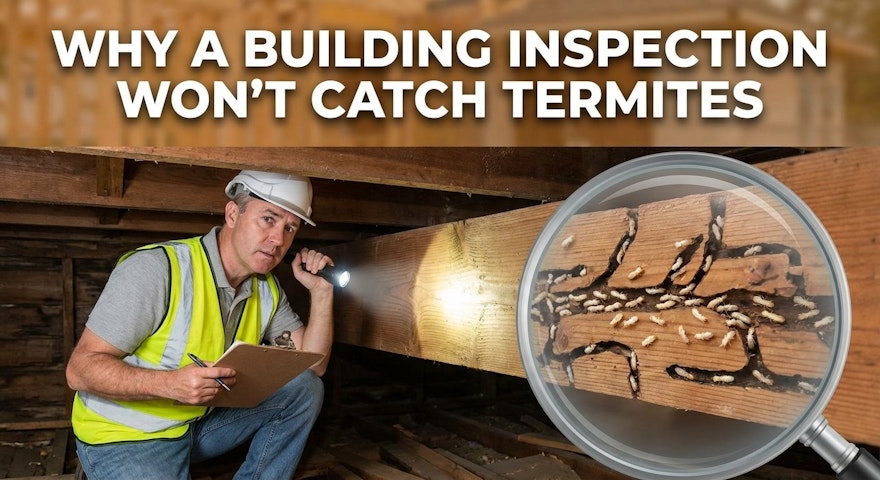
A standard building inspection in Victoria is not the same as a timber pest inspection. A building report is usually prepared under AS 4349.1-2007 and the Victorian contract treats it separately from a pest report, which must be prepared to the relevant Australian Standard for pest inspections. In the updated LIV and REIV contract, the building report condition is GC21 and the pest report condition is GC22, and both usually need to be switched on before you can rely on them.
A clean building report and an active termite problem can sit side by side. That sounds strange at first, but the two inspections are asking different questions. One looks at building defects. The other looks for timber pests.
Does a building inspection check for termites in Victoria?
No, a standard building inspection does not properly check for termites. It may mention visible signs that the inspector happens to notice, but it is not a timber pest inspection.
A building inspection looks at the condition of the home: stumps, roof framing, damp, cracks, movement, safety issues and defects that are visible and accessible. It is not designed as a focused hunt for subterranean termites, borers or wood decay.
A timber pest inspection is different. The inspector looks for live termites, termite damage, mud tubes, moisture conditions, borers and fungal decay. They know the usual hiding places: subfloors, damp garden edges, skirting boards, wall cavities, decks, fences and timber near wet areas.
So when someone says, ‘I got an inspection,’ the next question is: which one?
Why does the contract separate building and pest reports?
The standard Victorian contract treats building and pest reports as separate protections. GC21 is the building report condition, and GC22 is the pest report condition.
The building inspection clause is aimed at major defects in a structure on the land. In the updated contract, the building report must be prepared by an accepted building professional or architect, comply with AS 4349.1-2007, identify a current defect in a structure, and state that it is a major defect.
The pest report condition has its own test. It requires a pest inspector’s report prepared to the relevant Australian Standard, disclosing a current pest infestation and designating it as a major infestation affecting the structure of a building on the land.
That separation matters. Live termites may be present before there is obvious major structural damage. If your contract is subject to building only, a pest problem may not give you a clear contractual exit.
What happens if termites are found but I only had a building condition?
If the contract only gives you a building report condition, termites alone may not be enough. You may need the building report to identify a current major defect in a structure, not just a pest risk.
Picture a weatherboard in Coburg or Preston. The building report comes back looking manageable. You skip the pest report because the auction is close, the agent is pushing for offers, and you’ve already spent money on loan paperwork. After settlement, you pull up a piece of skirting and find the timber inside has been hollowed out.
By then, the contract has settled. The inspection condition window has gone. Treatment, repairs and any further investigation may be yours to manage.
In our practice, we’ve seen this worry come up most often when buyers thought ‘building and pest’ was one standard box, but the contract only dealt with one part of the risk. That gap can feel small when you sign. It feels much larger when a pest controller is tapping around the subfloor.
How long do I have to use a building or pest condition?
The usual GC21 and GC22 period is 14 days from the day of sale. Inside that time, you need the inspection completed, the written report received, advice taken if needed, and any termination notice served correctly.
That is a tight window. It is not enough to book an inspection on day 13 and hope the report arrives in time. If you want the right to end the contract, the paperwork has to be handled properly.
A good conveyancer will check:
- whether GC21 and GC22 are actually switched on
- whether any special conditions in a contract of sale change the usual position
- whether the inspection periods are workable
- whether the report meets the contract wording
- how notice must be served if you need to end the contract
The condition is useful only if you can use it in time.
Why are auctions riskier for termite issues?
At auction, you usually need to do your building and pest checks before bidding. Once the hammer falls and the contract is signed, the sale is usually unconditional.
Victorian buyers also need to be careful with the cooling-off period. Cooling off does not apply if you buy at a public auction, or within three clear business days before or after a public auction. That means you can’t rely on cooling off as a fallback if you discover termites after bidding.
This is why a building inspection before auction is often only half the job. If the home has timber framing, a subfloor, an old deck, damp garden beds against the walls, or visible timber repairs, a pest inspection should be part of your auction preparation too.
Yes, it’s frustrating to pay for reports and then lose the auction. It is still cheaper than winning a Saturday auction in Brunswick, Reservoir or Glen Iris and finding out later that termites were already active.
What termite warning signs should Melbourne buyers look for?
Termites often hide in concealed areas, so visible signs are only clues. You still need a proper pest inspection before you rely on the property’s condition.
At an inspection, look for:
- mud like tubes around brickwork, footings, piers or pipes
- skirting boards that sound hollow when tapped
- blistered paint or bubbling plaster
- timber that feels soft, papery or wafer thin
- damp subfloor areas
- mulch or garden beds built up against external walls
- timber decks, fences or sleepers touching soil
- moisture near bathrooms, laundries and kitchens
Older Melbourne homes can be lovely and still risky. A period home in the inner north, a weatherboard in the west, or a renovated cottage with an old timber subfloor may need more checking than a quick walk through on a rainy Saturday morning.
Good due diligence means looking at the contract and the property together. The report tells you what the inspector found. The contract tells you what you can do with that information.
What should I do before I sign or bid?
Order both reports and get the contract checked before you commit. That is the safest practical step.
For a private sale, ask your conveyancer to confirm that both the building and pest report conditions apply. Do this before signing, not after the agent has marked the contract as complete.
For an auction, arrange both reports before auction day. Also send the contract and Section 32 statement to your conveyancer early, so you understand the risks before you register to bid.
A simple buyer checklist looks like this:
- Send the contract and Section 32 statement for review.
- Confirm whether GC21 and GC22 apply.
- Book a building inspection and a timber pest inspection.
- Check the reports are prepared to the right standard.
- Ask what each report means under the contract.
- Do not assume visible repairs or fresh paint mean the property is fine.
- Keep all deadlines in writing.
The goal is not to panic about termites. It is to know what you are buying before the contract locks you in.
Frequently Asked Questions
Does a building inspection check for termites in Victoria?
No. A standard building inspection looks at the structure, safety and visible condition of the property, but it is not a timber pest inspection. Termites should be checked through a separate pest inspection prepared to the relevant Australian Standard.
What is the difference between a building inspection and a pest inspection?
A building inspection focuses on defects in the building, such as structural movement, damp, roof issues and visible safety concerns. A pest inspection looks for timber pests, including termites, borers and wood decay. They are separate inspections, even when sold together as a combined package.
Can I cancel a contract if I find termites after settlement?
Generally no. The usual building and pest report conditions operate before settlement and within the contract’s inspection period. Once settlement has happened, those contract rights are usually gone, so you should inspect before signing or bidding.
Do I need a pest inspection if I’m buying at auction?
Yes, if you want protection against termites, you should arrange a pest inspection before auction day. Auction contracts are usually unconditional, and you normally cannot add a pest condition after you are the successful bidder.
Is the standard Victorian contract subject to a building and pest inspection automatically?
Not in a way you should assume. The standard contract contains separate building and pest report conditions, but they usually apply only if the relevant boxes are checked and the contract has not been changed by special conditions. A conveyancer should check this before you sign.
How much does a building and pest inspection cost in Melbourne?
A combined building and pest inspection in Melbourne commonly costs several hundred dollars, with the price depending on the size, age, location and access of the property. Ask what is included, whether the pest component is a true timber pest inspection, and how quickly the written report will be provided.
What counts as a major defect or major infestation in the contract?
A major defect is a serious current defect in a structure that the report identifies as major under the contract wording. A major infestation is a current pest infestation affecting the structure of a building on the land. Live termites without clear structural impact can create arguments, which is why relying on the building condition alone is risky.
About the Pearson Chambers Conveyancing team
Pearson Chambers Conveyancing is a Melbourne focused conveyancing team that helps Victorian buyers review contracts, Section 32 statements and settlement steps every day. We work with first home buyers who are often juggling inspections, finance, auctions and agent pressure all at once. Checking whether building and pest protections actually work is part of what the PC team does day to day.
Sources we consulted
- Consumer Affairs Victoria: Inspect properties before you buy
- Consumer Affairs Victoria: Buying property by private sale
- Consumer Affairs Victoria: Buying property at auction
- Victorian Building Authority: Termites
- REIV: VicForms standard contract updates
Talk to Pearson Chambers before you sign
Worried that a building inspection may not protect you from termites? Pearson Chambers Conveyancing can review your contract and Section 32 statement before you sign or bid, and help you check whether the building and pest report conditions are set up properly.
Email contact@pearsonchambers.com.au to ask about a complimentary Section 32 contract review.
General information only, current as at the date of publication. Victorian conveyancing rules and legislation change frequently. Please contact the Pearson Chambers Conveyancing team for advice on your specific contract.