![[object Object]](https://umsousercontent.com/lib_lphGCikIbVHjRWIV/w8mzrofmgaa9b3om.png?w=52)
Weekend inspections in Melbourne can feel like a sport. You’re squeezing through a two bedder in Brunswick or Southbank, trying to picture your couch in the living room while the agent talks up the tram at the end of the street. It’s easy to fall in love.
Then you hear the words ‘body corporate report’ and the mood shifts.
In Victoria, ‘body corporate’ is really the owners corporation. The paperwork is where you find out whether the building is quietly ticking along, or whether it’s heading towards expensive repairs, messy disputes, and levies that sting every quarter. For apartment buyers, this due diligence can matter as much as any inspection, and at auction you often don’t get a second chance to change your mind.
This guide walks through 12 warning signs we look for all the time when reviewing owners corporation documents for Melbourne buyers. None of them automatically makes a property ‘bad’. A few together, or one serious issue with no plan, can be the moment you put the contract down and keep looking.
What a ‘body corporate report’ means in Victoria
Agents and sellers might use the term loosely. In practice, the key document is the owners corporation certificatethat’s usually provided with the Section 32 vendor statement for apartments and units. It’s a snapshot of how the owners corporation is being run and what it’s costing.
A typical set of owners corporation documents can include:
the current fees for the lot and whether they’re paid up to date
any special fees or levies that have been approved (plus what they’re for)
insurance details for the building
details of planned or proposed works that may lead to extra charges
minutes and resolutions from meetings, plus the current rules.
If the building has more than one owners corporation (common in larger developments with separate towers, car parks, or retail), you may see multiple certificates and sets of records, with separate fees.
If you’re trying to make sense of the bundle, start with a simple question: ‘If I owned this apartment next month, what unexpected costs or restrictions could land on me?’
How to read it without getting lost in the paperwork
Start with money: budgets, current balances, arrears, and any notes about upcoming works. Then skim the minutes for patterns: the same leak mentioned again and again, the lift that’s ‘being looked at’, owners complaining about a manager who never returns calls. Those themes tell you what it might cost, and what it’s like to live there.
If you want a deeper run through, our guide to owners corporation certificate red flags explains how the certificate, minutes and attachments fit together.
Now, the 12 red flags to watch for.
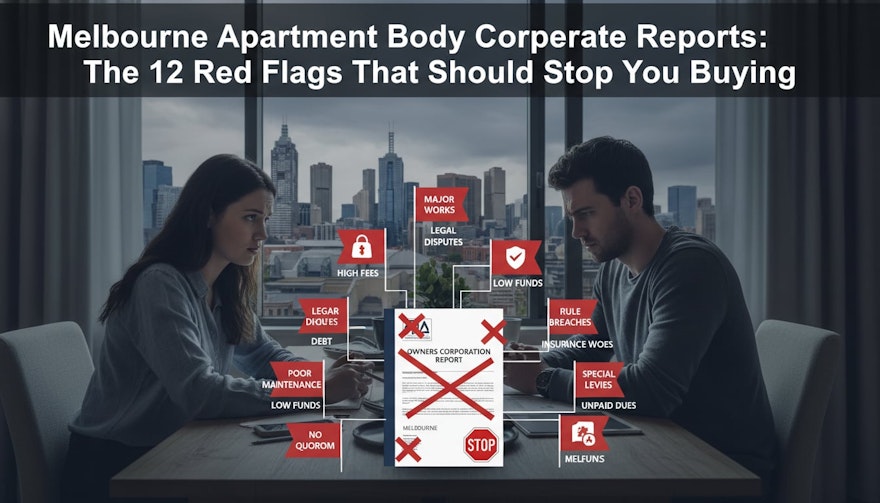
The 12 red flags that should stop you buying
Red flag 1: Lots of owners are behind on levies
A bit of arrears can happen in any building. The worry is when a noticeable chunk of lots are behind, or when arrears keep showing up year after year. It squeezes cash flow, then the owners corporation either delays repairs or leans harder on the owners who do pay.
What to do: ask whether there’s a recovery plan in place, and whether essential works have been postponed because money isn’t coming in.
Red flag 2: The maintenance fund looks thin for the building’s age and complexity
In Victoria you’ll often see admin funds and maintenance funds (sometimes still called ‘sinking funds’). There’s no single balance that suits every building. A newer, simple walk up in the inner north is different from a CBD tower with lifts, basement ventilation, fire systems, and a rooftop plant room.
A thin fund can mean the building has been under collecting levies, spending without planning, or both.
What to do: compare the fund balance with the building’s major assets. If a lift replacement or facade repair would wipe it out, you’re looking at future levies.
If you’d like a more detailed way to assess this side of the paperwork, see our body corporate financial health checks.
Red flag 3: Special levies keep popping up
A one off special levy for a clearly explained job isn’t automatically a deal breaker. Repeated special levies, or talk of another one ‘soon’, is different. It can point to poor budgeting, deferred maintenance finally catching up, or a problem the building can’t get on top of.
What to do: read what the special levy was for, whether it fixed the issue, and whether the minutes show a plan to stop the same problem returning.
Red flag 4: The budget never matches reality
Look for budgets that are consistently optimistic, with regular overspends or unpaid invoices rolling forward. It’s a sign the building is running on hope, not numbers, and owners can end up funding the gap when there’s no room left to shuffle expenses.
What to do: check whether levies have been adjusted to match real costs, and whether the owners corporation is building reserves rather than living month to month.
Red flag 5: Levies look ‘too good to be true’
Everyone loves low levies, especially when you’re already stretching for a deposit. The catch is that low levies can also mean low maintenance. That’s when you see peeling paint in common areas, water staining in basements, and a queue of jobs waiting for approval.
Higher levies aren’t always bad. A well run building with strong maintenance can cost more to run, especially with lifts and other shared services.
If you’re trying to work out what’s normal for your type of building, our explainer on body corporate fees can help you benchmark the figures.
What to do: ask where the money goes, and whether the building is keeping up with scheduled servicing and long term repairs.
Red flag 6: Big contracts you can’t escape
Many apartment buildings have long contracts: building management, caretaking, cleaning, lifts, security systems, waste services, even energy or internet through an embedded network. A contract itself isn’t a problem. The concern is when the contract is expensive, hard to change, or a constant source of disputes in the minutes.
What to do: look for complaints about service quality, repeated requests to terminate or renegotiate, or legal advice being sought about contracts. Those are signs the building is stuck.
Red flag 7: Missing minutes, missing attachments, missing answers
Good record keeping is part of good governance. If minutes are missing, attachments aren’t provided, or the documents look patchy, it’s harder to work out what’s really happening in the building.
What to do: ask for the missing documents. If you can’t get basic records now, it can be a sign of the frustration you’ll inherit.
Red flag 8: The same complaints keep returning with no clear outcome
Water ingress in the basement. The lift out again. Noise complaints. Security doors not latching. If it’s been raised across multiple meetings and never closed off, you’re seeing a building that can’t make decisions, can’t fund a fix, or can’t agree on priorities.
What to do: look for evidence of action, not just discussion. Quotes obtained, contractors engaged, works approved, follow up completed.
Red flag 9: A revolving door of managers or committees
People change roles, life gets busy, and committees can be thankless. Still, constant turnover can point to conflict, burnout, or dissatisfaction with the manager. It can also mean no one is holding long term knowledge of the building’s issues.
What to do: read between the lines of the minutes. Are there resignations and heated exchanges? Are routine decisions being delayed because the committee can’t function?
Red flag 10: Insurance is unclear, out of date, or loaded with nasty surprises
Owners corporation insurance should cover the building and common property, yet policies can come with large excesses, exclusions, and premium rises after claims. Some buildings struggle to obtain cover on reasonable terms if there are known defects or a history of claims.
What to do: check that insurance documents are current, read the excess amounts, and look for notes about claims. Also remember that building insurance isn’t the same as contents cover for your own belongings.
Red flag 11: Disputes, tribunal matters, or legal letters are a regular feature
A building can be in dispute for all sorts of reasons: unpaid levies, contract fights, defect claims against builders, or neighbour disputes that escalate.
A single dispute can be manageable. A pattern of disputes suggests an unhappy building, and legal costs can chew through funds fast.
What to do: find out what the dispute is about, where it’s up to, and whether the owners corporation has budgeted for legal costs.
Red flag 12: A serious building issue is known, yet there’s no funded plan
Serious issues come in many forms: combustible cladding and fire safety upgrades, widespread waterproofing failures, structural movement, concrete spalling in basements, chronic mould, or major plant failures. In Melbourne you’ll also see building features that can become expensive headaches, like car stackers, complex glazing, and rooftop plant that’s hard to access and repair.
What to do: match the paperwork with the physical reality. If the documents mention defects, get clarity on scope, quotes, timing and how the bill will be shared. It can be wise to pair document review with a specialist building inspection for apartments, especially for older buildings or anything showing signs of water issues.
What to do when you spot one of these red flags
A red flag doesn’t always mean ‘run’. It does mean slow down.
In a private sale, you may have room to ask questions, seek more documents, and negotiate special conditions. At auction (and for contracts signed close to an auction date), you may not have cooling off rights, so the work needs to happen before you bid.
Practical steps that often help:
Ask for the latest minutes and any committee minutes, not just the annual general meeting paperwork.
Ask whether any special fees have been approved, proposed, or discussed, even if they aren’t due yet.
Look for a maintenance plan or long term plan. If there isn’t one, look for evidence the building still plans ahead.
Check the owners corporation rules for pet approvals, renovations, noise, smoking, and short stay arrangements. If a rule clashes with your plans, treat it as a red flag too.
If there’s a known issue, ask what work has been done so far, what’s approved, and what’s still undecided.
Most buyers don’t mind paying for a well run building. They mind being surprised.
A few Melbourne buying scenarios we see all the time
You’re at an auction in Fitzroy and the contract looks clean at first glance. Then the owners corporation minutes reveal months of water ingress into the basement and a consultant report recommending major works. That’s the moment to decide whether you’re comfortable funding those works, not after the hammer falls.
Or you’re in a low rise block in Carlton North with very low levies. The common areas are worn, the gutters haven’t been cleared in ages, and the minutes show owners can’t agree to spend money. The apartment might be lovely, yet the building is your shared responsibility.
Want a second set of eyes before you commit?
Owners corporation documents are where apartment purchases can quietly go wrong. When we review a Section 32, we’re looking for the practical risks that can hit your wallet or your lifestyle once you’re an owner.
Pearson Chambers Conveyancing can review the contract and owners corporation material, explain what it means in plain English, and help you decide your next move. If you’re buying in Melbourne and want peace of mind, contact us for a complimentary Section 32 contract review.
Email: contact@pearsonchambers.com.au
This article is general information only and isn’t legal advice.