![[object Object]](https://umsousercontent.com/lib_lphGCikIbVHjRWIV/w8mzrofmgaa9b3om.png?w=52)
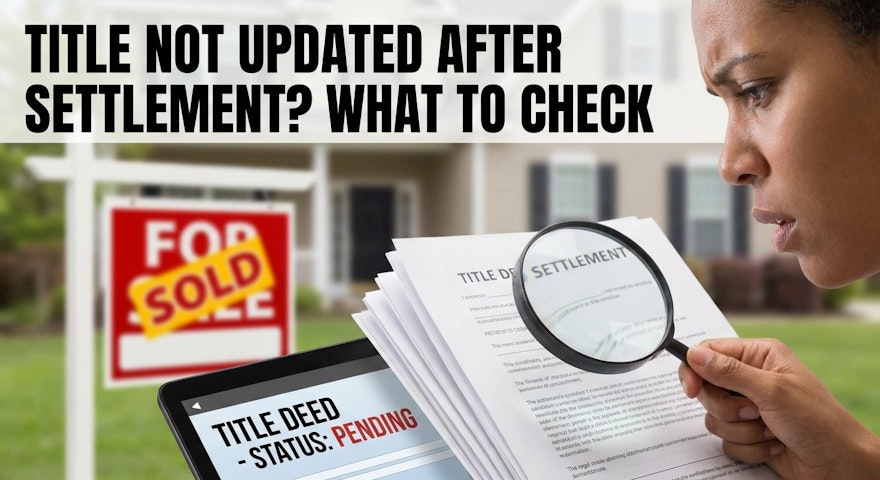
You've collected the keys and moved into your Melbourne home, yet a fresh title search still names the seller. The useful question now is what happened to the transfer after the money was paid.
The short answer: Settlement and title registration are separate stages in Victoria. If a current search still shows the seller, ask your conveyancer for the transfer's dealing number, lodgement date and present registration status, plus any registry correspondence. Under the Transfer of Land Act 1958, the Victorian Register of land is the official ownership record, so a settlement receipt or duty record isn't a substitute for checking what has actually been registered.
Is settlement the same as title registration in Victoria?
No. Financial settlement completes the payment and settlement steps, while registration updates the Victorian Register of land to record the new proprietor.
For most electronic transactions, the transfer is prepared through an Electronic Lodgment Network and lodged with the Land Registry as part of the settlement process. After lodgement, electronic instruments are examined. Some are dealt with electronically and some need manual examination.
Many transfers register very soon after lodgement, but that doesn't mean every transfer is registered at the instant money changes hands. A particular dealing can remain pending if an examination step or registry requirement still needs attention.
The document at the centre of the process is the transfer of land. Settlement confirmation tells you the financial transaction has completed. Registration confirmation and the Register tell you what happened to the title.
That distinction matters if you're already living in the property but your name isn't yet appearing on a fresh title search. Rather than guessing that something has gone wrong, identify the exact stage the transfer has reached.
How do I check whether the title search is current?
Start with a current title search for the correct folio. An old search attached to the Section 32 statement will naturally show the ownership recorded when that search was obtained.
Check:
- the date of the search
- the volume and folio number
- the property description
- the registered proprietor names
- any mortgage or other relevant dealings shown.
Apartments need a little extra care. Your purchase may involve the apartment lot plus a separately titled car space or storage lot. Make sure the search you're reading matches the title you actually bought.
Picture unpacking in Footscray while a family member spots the seller's name on the title copy in your old contract pack. That isn't proof of a post-settlement problem. If a new register search statement obtained after settlement still names the seller, that's when you should ask for the transfer status.
Has the transfer been lodged, or is it still waiting to register?
Ask for the dealing number, lodgement date and current status. A vague update such as 'it's being processed' doesn't tell you which step remains outstanding.
The records will usually point to one of four positions:
- Lodgement can't be established. Your representative should identify whether the transaction used an electronic or paper process, why registration hasn't progressed and what action is required.
- The transfer is lodged and pending. Ask whether normal examination is continuing or a specific requirement is holding the dealing up.
- A registry requisition or request has been issued. Obtain the details, the required response and the date by which it must be dealt with.
- The instrument has been withdrawn, rejected or abandoned. That needs a specific response and shouldn't be described as merely waiting for registration.
For an electronic settlement, the State Revenue Office says the electronic lodgement network transfers duty at settlement and simultaneously lodges the titles with the Land Registry. If your records don't show that expected progression, your conveyancer should reconcile the settlement record and lodgement record rather than relying on the settlement email alone.
What is a registry requisition after settlement?
A registry requisition is a request made while a lodged instrument is being examined. It can require more information, evidence or another step before registration can continue.
This is different from contractual requisitions on title, which concern questions about title and the seller's obligations in the conveyancing transaction. A registry requisition concerns an instrument already lodged for registration.
Ask your conveyancer to tell you:
- what the registry requires
- which document or detail is affected
- who must provide the answer or evidence
- what response date applies
- whether the response has been submitted
- whether anything further has been requested.
Don't assume every requisition comes with the same response period. The actual notice and registry requirements for that dealing matter.
In our practice, we've seen buyers focus on the settlement receipt because it feels like the natural proof that everything is finished. When a fresh search still names the seller, we separate the checks: settlement first, lodged transfer second, registry correspondence third, and the registered result last.
Who is responsible for replying to the Land Registry?
The formal response must come from the lodging party for a paper lodgement or the Responsible Subscriber for an electronic lodgement. Land Registry Services states that it communicates with those parties about the lodged matter.
That means the person who sent your settlement confirmation isn't necessarily the person expected to answer a registry request. A lender, conveyancer, solicitor or other subscriber may hold the relevant role in the electronic lodgement.
Ask your conveyancer to identify the responsible party and confirm:
- who has the registry request
- what they need to provide
- who is following them up
- whether a deadline applies
- what evidence will confirm the issue has been resolved.
If your representative changes while the instrument is still being processed, the outgoing and incoming representatives must notify the Registrar in writing. That handover matters because you don't want a registry request sitting with a party who no longer has carriage of your file.
What if the transfer was withdrawn or rejected?
Get the actual notification and ask what needs to happen before a fresh lodgement can be made. A withdrawn, rejected or abandoned instrument is not the same as one that remains pending examination.
Since 21 May 2025, a previously withdrawn or rejected instrument that is relodged attracts the full lodgement fee rather than the former reduced fee. Whether a new instrument is needed, and who should meet any extra cost, depends on why the problem occurred and the terms and circumstances of the transaction.
There's also a practical change worth knowing. From 1 May 2026, Land Registry Services stopped attaching a PDF copy of a withdrawn, rejected or abandoned electronic instrument to its customer email. The lodging subscriber can retrieve the rendered instrument through the electronic network if needed.
Before authorising extra work, ask what is being corrected, who will prepare it, what evidence or authority is needed and what fees are proposed.
What proves title registration is complete?
The clearest evidence is the registration confirmation statement together with a fresh title search showing the registered result. After an electronic instrument is registered, a registration confirmation statement is issued to the lodging party or Responsible Subscriber.
Ask your conveyancer to check the new title carefully, including:
- the correct property and folio
- the purchaser names
- whether ownership is recorded in the intended form
- any mortgage that should appear
- any unexpected dealing or notation.
Don't use a paper certificate arriving in the post as your test. From 3 August 2024, all new Victorian certificates of title are electronic. The move to electronic certificates of title means a successful registration may produce no new paper title for you to hold.
Duty records also answer a different question. In Duties Online, 'Finalised' means settlement has occurred and 'Completed' means duty has been paid. Those statuses do not, by themselves, prove that the Register has been updated with your name.
What if my name is registered incorrectly?
Compare the registered title with the lodged transfer and the instructions you gave before settlement. A registry recording issue, an error in the transfer document and a later decision to change ownership are not the same problem.
For example, fixing a spelling or document error may involve a different process from changing from joint ownership to unequal shares after settlement. A later ownership change can raise fresh conveyancing, duty and lender questions, so it shouldn't be treated as a simple administrative correction.
If the problem involves disputed ownership, suspected fraud or a claim for loss, specialist legal advice may be needed. The first conveyancing task is still to assemble the title, lodged instrument and correspondence so the actual registration history is clear.
How quickly should I chase an unregistered transfer?
Follow it up as soon as a current search and your file records don't clearly establish registration. You don't need to wait for an arbitrary two-week or four-week anniversary before asking a specific question.
The need becomes more pressing if another transaction depends on the title. A Brunswick owner planning a refinance, for example, needs to know whether the earlier transfer has registered before the next dealing can proceed cleanly.
Keep your follow-up focused. Ask for the dealing number, status, any registry request, the responsible party and the next required action. Retain the replies so there is a written history if the matter changes hands.
If you're asking Pearson Chambers to review the problem, gather the documents your conveyancer needs, particularly the contract, settlement confirmation, fresh title search, dealing reference and any registry correspondence. Those records usually make it much easier to work out whether the issue is an old search, a pending dealing or a registration problem that needs active attention.
Frequently asked questions
Why does the title still show the seller after settlement?
You may be reading an old title search, or the transfer may have been lodged but not yet registered. Obtain a fresh Victorian title search and ask your conveyancer for the transfer's dealing number, lodgement date and current status before assuming the transfer failed.
How long should title registration take in Victoria?
Many electronic transfers register very soon after lodgement, but a dealing can take longer if manual examination or a registry requirement is involved. There isn't a useful fixed waiting period for every file, so ask what stage your particular transfer has reached and whether anything is outstanding.
Does a settlement confirmation email prove the transfer is registered?
No. A settlement confirmation can confirm financial completion without being proof that the transfer has been registered on the Victorian Register of land. Ask separately for the registration confirmation statement and a current title search.
Can I reply to a registry requisition myself?
Formal registry correspondence must be handled by the lodging party for a paper lodgement or the Responsible Subscriber for an electronic lodgement. You may still need to give your representative identity evidence, instructions or another document so they can answer the request.
Does paying stamp duty mean my name is on the title?
No. Duty payment and title registration are separate records. Duties Online can show that settlement occurred and duty was paid, but your conveyancer should still check the registration confirmation and current title search.
What should I send Pearson Chambers about an unregistered transfer?
Send the contract, settlement confirmation, current title search, any dealing number and any registry emails or requisitions you have. Include prior updates from your conveyancer or lender and flag any approaching refinance, sale or other deadline that depends on the title.
About the Pearson Chambers Conveyancing team
Pearson Chambers Conveyancing assists residential buyers, sellers and property owners across Melbourne and Victoria. We help with contracts, Section 32 statements, settlements and title-transfer work. Checking lodged transfers, tracking outstanding registry requirements and confirming the registered title are part of the conveyancing work our team handles day to day.
Sources we consulted
- Transfer of Land Act 1958, current in-force Act
- About electronic lodgment
- Property and land titles information
- Customer Information Bulletin 233: communication with lodging parties and relodgement fees
- Customer Information Bulletin 239: withdrawn, rejected or abandoned electronic instruments
- After you lodge a duty transaction
Get the outstanding title steps checked
If settlement has finished and your transfer's registration is unclear, contact Pearson Chambers Conveyancing promptly. We can review the contract, settlement records, title search and registry correspondence, identify any deadlines and discuss the next conveyancing and title-transfer steps for your circumstances.
Email contact@pearsonchambers.com.au.
General information only, current as at the date of publication. Victorian conveyancing rules and legislation change frequently. Please contact the Pearson Chambers Conveyancing team for advice on your specific contract.